





Q&A: Filmmaker Ursula Liang on 9-MAN


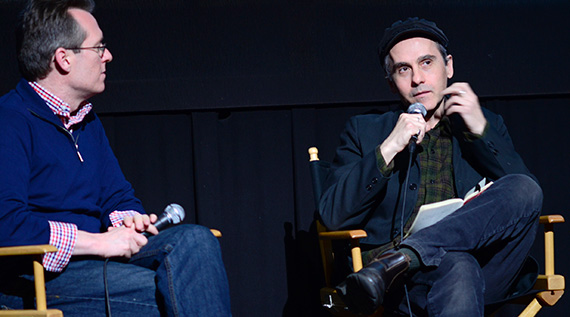
STF Executive Director Raphaela Neihausen in conversation with filmmaker Ursula Liang, editor Michelle Chang and film subject and athlete, Wayne Chow, following the screening of 9-MAN. © 8 Salamander Productions, Simon Luethi

This post was written by STF blogger Krystal Grow.

Sports journalist Ursula Liang waited for years for someone to recognize the phenomenon know as 9-Man in Chinatowns across North America, but eventually picked up a camera and started shooting herself.

Liang’s interest in 9-man volleyball is both personal and objective. As a German-Chinese sports journalist whose brother was deeply involved in the game and the community that surrounded it, she sensed the drama on the blacktop courts and empty parking lots where most 9-man games are played. She was invested in the culture surrounding the game, but with no allegiance to any particular team, she was able to tell a bigger story in her film – one about Chinese-American identity, the unique history of Chinese immigrants and their struggles to establish something truly their own.

In her first film, Liang dives into a distinctly Chinese-American game that has exploded into a community of dedicated players striving to maintain a connection to their culture. Logistically speaking, the rules of 9-man are more rigid and complicated than a standard, 6-person volleyball. Though players don’t rotate positions, they can make contact the with the ball twice in a row. While these variations have attracted volleyball players from around the world, it’s another set of rules that have remained a key point of contention among and outside the 9-man community.

‘Content rules,’ as defined by a group of 9-man elders and passed on through the generations, states that only Asian Americans are allowed to play. There are various percentage rules that define which position a player can occupy, and if a player’s racial integrity is questioned, they must present proof of their Asian heritage to tournament officials or be barred from the court.

Liang said the content rules were initially enacted to maintain the cultural significance of the game, which originated during the early days of Chinese immigration to North America as a way for Chinese men to build community during a bleak period of Chinese-American history. As the years have passed, younger generations of Chinese men, who spend their lives outside the tight-knit Chinatown community, see 9-man as a way to reconnect.

The cultural significance of 9-man makes the annual Labor Day tournament far more than a game. It is a yearly statement of the game’s legacy and the feverish loyalty of the men who play. By following a few select teams from their off-season practices through the final round of the grueling 4-day tournament, Liang captures the elements that make the best sports movie riveting, and the most effective documentaries captivating: drama, suspense, surprise and characters the audience can truly root for.

FULL Q&A

Raphaela Neihausen: How did you come to know about 9-man, how did you start shooting this film, and how did you come to this project?

Ursula Liang: My brother played 9-man. He played a lot of sports and so did I, but when I saw him play this sport, I saw the importance it took in his life. He came to it in his 20s, and the 9-man community became incredibly important to him. I saw that there was something else there greater than just a sport. I’d been a print journalist for most of my life, and this is my first film.

Neihausen: Let’s clap for that.
Continue reading…


Q&A: Filmmaker Jem Cohen on Chris Marker


STF Artistic Director Thom Powers in conversation with filmmaker Jem Cohen (MUSEUM HOURS) following the screening of Marker's SANS SOLEIL. ©Ruth Somalo

This post was written by STF blogger Krystal Grow.

We are invited into SANS SOLEIL by the icy and congenial voice of an imaginary narrator, the only source of stability in Chris Marker‘s legendary 1983 anti-documentary which opened the 2014 Stranger Than Fiction series at the IFC Center on May 6.

An abstract travelogue punctuated by dense, poetic descriptions and lush, vibrant imagery, Marker floats through his frames with an intentional dissonance that feels both reckless and precise. Regarded as a master editor in the days before Final Cut and non-linear editing, Marker bends and twists the documentary form in a way that never claims to know the truth about anything, and questions the very nature of history, memory and reality.

The film takes massive leaps on all fronts, intellectually, technologically, aesthetically and psychologically, but at a pace that’s almost hypnotic. The female voice with the cold British accent becomes soothing to a point where Marker’s imagery starts to look like a surrealist National Geographic special, complete with viscous wildlife footage and pointed socio-cultural observations.

SANS SOLEIL is Marker’s most widely seen film, and has left an indelible impression on the cult community that’s grown around his work. Filmmaker Jem Cohen, director of MUSEUM HOURS and BENJAMIN SMOKE said he first saw the film when a group of Australian friends forced him to watch the movie soon after he arrived in the country.

“I always experience a kind of jet-lagged reverie every time I see it. ,” Cohen told STF Artistic Director Thom Powers during the Q&A session that followed the screening. “That feels appropriate,” Powers responded, as the audience slowly emerged from their Sunless-inflicted trance. “I feel like everybody needs a pause because it feels so ridiculous to do anything after seeing this film, because it’s so dense and marvelous,” Cohen said.

Even to fans like Cohen, SANS SOLEIL is essentially unknowable, a factor that Cohen said actually contributed to his love of the film. “I’m delighted to think about how utterly indescribable and unpitchable it is,” he said. “I feel like we’re in a time where documentaries are forced into situations where they have to be pitched and you’re supposed to have a one sentence line you can throw to some money person in an elevator. You cannot do that with this movie.”

Good films thrive on mystery, but Marker takes that to an almost profound level, using the conventions of documentary filmmaking to tell what could be a completely fabricated story, and by using the classic vehicle of voice-over narration to establish structure in an intentionally unstructured world. Marker takes us to places that could be familiar, but makes us question our own memories in the process of following him on his journey. We eventually come full circle, to the image that opened the film. The narrator, dictating a fictional traveler’s letters, calls it ‘the happiest image in the world.’ All the audience sees are three blonde children, staring skeptically at the camera and pondering its purpose. A fitting end to a film that defies easy answers, and demands a total dismissal of everything you thought was true about documentary filmmaking.

“It’s a film that works like memory and it works like life, so the density is to me, an appropriate function of something that is meant to feel like the way that we think, the way we remember, the way that we look and the way we experience the world,” Cohen said. “Maybe that’s dumbing down, or maybe that is just what it is.”

Full Q&A

Thom Powers: Chris Marker passed away in the late ‘90s and left behind a vast filmography that covers all kinds of topics and genres. He was also a writer that always seemed to be interested in upcoming technologies. I understand late in his life he was very interested in Second Life, the virtual reality game. Jem, Can you talk about talk about when you first encountered Marker’s work and what it meant to you?

Continue reading…