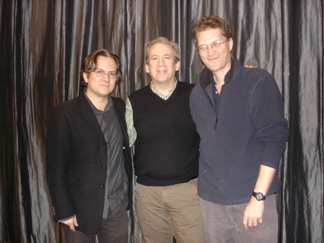
A brief surf of cable news shows and their speaking-points, sound-byte oriented talking-head experts might lead one to ask where public intellectual discourse has gone in our media saturated 21st century world. This week’s STF presentation ARGUING THE WORLD is a swansong to the golden age of New York public intellectual life through a portrait of several of its most influential participants: Daniel Bell, Nathan Glazer, Irving Howe, and neo-con godfather Irving Kristol. New York doc veterans Director Joseph Dorman and Editor Jonathan Oppenheim joined the STF audience for a discussion of the circumstances that made the City College of the 1930s the cradle of public intellectual discourse for the remainder of the 20th Century, and how the changing nature of our society and media-scape perhaps no longer allow for public intellectuals to have the prominence and influence that they once did. As is traditional, the conversation continued at STF hangout 99 Below where Dorman and Oppenheim were joined by a slew of familiar faces from the New York documentary scene: Jean Tsien, Jenni Livingston, Pola Rapaport, Martina Radwan, and others. Several hours later, fueled by good conversation and perhaps the special pear schnapps STF drink special, one left thinking that perhaps the prognosis for intellectual discourse was not as bleak as one thought.
There are a limited number of discounted tickets being made available to the STF community for the March 29 presentation of the Cinema Eye Honors. Last year, the first Cinema Eye Honors was one of the my favorite documentary events of 2008. This year’s edition promises to be even better, moving to the gorgeous Times Center in the New York Times building.
Top documentary makers and film industry leaders will gather to celebrate excellence and innovation in the nonfiction films of 2008. Awards
presenters include Laurie Anderson, Albert Maysles, D.A. Pennebaker and Morgan Spurlock. The diverse array of nominated films include MAN ON WIRE, WALTZ WITH BASHIR, and MY WINNIPEG. More than a typical awards show, the night will feature music DJ-ed by composer and musician Ion Furjanic (composer of MANDA BALA and JESUS CAMP) and other surprises.
The ticket price includes a post-ceremony reception with hors d’oevres and an open bar at the nearby venue, ARENA (135 West 41st St).
Tickets are normally priced at $75, but if you enter the access code “STF”, you’ll pay only $50. CLICK HERE TO ORDER TICKETS
I knew the William Greaves Tribute was going to be special when I got a call on Monday from Sidney Poitier in Los Angeles. Since he couldn’t honor Greaves in person, he asked me to read a note on his behalf: “I have had the privilege of working with William Greaves and will always remember how gifted he has been in life and as a groundbreaking filmmaker…. He has given us visions of the best in ourselves and reminds us to always reach beyond our grasp.”
Greaves’s achievements were expressed through film excerpts spanning 50 years of work. The clips included EMERGENCY WARD (1959) made while Greaves was working for the National Film Board of Canada; STILL A BROTHER (1968), a feature-length film about the black middle class; THE FIRST WORLD FESTIVAL OF NEGRO ARTS (1966), featuring footage of Duke Ellington and the Alvin Ailey Dance Company in Dakar, Senegal; THE FIGHT (1974), chronicling the boxing match between Muhammad Ali and Joe Frazier at Madison Square Garden; and SYMBIOPSYCHOTAXIPLASM: TAKE ONE (1968), an experimental work, shot in Central Park, where reality and fiction overlap.
The final clip was from Greaves’s latest work-in-progress that revives 16 mm footage he took in 1971 at a gathering to remember the Harlem Renaissance. The crowd is a who’s who of Harlem speaking with living memory of Zora Neale Hurston, Marcus Garvey, Countee Cullen and other major figures. The footage was a revelation. Greaves is still seeking funds to complete the work. Any arts agency would do itself proud to pitch in.
Each summer as I review submissions for the Toronto International Film Festival, I look forward to receiving a big package of screeners from Sandra Buchta, who leads documentary promotion for German Films. Last year, she turned me on to HEART OF JENIN, a co-production of Germany and Israel. In addition, I receive German titles from other sources, such as UPSTREAM BATTLE that came straight from the director. It’s a healthy sign for a country’s output when the official organization can’t keep track of everything. Given so much production happening in Germany, Sandra does a fine job with staying on top of the national scene. Here’s how she responded to my three questions…
DESCRIBE THE TRADITION OF GERMAN DOCUMENTARY MAKING.
Sandra Buchta: In Germany there are two traditions of modern documentary filmmaking: one evolved in Eastern Germany, the other one in Western Germany. In the former GDR most documentary films were produced by the state-owned DEFA studio. Among the notable directors who created a distinct style are such names as Volker Koepp, Jürgen Böttcher and Thomas Heise. In Western Germany the documentary production was closely linked to the public broadcasters. The 60s and 70s were particularly fruitful and produced the rise of filmmakers such as Werner Herzog, Alexander Kluge or Hartmut Bitomsky, to mention a few. After 1989 these two traditions of documentary filmmaking crossed – and a new generation of filmmakers has been emerging since then.
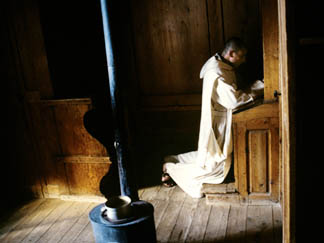
Three German documentary filmmakers who have had an impact on the documentary world: Werner Herzog – no comment necessary or if so, watch his latest film ENCOUNTERS AT THE END THE WORLD (by the way, not a German production). Volker Koepp – from his Wittstock-series in the 70s up to his last two films SONS and ELDER BLOSSOM in 2007, he has been exploring unknown Eastern territories and has introduced us to unforgettable protagonists such as Mr. Zwilling and Mrs. Zuckermann in a very unique and human approach. Philip Gröning – for creating a 3-hour-documentary about Carthusian monks which turned out to become not only an international festival-hit, but one of the most successful German documentaries in cinemas at home and abroad (INTO GREAT SILENCE, pictured).
My awakening to Brazil’s documentary scene came when I first saw Jose Padilha’s gripping BUS 174 (pictured) at the 2003 Sundance Film Festival. Since then, I’ve seen a smattering of other Brazilian docs and heard great things about the country’s festival It’s All True named after Orson Welles’ unfinished work. My colleague Diana Sanchez who programs Latin American films for the Toronto International Film Festival suggested that I reach out to the scholar Jose Carlos Avellar, who’s written extensively on Brazilian film and literature. (If you read Portuguese, visit his website escrevercinema.com).
In answering my simple questions, Avellar opens up a robust national cinema movement full of directors who were new to me, but whose work I’m eager to explore. I’ve linked several names and titles to other resources below to encourage further exploration.
DESCRIBE THE TRADITION OF DOC MAKING IN BRAZIL
Jose Carlos Avellar: Let me exaggerate a little: the tradition of modern Brazilian cinema is documentary. It goes beyond documentary films. Documentaries created the basis for the invention of Cinema Novo and its hand held camera narrative, where the filmmaker more or less improvised action as a kind of reporter. That is why many Cinema Novo directors cross between documentary and fiction. Among the documentaries from the sixties, we can keep the ones by the late Leon Hirszman and Joaquim Pedro de Andrade (who received a retrospective at the 2007 New York Film Festival); and most of the 28 films from the series “A Condição Brasileira” produced by Thomas Farkas – for example VIRAMUNDO and VIVA CARIRI! by Geraldo Sarno; and MEMORIES OF THE CANGAÇO by Paulo Gil Soares.



 A brief surf of cable news shows and their speaking-points, sound-byte oriented talking-head experts might lead one to ask where public intellectual discourse has gone in our media saturated 21st century world. This week’s STF presentation ARGUING THE WORLD is a swansong to the golden age of New York public intellectual life through a portrait of several of its most influential participants: Daniel Bell, Nathan Glazer, Irving Howe, and neo-con godfather Irving Kristol. New York doc veterans Director Joseph Dorman and Editor Jonathan Oppenheim joined the STF audience for a discussion of the circumstances that made the City College of the 1930s the cradle of public intellectual discourse for the remainder of the 20th Century, and how the changing nature of our society and media-scape perhaps no longer allow for public intellectuals to have the prominence and influence that they once did. As is traditional, the conversation continued at STF hangout 99 Below where Dorman and Oppenheim were joined by a slew of familiar faces from the New York documentary scene: Jean Tsien, Jenni Livingston, Pola Rapaport, Martina Radwan, and others. Several hours later, fueled by good conversation and perhaps the special pear schnapps STF drink special, one left thinking that perhaps the prognosis for intellectual discourse was not as bleak as one thought.
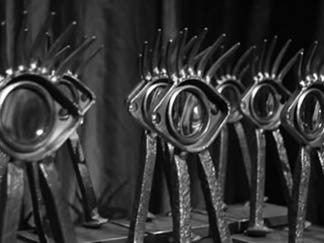 There are a limited number of discounted tickets being made available to the STF community for the March 29 presentation of the
 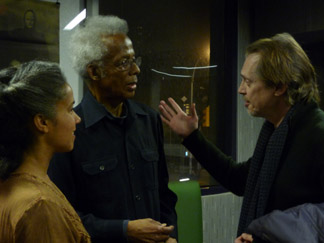 I knew the William Greaves Tribute was going to be special when I got a call on Monday from Sidney Poitier in Los Angeles. Since he couldn’t honor Greaves in person, he asked me to read a note on his behalf: “I have had the privilege of working with William Greaves and will always remember how gifted he has been in life and as a groundbreaking filmmaker…. He has given us visions of the best in ourselves and reminds us to always reach beyond our grasp.”
 Each summer as I review submissions for the Toronto International Film Festival, I look forward to receiving a big package of screeners from Sandra Buchta, who leads documentary promotion for
  My awakening to Brazil’s documentary scene came when I first saw Jose Padilha’s gripping BUS 174 (pictured) at the 2003 Sundance Film Festival. Since then, I’ve seen a smattering of other Brazilian docs and heard great things about the country’s festival