So what hasn’t already been said about Grey Gardens? In the years since its 1975 release, the film has influenced incredibly distant corners of American culture. For instance, it has somehow managed to earn a strong following among gay men, while simultaneously spawning a cult fashion following based on Little Edie’s sublime self-styled “costumes.” Grey Gardens tells a story that resonates so deeply that, in the last five years alone, it has been reconceived not once, but twice, in eponymous homage—first as a Broadway musical in 2006, and then as an narrative film based on the Beales’ lives that premiered on HBO last year. The film has the uncanny ability to improve on repeated viewings, and it proves hard to avoid inferring deeper meaning from some of the memorable lines dropped by the Beales. A favorite bit of dialogue arrives when Little Edie, in a moment of existential musing, shares with the camera, “It’s very difficult to keep the line between the past and the present. You know what I mean? It’s awfully difficult.” Similar difficulties are faced when attempting to encapsule this incredible example of the direct cinema movement. Following the screening, STF Artistic Director spoke with Albert Maysles and Muffie Meyer, who, along with David Maysles and Ellen Hovde, directed the film. Click “Read more” below for the Q&A.
(photo: from left, Thom Powers and directors Muffie Meyer and Albert Maysles, courtesy of Ruth Somalo)
Whether you’re going to Sundance or following from afar, the line-up of 40 or so documentaries can be daunting. This year, I’ve been privileged to see roughly half the titles in private screenings. Here’s my tip sheet of 10 titles in alphabetical order:
BLACK POWER MIXTAPE 1967-1975: When Shola Lynch brought CHISHOLM 72 to STF, she talked about tapping into European archives for footage. Well, there’s more where that came from. Swedish filmmaker Göran Hugo Olsson uncovers a mother load from his country and gives us generous samplings. Like any good mixtape, this one is full of discoveries. If it arouses your interest, plunge into Henry Hampton’s EYES ON THE PRIZE II.
BOBBY FISCHER AGAINST THE WORLD: For years, the story of Bobby Fischer has beguiled and eluded filmmakers. I recall Bennett Miller, in between making THE CRUISE and CAPOTE, speaking publicly about his Fischer fascination at a Moth event devoted to “the story that got away”. Now director Liz Garbus delivers the goods. She draws out strong new interviews from Fischer’s contemporaries, combined with riveting archival footage.
THE GREATEST MOVIE EVER SOLD: Exposing product placement may not be new. Back in the late 80s, Mark Crispin Miller wrote a memorable expose, published in the anthology “Seeing Through Movies.” But Morgan Spurlock has a knack for giving us fresh and hilarious perspective on things we take for granted. His talents are well-suited to start a wider conversation about the world of sponsorship that permeates our lives.
Having garnered accolades from disparate corners of the film and critical world since its release last year, the film Enemies of the People is assuredly many things. Most importantly, it is a record of the violence ordered by the Khmer Rouge in the late 1970s that killed as many as 1.7 million people, as detailed by “Brother Number Two,” the regime’s second-in-command, Nuon Chea. But the film also functions as strong evidence of the dogged determination of investigative journalist (and the film’s co-director) Thet Sambath, who dedicated 10 years—often at the expense of his personal life and bank account—to befriending Nuon Chea, and convincing him to share his story on film for the first time. The tale is made all the more remarkable by the fact that much of Sambath’s immediate family were victims of the genocide.
It is a testament to the filmmaking skill of Sambath and co-director Rob Lemkin that the viewer is able to feel empathy for cadre-level executioners who did much of the killing, and even Nuon Chea himself, without ever losing sight of the horrific crimes that were ordered or committed. The need to place blame feels largely absent from Enemies of the People. Instead, we watch Sambath, whose beatific demeanor seems perpetual, struggle with the difficult questions of why and how the mass killings happened. The rippling effects of the Khmer Rouge are still being wrought on Cambodian society today, and the murders carried out on Killing Fields remain a moment in human history that is difficult and uncomfortable to contemplate. But what is even more disturbing is the idea that the crimes were made possible by the complicity of a culture and society that simply did not know how to stop them. Click “Read More” below for a Q&A with co-director Rob Lemkin.
(photo: co-director Rob Lemkin, courtesy of Cathryne Czubek)
It’s hard to figure out just who the protagonist is in the Ballad of Eliot Spitzer, and director Alex Gibney’s film, Client 9: The Rise and Fall of Eliot Spitzer, makes the task no easier. The film’s narrative should already familiar to New Yorkers, or anyone with a passing interest in politics (or who reads the newspaper, for that matter). Bronx-born, Princeton-educated Spitzer targets the mob as a New York City district attorney; gains political heat as the New York Attorney General following a streak of successful prosecutions focusing on white collar crime; then rides to the Governor’s mansion amidst a wave of populist energy. Spitzer’s political ascendancy came at a time when New York state residents were increasingly disillusioned with both the economic disparity neatly symbolized by Wall Street excesses, and a corrupt and dysfunctional state legislature that had largely abandoned the practice of good governance. Gibney shows us all of this, as well as the incredibly powerful enemies Spitzer accrued along the way, among them Home Depot co-founder and investment banker Ken Langone, New York Stock Exchange President Dick Grasso and AIG CEO Hank Greenberg.
Where Client 9 excels is in ferreting out the previously unknown details of Spitzer’s story. While much of the press attention surrounding Spitzer’s extramarital dalliances focused on escort Ashley Dupre, Gibney reveals that he actually had a much more substantial relationship with another escort, identified in the film only as “Angelina.” Gibney also lays out a pretty good case for the idea that the federal investigation into the Emperors Club VIP escort service that eventually brought about Spitzer’s fall was a political hit orchestrated by Republican enemies (although it must be noted that all of the evidence pointing to this conclusion is circumstantial at best).
This winter season mixes current sensations with rarities and timeless classics. The best and most affordable way to experience STF is with a Winter Season Pass. Purchase by Jan 10 to receive the early bird special: $99 for 11 films. Follow this link to order, look for CLIENT 9 and click on 8:00 pm.
Week one kicks off with celebrated films on consecutive nights. On Jan 10, CLIENT 9: THE RISE AND FALL OF ELIOT SPITZER screens as a Monday special including a Q&A with director Alex Gibney. On Tues, Jan 11, ENEMIES OF THE PEOPLE, winner of the Sundance Film Festival World Documentary Prize, will serve as the official Opening Night of winter season, chronicling a journalist’s personal search for truth in Cambodia. STF will take a special Wednesday night spot on Jan 19 to feature GREY GARDENS with filmmakers Albert Maysles and Muffie Meyers, being honored the previous night with the Cinema Eye Honor Legacy Award. Karen Schmeer, the award-winning editor killed in a 2010 car accident, will be honored at STF on Feb 15 with FAST, CHEAP & OUT OF CONTROL that she edited for director Errol Morris. Friends of Schmeer will pay tribute to her in the Q&A. The season concludes on March 15 with Barbara Kopple presenting her Oscar-winning classic HARLAN COUNTY, USA.




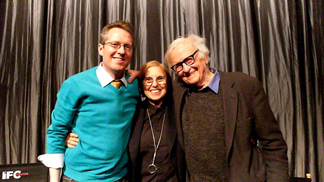 So what hasn’t already been said about Grey Gardens? In the years since its 1975 release, the film has influenced incredibly distant corners of American culture. For instance, it has somehow managed to earn a strong following among gay men, while simultaneously spawning a cult fashion following based on Little Edie’s sublime self-styled “costumes.” Grey Gardens tells a story that resonates so deeply that, in the last five years alone, it has been reconceived not once, but twice, in eponymous homage—first as a Broadway musical in 2006, and then as an narrative film based on the Beales’ lives that premiered on HBO last year. The film has the uncanny ability to improve on repeated viewings, and it proves hard to avoid inferring deeper meaning from some of the memorable lines dropped by the Beales. A favorite bit of dialogue arrives when Little Edie, in a moment of existential musing, shares with the camera, “It’s very difficult to keep the line between the past and the present. You know what I mean? It’s awfully difficult.” Similar difficulties are faced when attempting to encapsule this incredible example of the direct cinema movement. Following the screening, STF Artistic Director spoke with Albert Maysles and Muffie Meyer, who, along with David Maysles and Ellen Hovde, directed the film. Click “Read more” below for the Q&A.
 Whether you’re going to Sundance or following from afar, the line-up of 40 or so documentaries can be daunting. This year, I’ve been privileged to see roughly half the titles in private screenings. Here’s my tip sheet of 10 titles in alphabetical order:
 Having garnered accolades from disparate corners of the film and critical world since its release last year, the film Enemies of the People is assuredly many things. Most importantly, it is a record of the violence ordered by the Khmer Rouge in the late 1970s that killed as many as 1.7 million people, as detailed by “Brother Number Two,” the regime’s second-in-command, Nuon Chea. But the film also functions as strong evidence of the dogged determination of investigative journalist (and the film’s co-director) Thet Sambath, who dedicated 10 years—often at the expense of his personal life and bank account—to befriending Nuon Chea, and convincing him to share his story on film for the first time. The tale is made all the more remarkable by the fact that much of Sambath’s immediate family were victims of the genocide.
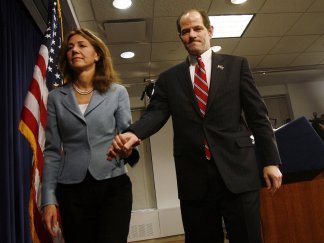
 It’s hard to figure out just who the protagonist is in the Ballad of Eliot Spitzer, and director Alex Gibney’s film, Client 9: The Rise and Fall of Eliot Spitzer, makes the task no easier. The film’s narrative should already familiar to New Yorkers, or anyone with a passing interest in politics (or who reads the newspaper, for that matter). Bronx-born, Princeton-educated Spitzer targets the mob as a New York City district attorney; gains political heat as the New York Attorney General following a streak of successful prosecutions focusing on white collar crime; then rides to the Governor’s mansion amidst a wave of populist energy. Spitzer’s political ascendancy came at a time when New York state residents were increasingly disillusioned with both the economic disparity neatly symbolized by Wall Street excesses, and a corrupt and dysfunctional state legislature that had largely abandoned the practice of good governance. Gibney shows us all of this, as well as the incredibly powerful enemies Spitzer accrued along the way, among them Home Depot co-founder and investment banker Ken Langone, New York Stock Exchange President Dick Grasso and AIG CEO Hank Greenberg.
 This winter season mixes current sensations with rarities and timeless classics. The best and most affordable way to experience STF is with a Winter Season Pass. Purchase by Jan 10 to receive the early bird special: $99 for 11 films.