
Held at the Tribeca Cinemas, the annual Gotham Film Party was hosted by Kodak and featured many familiar faces. Here are a few snapshots from the night.
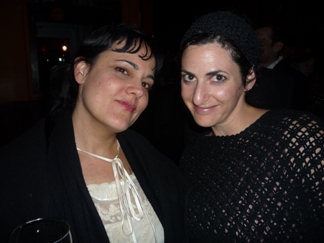 Ann Rose of the Sundance Channel with Dia Sokol.
STF is now Pure Nonfiction at IFC Center! See our new series page at the link below:
» website

Held at the Tribeca Cinemas, the annual Gotham Film Party was hosted by Kodak and featured many familiar faces. Here are a few snapshots from the night.
Ann Rose of the Sundance Channel with Dia Sokol. Auteurism had Andrew Sarris. Abstract expressionism had Clement Greenberg. Punk rock had Lester Bangs. Where is the equivalent voice for today’s documentary scene? In the past, nonfiction film has drawn the attention of a few notable critics. Starting in the 1920’s, John Grierson actively championed the form. His generation gave way to the breakthroughs in direct cinema, covered by Jonas Mekas for the Village Voice and the “Living Room War” of Vietnam, analyzed by Michael Arlen for The New Yorker. Back then, documentary filmmakers were still dreaming of a future when equipment would be cheaper and distribution more accessible. Now, thanks to digital technology, that future has arrived. But America’s critical arbiters have lagged behind. Newspapers and magazines still follow the customs of an old era, squeezing in the occasional documentary review between saturation coverage of Hollywood dramas and comedies.
Two years ago, I lamented this state of affairs for an Indiewire survey titled “Wrapping 06 and Looking Ahead at 07.” Around that time, I was plowing through myriad Top Ten lists with dismay over the propensity of critics to name ten fiction films and one token documentary. I suggested that newspaper and magazine editors look to the example of book reviews by distinguishing between fiction and nonfiction lists and cultivate critics who can specialize in the latter.
Now the situation has grown even worse. Documentary filmmakers are increasing their output, but publications are decreasing staff and space for reviews. Bloggers fill some of the void. But the pressure on blogs to be quick and current leaves a gap for more thoughtful analysis. For any critic who wants to delve into documentary, an exciting job awaits. But the job is not likely to be offered. It has to be seized.
Written by Nicole Alicia Watson
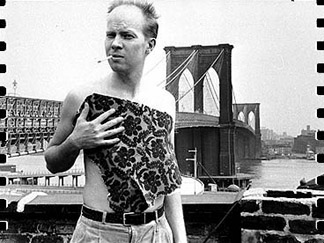
Walter was on hand to discuss his work on HOW TO DRAW A BUNNY as well as his upcoming film THEATER OF WAR, a documentary following the Public Theatre’s recent production of Mother Courage. THEATER OF WAR will open at the Film Forum on December 25, 2008.
Written by Nicole Alicia Watson

Written by Nicole Alicia Watson

If waiting until Tuesday seems like a long time to get your next documentary fix, STF recommends the Margaret Mead Film and Video Festival. The Festival runs through November 16 at the American Museum of Natural History. This international film festival screens films on a wider range of topics. Two films, PEACE WITH SEALS and MARCH POINT deal with climate change and environmental protection. David MacDougall’s film GANDHI’S CHILDREN, follows the lives of 181 orphans at The Prayas Children’s Home for Boys. The festival includes NY premiers of films such as THROW DOWN YOUR HEART, a film about banjo great Bela Fleck and his travels throughout Tanzania, Uganda, Mail and the Gambia in search of the African roots of the banjo and Edward S. Curtis’ 1914 silent film, IN THE LAND OF THE HEAD HUNTERS. The film depicts the lives of First Nation people before their encounters with Europeans. This film will be accompanied by the Coast Orchestra, a Native American classical ensemble conducted by Timothy Long. On Sunday, I will be going to see VISIONS OF ZORA NEALE HURSTON, a presentation and panel discussion on Hurston’s own work as a filmmaker. See you there.