The morality issue at play in the film Stolen is Manichean in its clarity—slavery is unarguably one of the most abhorrent crimes that humanity can perpetrate against itself. But as filmmakers Dan Fallshaw and Violeta Ayala discovered, the politics of sharing the stories of slavery they encountered in Polisario Front-run refugee camps in Algeria proved to be much more complicated. After traveling to the camps to document a family reunion in verite style, Ayala and Fallshaw were forced to make a hard turn after being told tales of modern-day oppression; the second half of the film shifts into thriller territory as we watch the pair struggle to tell the film’s story, while also navigating the minefield politics engulfing the continued conflict between Morocco and the Polisario Front. The filmmakers have since come under heavy criticism from some quarters for their handling of the film’s subjects, who later withdrew their consent to appear in the film. But it’s difficult to figure out how much of this and other attacks originated with the Polisario Front itself, which was resistant to admitting to the existence of slavery traditions in their refugee camps. Stolen perhaps raises more questions than it answers, but does so in the tradition of the best sort of political art. As always, it remains to the viewer to decide exactly where the truth lies. Following the screening, STF Artistic Director Thom Powers spoke with Fallshaw and Ayala. Click “Read more” below for the Q&A.
(Photo: from left, Thom Powers, Violeta Ayala and Dan Fallshaw, courtesy of Simon Luethi)
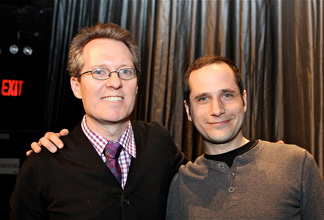
It’s interesting to think of the film Resurrect Dead in terms of its debt to technology. It took the development of new, sometimes asymmetrical, communication modes unique to the Internet to allow the thinly spread followers of the Toynbee tile cult to crowdsource their investigations. The film’s ad hoc team of detectives also find each other on the web before realizing real-life relationships. And director Jon Foy made the film over a 10-year period, largely through self-financing, but turned to a web-based fundraising tool—Kickstarter—when in need of completion funds. Interestingly, the team of amateur sleuths are also participants in the creation of the film (Foy remains off camera). Colin Smith pulls double duty as film subject, and producer, while another character, tile photographer Steve Weinik, is credited as an associate producer. The blurring of subject and filmmaker seems right in line with Foy’s filmmaking philosophy. He admits to being heavily influenced by the punk DIY ethos, and it shows in Resurrect Dead. Foy one-man-banded the film, serving as director, dp and editor—and even scored the film himself. While the Internet has provided filmmakers with new tools, drive and determination remain necessary ingredients to finishing an indie doc. Lucky for us, sometimes the end result is a film like Resurrect Dead. Following the screening director Jon Foy, film subject Justin Duerr, producer and film subject Colin Smith, associate producer and film subject Steve Weinik and animator Matt Rota spoke with STF Artistic Director Thom Powers. Click “Read more” below for the Q&A.
(Photo: from left STF Artistic Director Thom Powers and director Jon Foy, courtesy of Simon Luethi)
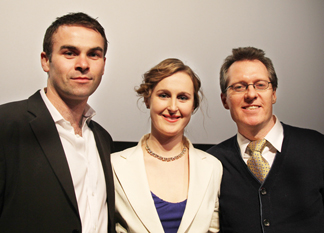
Written by STF blogger Cameron Carnegie In The Pipe, the tiny Irish town of Rossport and its colorful inhabitants are exposed through the gentle lens of Director Risteard Ó Domhnaill. The film, produced by Rachel Lysaght, gives us something resounding. In an age of commonplace political betrayal and corporate audacity, fishermen and their families turn back a corporate Goliath with the only weapons at their disposal.
Armed with fierce integrity and steadfast determination, oppressor Shell Oil finds its goal of laying a pipeline through the lush and vibrant countryside rendered impotent by its inhabitants. Using sit-ins, and even a hunger strike stretched over eight years, the townspeople manage to turn back behemoth Shell Oil repeatedly. But it is not without pain and enormous human suffering. Click “Read More” below.
(Photo: From left, Risteard Ó Domhnaill, Rachel Lysaght and Thom Powers, courtesy of Cathryne Czubek)
In 1961, the same year in which Mooney vs. Fowle was shot, President John F. Kennedy signed into law a bill that legalized contracts between single networks and sports leagues. The following year, the one in which Mooney vs. Fowle was aired as part of the The Living Camera television series, CBS signed a $4.65 million contract guaranteeing it the right to broadcast NFL games. It was a move that would usher in a new era of popularity for professional football, which up until then was largely populated by hard-nosed working class men given little remuneration for sacrificing their bodies on the field. The prospect of a multimillion dollar professional contract waiting at the other end of four years of college play was not even a possibility for the young players at Miami High and Edison High.
The observation seems salient given the depiction of the game at the hands of an all-star Drew Associates crew—helmed by director James Lipscomb—that included D.A. Pennebaker, Richard Leacock and Bill Ray as cameramen. The film shows us the deadly seriousness with which a group of not-quite men—along with coaches that sometimes act more like overgrown children—take football, seemingly motivated by nothing more than a sense of pride. Mooney vs. Fowle also marks a point in time in which the filmmakers at Drew Associates were ushering in a radical change in the way that documentary films were produced. New camera technology allowed for mobile cameras with sync sound that took us into the locker rooms and onto the playing fields of both teams, showing us a story instead of telling us one. Following the screening, STF Artistic Director Thom Powers spoke with producer Robert Drew, director James Lipscomb, cameramen D.A. Pennebaker and Bill Ray, sound engineer Hope Ryden and Miami High football player Steve Diamond. Click “Read more” below for the Q&A.
(Photo: from left, James Lipscomb, Hope Ryden, Robert Drew and D.A. Pennebaker, courtesy of Cathryne Czubek)
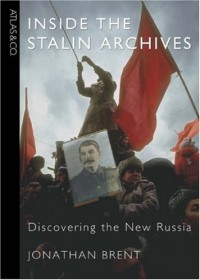
As Robin Hessman’s MY PERESTROIKA opens this week in theaters across the country (some of you may have caught it at STF last May), we thought it would be an appropriate moment to publish an interview STF conducted with author Jonathan Brent back in January 2009 about his book Inside the Stalin Archives: Discovering the new Russia. Both MY PERESTROIKA and Inside the Stalin Archives make incredible use of Russian archives to illuminate the history and reality of Russia, then and now.
Below is a transcript of the conversation between STF artistic director Thom Powers and author Jonathan Brent.






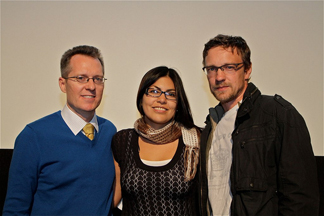 The morality issue at play in the film Stolen is Manichean in its clarity—slavery is unarguably one of the most abhorrent crimes that humanity can perpetrate against itself. But as filmmakers Dan Fallshaw and Violeta Ayala discovered, the politics of sharing the stories of slavery they encountered in Polisario Front-run refugee camps in Algeria proved to be much more complicated. After traveling to the camps to document a family reunion in verite style, Ayala and Fallshaw were forced to make a hard turn after being told tales of modern-day oppression; the second half of the film shifts into thriller territory as we watch the pair struggle to tell the film’s story, while also navigating the minefield politics engulfing the continued conflict between Morocco and the Polisario Front. The filmmakers have since come under heavy criticism from some quarters for their handling of the film’s subjects, who later withdrew their consent to appear in the film. But it’s difficult to figure out how much of this and other attacks originated with the Polisario Front itself, which was resistant to admitting to the existence of slavery traditions in their refugee camps. Stolen perhaps raises more questions than it answers, but does so in the tradition of the best sort of political art. As always, it remains to the viewer to decide exactly where the truth lies. Following the screening, STF Artistic Director Thom Powers spoke with Fallshaw and Ayala. Click “Read more” below for the Q&A.
 It’s interesting to think of the film
  In
In 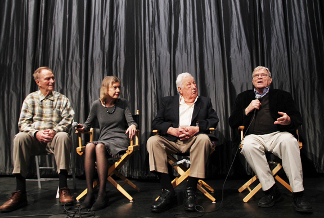 In 1961, the same year in which Mooney vs. Fowle was shot, President John F. Kennedy signed into law a bill that legalized contracts between single networks and sports leagues. The following year, the one in which Mooney vs. Fowle was aired as part of the The Living Camera television series, CBS signed a $4.65 million contract guaranteeing it the right to broadcast NFL games. It was a move that would usher in a new era of popularity for professional football, which up until then was largely populated by hard-nosed working class men given little remuneration for sacrificing their bodies on the field. The prospect of a multimillion dollar professional contract waiting at the other end of four years of college play was not even a possibility for the young players at Miami High and Edison High.
 As Robin Hessman’s