In retrospect, plumber Shawn Nelson’s fatal march toward his 1995 joyride in a stolen tank, which he piloted through a series of Southern California residential neighborhoods, seems almost inexorable. In Cul de Sac: A Suburban War Story, director Garrett Scott nimbly spells out the confluence of social and historical trends that found Nelson, a former soldier and methamphetamine user, trapped in an armored vehicle on a highway at gunpoint. Police footage of Nelson’s rampage seems surreal in its absurdist juxtaposition of a tank loosed in generic suburbia, but the imagery is suffused with heavy—though unintended—symbolism. Fed on a mother’s milk of Pentagon defense contractor money, the enclave of Clairemont was only one of a number of cities that benefited from the lifting of thousands of blue collar workers into a comfortable middle class lifestyle. But when the flood of dollars ended, violence that was once exported as an industrialized good was instead left to fester in dying communities. Cul de Sac shows us the heavy burdens borne by some of those attempting to find their way in the deindustrialized remains of the U.S.’s post World War II boom. Following the screening, Stranger Than Fiction Artistic Director Thom Powers spoke with Cul de Sac editor Ian Olds, and filmmaker Jem Cohen, who had a role in helping the film gain a viewership. Click “Read more” below for the Q&A.
Also, work was shown by recipients of the Garrett Scott Documentary Development Grant, established following Scott’s death in 2006 in order to aid first time documentary filmmakers. Lofty Nathan showed an excerpt of Twelve O’ Clock Boyz, while Katharine Fairfax Wright and Malika Zouhali-Warral showed a trailer for their film Call Me Kuchu.
[Photo: From left, Jem Cohen, Ian Olds and Thom Powers, courtesy of Simon Luethi]
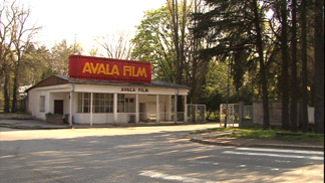
Stranger Than Fiction co-presented the film Cinema Komunisto at the 2011 Tribeca Film Festival. Viewers of Mila Turajlic’s film Cinema Komunisto might be surprised to learn that Yugoslavia’s state-run Avala Film Studios was not dedicated solely to enlarging the cult of personality surrounding Joseph Broz Tito, although it certainly did not shrink from that task. Relying on copious amounts of research and a trove of archival material, Truajlic’s film shows us Comrade Tito the cinephile—one who watched a film almost every day, and transformed his Yugoslavia into a prolific locus of filmmaking, for both artistic and propagandistic purposes. The heart of the film lies in the scenes bearing Tito’s personal projectionist, Leka Konstantinovic. In a powerful moment, Konstantinovic is shown arriving at Tito’s old estate in Belgrade for the first time in decades, where he ceremoniously hands over his key to the property to its current caretaker, who receives the gift with relative indifference. From the front, the house, though lacking a door, appears to be relatively intact. It’s only when Konstantinovic goes inside that he, and the viewer, discover that the projected reality of the edifice’s facade masks a hollowed out shell of little substance. Following the screening, Turajlic held a Q&A with the audience. Click “Read more” below.
[Photo courtesy of Cinema Komunisto]
Stranger Than Fiction co-presented the film Bombay Beach at the 2011 Tribeca Film Festival. The U.S. government doesn’t even consider Bombay Beach a city, instead describing it as a census-designated place (with the population in 2000 recorded at a scant 366 people) comprised of one square mile of land in the California desert that hugs the eastern shore of the Salton Sea, a rift lake whose salinity now exceeds that of the ocean. Once touted as a vacation destination for Southern California’s well-heeled, the area today scans like the physical manifestation of the death of the American Dream. Alma Har’el’s film Bombay Beach is an intimate portrait of those living in this impoverished afterworld, who strive mightily for survival at society’s margins. In some of its most powerful scenes, the film shows the children of a post-apocalyptic landscape wandering the salt-encrusted detritus of a middle-class existence that no longer exists, appropriating from abandoned houses whatever they can to aid their amusement. The film is a needed reminder that poverty in America takes on a number of forms, and is too often ignored as a topic of discussion in mainstream media outlets. Perhaps it’s the sort of story that be best relayed with clear eyes by someone like the Israel-born Har’el, someone with some objective distance on the myths of America. Following the screening, Har’el and the film’s music composer Zach Condon (who performs under the band name Beirut) held a Q&A with the audience. Click “Read more” below.
[Photo: From left, director Alma Har’el, film subject Benny and musician Zach Condon, courtesy of Simon Luethi]
Written by STF blogger Deena Ecker These Amazing Shadows is a movie for, about and by people who love movies. The National Film Registry was created by Congress in 1989 for the purpose of protecting and preserving important American films, those considered culturally, historically or aesthetically significant. Directors Paul Marino and Kurt Norton take us through a journey with these films that weave the American story. The films preseved by the Registry are not just the big movies that appear on most lists. While Gone With the Wind, Citizen Kane and The Godfather are on the list, these movies and others like them do not show us a complete picture of America. These Amazing Shadows takes us through the list in a way that demonstrates what culturally, historically and aesthetically significant means to the members of the National Film Preservation Board. Is The Rocky Horror Picture Show worthy of an Oscar? No. Is it a significant part of American culture? Yes. Will ducking and covering protect you from an atomic bomb? No. Are the films telling us it will an important piece of history? Yes. Censored films, films by women in the 1910’s, propaganda, commercials, newsreels: all these aspects of film are represented on the list and addressed in this captivating documentary. Following the screening, STF Artistic Director Thom Powers spoke with Director/Producers Kurt Norton and Paul Marino and National Film Preservation Board member Dan Streible. Click “Read more” below.
[Photo: from left, Kurt Norton and Paul Marino, courtesy of Simon Luethi]
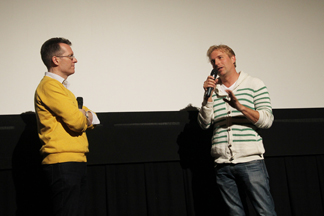
In 2005, the Dave Eggers-helmed McSweeney’s media empire was expanded to encompass lens-based media, yielding the eclectic quarterly DVD magazine Wholphin. Since then, the series has established itself as the filmic equivalent of a cabinet of curiosities for the modern age, shining a light on brilliant shorts that are too often screened at festivals, and then lost in the ether. Editions of the magazine include films that vary in category from experimental to narrative to documentary—as well as in the ill-defined spaces between. In deference to Stranger Than Fiction’s ongoing quest for truth, Wholphin curator Brent Hoff brought with him a group of short documentary films whose unifying theme seemed to be a lack thereof. But the scattershot nature of the films’ forms and topics ending up serving as a varied showcase of the elastic nature of non-fiction cinematic storytelling. Among other films, the eccentricities of an amateur chiropterist and his mother are artfully shared in the Slovenian short Arsy Varsy, while Here Comes Greatness examines a fascinating manifestation of the ennui suffered by suburban kids in Southern California. Wholphin makes one glad that someone out there is attempting to redress the short shrift given to short films. Stranger Than Fiction Artistic Director Thom Powers and Hoff gave short introductions to the films, and a Q&A followed the program. Click “Read more” below.
[Photo: From left, Thom Powers and Brent Hoff, courtesy of Cathryne Czubek]






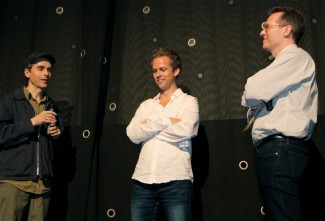 In retrospect, plumber Shawn Nelson’s fatal march toward his 1995 joyride in a stolen tank, which he piloted through a series of Southern California residential neighborhoods, seems almost inexorable. In Cul de Sac: A Suburban War Story, director Garrett Scott nimbly spells out the confluence of social and historical trends that found Nelson, a former soldier and methamphetamine user, trapped in an armored vehicle on a highway at gunpoint. Police footage of Nelson’s rampage seems surreal in its absurdist juxtaposition of a tank loosed in generic suburbia, but the imagery is suffused with heavy—though unintended—symbolism. Fed on a mother’s milk of Pentagon defense contractor money, the enclave of Clairemont was only one of a number of cities that benefited from the lifting of thousands of blue collar workers into a comfortable middle class lifestyle. But when the flood of dollars ended, violence that was once exported as an industrialized good was instead left to fester in dying communities. Cul de Sac shows us the heavy burdens borne by some of those attempting to find their way in the deindustrialized remains of the U.S.’s post World War II boom. Following the screening, Stranger Than Fiction Artistic Director Thom Powers spoke with Cul de Sac editor Ian Olds, and filmmaker Jem Cohen, who had a role in helping the film gain a viewership. Click “Read more” below for the Q&A.
 Viewers of Mila Turajlic’s film
  The U.S. government doesn’t even consider Bombay Beach a city, instead describing it as a census-designated place (with the population in 2000 recorded at a scant 366 people) comprised of one square mile of land in the California desert that hugs the eastern shore of the Salton Sea, a rift lake whose salinity now exceeds that of the ocean. Once touted as a vacation destination for Southern California’s well-heeled, the area today scans like the physical manifestation of the death of the American Dream. Alma Har’el’s film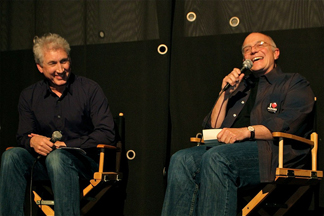
 In 2005, the Dave Eggers-helmed