Like the film’s subject and namesake, the camerawork in Buck expertly captures the horses in the film as thinking creatures with their own emotional worlds by shooting them at eye level. It’s a telling technique that underscores the main thrust of what the film’s characters are trying to understand as they work with their horses. It’s the humans, though, that get the best lines and arguably the most transformative experiences in working with Buck Brannaman, who teaches clinics in Natural Horsemanship, an approach that replaces violently “breaking” a horse with “starting” a horse by establishing trust and building a true union between horse and rider.
Buck chronicles Brannaman’s path from a six-year-old professional trick roper in Corn Pops commercials to success running riding clinics worldwide—and even serving as the inspiration for the book and film The Horse Whisperer. It’s a story that comes out naturally, interspersed with Brannaman’s daily teachings in his clinics, and with archival film and photographs pulling in hints of his dark days as an abused child performer. The film’s structure handles this beautifully, building empathy while teaching, bringing in pieces of the story at just the right moments and lingering on the natural beauty of the horse and wide open spaces where Brannaman plies his trade.
Amazingly, this is director Cindy Meehl’s first film. Meehl first met Brannaman as a horse owner, recommended to one of his clinics by friends who vouched for his ability to transform not only the rider-horse relationship, but one’s approach to life too. While his approach stresses gentleness, “He is not easy on anybody,” Meehl said. “And we all like that.” Some of that drive and discipline no doubt paid off in the process of editing down the 300 hours of footage her crew shot over two and a half years.
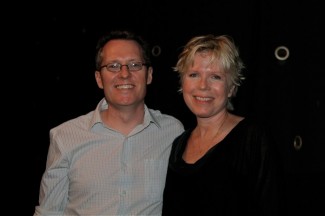
[Photo: From left, Stranger Than Fiction Artistic Director Thom Powers and Director Cindy Meehl, courtesy of Simon Luethi]
In 1996, the well-financed developer juggernaut Pyramid Companies broke ground on a massive mall development project in West Nyack, New York, a tiny hamlet off the Hudson River. In Megamall, filmmakers Vera Aronow, Roger Grange and Sarah Mondale document the resulting tale of corporate tyranny writ small, and the efforts of a group of activists who arose to stop Pyramid from running roughshod over their community. The film’s subtext is one that’s become all too familiar since the 2008 economic downturn: what happens when the darker drives of capitalism begin to work at odds with the Democratic principles this country was founded upon? And what is the result on our cities and communities when the unbridled consumption of resources and goods is given free rein? All too often, it seems, it’s the little guy who is left to pay the costs. Following the film, Stranger Than Fiction Artistic Director Thom Powers spoke with Aronow, Grange and Mondale. Click “Read more” below for the Q&A.
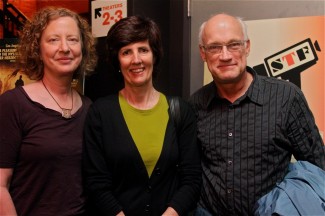
[Photo: From left, Directors Vera Aronow, Sarah Mondale and Roger Grange, courtesy of Simon Luethi]
The chronicle of American wars contains many smaller conflicts wedged in between the marquee names of World War II, Vietnam and Iraq. Director Barbara Trent’s film The Panama Deception reminds us that for the people being bombed, shot and terrorized by the invading war machine, there are no small wars. Using footage of explosions, charred bodies, and the leveled neighborhoods of the poor, The Panama Deception turns again and again back to the U.S. media’s sanitized version of the “intervention” that omitted everything but the U.S. government’s carefully controlled narrative. Interviews with ex-CIA analysts, investigative journalists, and Panamanians caught in the crossfire put the lie to that narrative, revealing the operation as a live-fire rehearsal for the wars of the 21st century, during which the U.S. tested new weapons on real people.
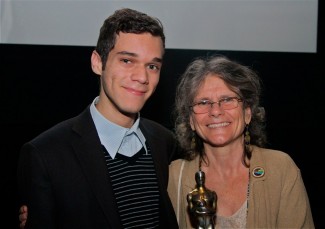
Barbara Trent was on hand, passing her Oscar statuette around, to provide the audience with context of the true goals of the Panama invasion, and to describe the fierce censorship she and her collaborators faced from an occupying force that sought to dodge the bad P.R. of collateral damage in moves that resulted in mass graves and media blackouts. Special guest Jean-Manuel Beauchamp—grandson of the invasion’s target, Panamanian President Manuel Noriega—also took questions from the audience about growing up in the aftermath of invasion and occupation, and the game of international politics that has kept his grandfather imprisoned.
[Photo: From left, Jean-Manuel Beauchamp and director Barbara Trent, courtesy of Simon Luethi]
The idea of long-term polyamory seems to most often stagger its way to the American mainstream represented as a husband with multiple wives, where dynamics and hierarchies are expected to be firmly entrenched in a patriarchal structure. Three of Hearts: A Postmodern Family refreshingly avoids that trope in its examination of a male-male-female threesome. While twentysomethings living in New York City, the trio of Sam, Samantha and Steven establish a relationship that acknowledges the fluidity of human sexuality, while simultaneously thumbing their collective nose at the admittedly abstract conventions of romantic relationships. The threesome’s own struggles with the rarity of their bond are conveyed in a few telling moments, as when they trouble themselves for an appropriate nomenclature to describe what it is they’re doing (eventually resorting to the unwieldy “trinogomous”). In the end, however, the viewer learns that even these unconventional three are not immune to the bitterness that envelopes any jilted ex, as we watch the relationship collapse and the group’s members tread through moments of barely contained rage and pettiness. For anyone who’s lived through a failed relationship, that part of the story is all too familiar. Following the screening, Stranger Than Fiction Executive Director Raphaela Neihausen led a Q&A with Director Susan Kaplan. Click “Read more” below.
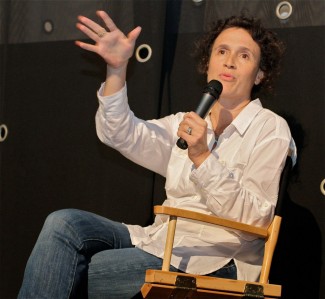
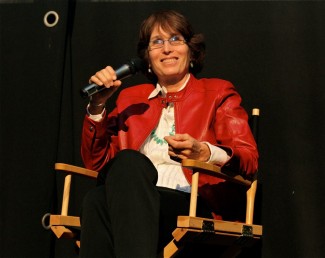
[Photo: Director Susan Kaplan, courtesy of Simon Luethi]
The link between language and culture is an indelible one, as is shown in Anne Makepeace’s film We Still Live Here. The film follows Mashpee Wampanoag Jesse Little Doe’s incredible efforts to resurrect the left-for-dead language of her people, despite having no formal training in linguistics. Although the Wampanoag language was thought to have lacked a fluent speaker for some 150 years, Little Doe in the early 1990s was besieged by a recurring dream in which Mashpee Indians sang to her in a language she didn’t understand. Through her efforts, she was able to realize a her own dream—one in which her daughter, Mae, became the first person raised in the Wampanoag language since the 19th century. In the ultimate irony, Little Doe and other linguists were able to use a body of texts created largely through the efforts of Christian missionaries—who effectively sought to destroy the native culture of the Wampanoag—as source material in rediscovering words that had not been spoken aloud for at least six generations, with a Wampanoag-language Bible serving as perhaps the most useful resource. Following the screening, Makepeace spoke with Stranger Than Fiction Executive Director Raphaela Neihausen. Click “Read more” below for the Q&A.
[Photo: Director Anne Makepeace, courtesy of Simon Luethi]






 Like the film’s subject and namesake, the camerawork in Buck expertly captures the horses in the film as thinking creatures with their own emotional worlds by shooting them at eye level. It’s a telling technique that underscores the main thrust of what the film’s characters are trying to understand as they work with their horses. It’s the humans, though, that get the best lines and arguably the most transformative experiences in working with Buck Brannaman, who teaches clinics in Natural Horsemanship, an approach that replaces violently “breaking” a horse with “starting” a horse by establishing trust and building a true union between horse and rider.
 In 1996, the well-financed developer juggernaut Pyramid Companies broke ground on a massive mall development project in West Nyack, New York, a tiny hamlet off the Hudson River. In
  The chronicle of American wars contains many smaller conflicts wedged in between the marquee names of World War II, Vietnam and Iraq. Director Barbara Trent’s film
  The idea of long-term polyamory seems to most often stagger its way to the American mainstream represented as a husband with multiple wives, where dynamics and hierarchies are expected to be firmly entrenched in a patriarchal structure.
  The link between language and culture is an indelible one, as is shown in Anne Makepeace’s film