Soul Power plays like a 70s R&B/Soul field trip to Africa, intermittently meandering through the shadow of the delayed Ali-Foreman fight and the kleptocratic rule of Zairean strongman Mobutu Sésé Seko. B.B. King, The Spinners, Bill Withers, James Brown and too many others to list all came to Kinshasa in 1974 for a three day concert, an event that was supposed to coincide with Muhammed Ali’s comeback fight with George Foreman, which was chronicled in Soul Power‘s big brother, the 1996 documentary When We Were Kings. It has the flashbulbs, press conferences, backstage camaraderie and amazing performances that a concert film with a narrative arc promises and does it better than most. There’s plenty of bright spots of pure entertainment—backstage cultural exchange and flirtation, the goofy candidness of watching a shirtless Bill Withers dig into his breakfast steak next to Ali pontificating on freedom—but the film doesn’t flinch from putting images front and center that remind you that this carnival is taking place under an authoritarian regime—lines of soldiers, four-story high portraits of Mobutu, the faces of the front row viewed through barbed wire.
What we’re all showing up for, though, is James Brown. We know it, the film knows it, and the first thing you get is a long piece of The Great Black Leader and the opening shouts of Soul Brother Number One. This is rhinestones and mustache era James Brown, a year after The Payback and backed up by the J.B.s., seeming at the same time to be fully in command of his talents and a little distant from the machinery of fame that swirls around him. The closing shot (by Albert Maysles) that follows J.B. from the stage to his dressing room perfectly captures this transformation from World Touring Superstar Sex Machine to tired man who just wants to have a few moments to himself right now, thank you.
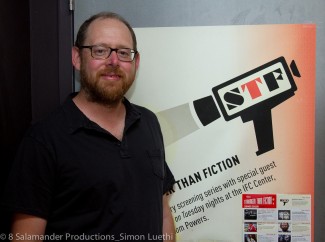
Soul Power came about after director Jeffrey Levy-Hinte had the “nagging feeling we were committing some sort of cultural crime” in putting aside so much great footage of the music of Zaire 74 after editing When We Were Kings. Serendipity helped too, with film stock choices back in ‘74 resulting in a nearly miraculous incorruptibility of the original negative 30 years later, giving Levy-Hinte 177 hours of footage to pore over and select. He claims there may even be a third documentary in there from all the verite sequences of life in Kinshasa that have so far gone unused.
[Photo: Director Jeffrey Levy-Hinte, courtesy of Simon Luethi]
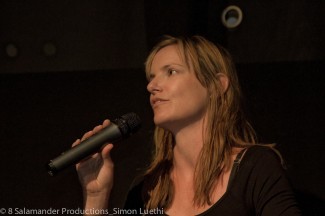
Stringing together a narrative that scans like a solid heist flick, the film Better This World by directors Katie Galloway and Kelly Duane de la Vega explores the actions of David McKay and Bradley Crowder, a pair of young, idealistic radical activists who, in the leadup to the 2008 Republican National Convention in Minneapolis-St. Paul, constructed several gasoline bombs that they never used. Following an early morning police raid, the pair were arrested and labeled domestic terrorists by the government, then prosecuted as such. Clearly sympathetic to McKay and Crowder, Duane de la Vega and Galloway laudably grant federal investigators and prosecutors ample screen time in which they present a reductive picture of the two defendants as domestic terrorists. But it’s a picture that doesn’t gibe with the evidence uncovered by the filmmakers, which bolsters the claim that McKay and Crowder were led to potentially violent action by an undercover FBI informant. What makes the film truly chilling is the questions it raises regarding the role the government itself plays in creating these so-called terrorists, and the complicity of law enforcement informants acting as agents provocateur. Following the screening, friend of Stranger Than Fiction Hugo Perez spoke with director Katie Galloway. Click “Read more” below for the Q&A.
[Photo: Director Katie Galloway, courtesy of Simon Luethi]
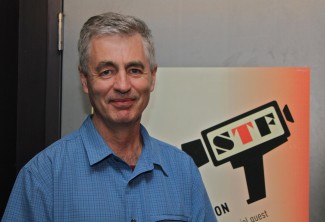
Several times in Stevie, director Steve James directly acknowledges his own ethical precariousness in making the film, and the line-straddling he does between self-professed benefactor to subject Stevie Fielding, and exploitative filmmaker. The access gained by James allows for an incredibly full picture of Fielding, which has the unsettling effect of blurring empathy and sympathy for the film’s central character—who is both the perpetrator of heinous sexual crimes and a victim of them. In the film, blame for the emotional damage that leaves Fielding remorseless for his offenses is spread thin. There is Fielding himself, who shows little reflection on his crime and declines to seek treatment for his problems. There is his mother, who physically abused him before emotionally (and literally) abandoning him. There is his grandmother, who manipulates Fielding’s emotions as a proxy battlefield from which to launch blows at his mother, an archrival. And there is the state foster care system that failed to protect him, leaving him vulnerable to sexual assaults that likely planted the seeds for his own predation. James too, gets in on the action, self-flagellating when admitting that he abandoned a young Fielding when his filmmaking pursuits required it. A minor character in the film invokes truth, as well as cliche, in noting that it takes a village to raise a child. Stevie shows us an disturbing picture of what it looks like when that village reacts to the vulnerable with something too close to indifference, allowing the cycles of abuse to continue unbroken. Following the screening, Stranger Than Fiction Artistic Director Thom Powers spoke with James. Click “Read more” below for the Q&A.
[Photo: Director Steve James, courtesy of Simon Luethi]
I look at the human sciences as poetic sciences in which there is no objectivity, and I see film as not being objective, and cinema verite as a cinema of lies that depends on the art of telling yourself lies. If you’re a good storyteller then the lie is more true than reality, and if you’re a bad one, the truth is worse than a half lie.
-Jean Rouch
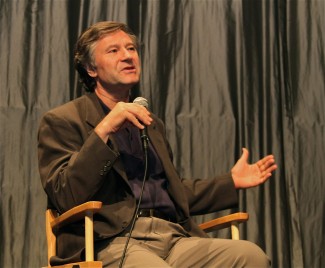
It would be interesting to learn what the subjects of 16 In Webster Groves, if asked today, think of the storytelling skills of Arthur Barron, the film’s producer. Alone, the film is an interesting portrayal of a prototypical upper middle class, largely white American suburb of a certain time period. But in tandem with 16 In Webster Groves Revisited, Barron’s project takes on a self-reflexiveness that is also an examination of the documentary process, particularly that sort practiced by network news film crews of the era. In the latter film, Barron examines the effect that observation has had on both the observed and the observer. The films shun the traditional “objective” model of journalism, as well as the strict observational direct cinema practices being pioneered by the Drew Associates production company around the same time. Seen as one unit, the films have more in common with the French cinema verite approach, in which the filmmaker is an actor (though not necessarily on-camera) whose presence and influence is made clear to the viewer. In 16 in Webster Groves Revisited, narrator/reporter Charles Kuralt pulls back the production curtain to show viewers still photos of the cameraman in action, a technique intended to draw attention to the filmmakers’ manipulation of reality. Barron uses the setting of Webster Groves High School to implicitly criticize attitudes about class stratification, the perils of capitalism, political apathy, and racial segregation. For Barron, investigating the high school as an analogy for Webster Groves’ wider society is something like pulling apart a matryoshka doll—piercing one layer yields another almost identical to its precursor, only smaller in scale. Following the screening, Stranger Than Fiction Artistic Director Thom Powers spoke with Ron Simon, a curator at the Paley Center for Media. Click “Read more” below for the Q&A.
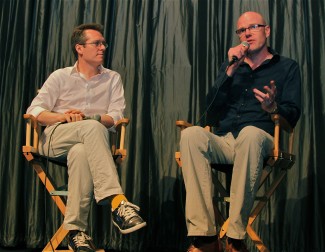
If anyone ever needed further proof of Donald Trump’s narcissism, greed and inflated self-regard, You’ve Been Trumped will supply the necessary evidence in spades. In the film, director Anthony Baxter set out to document Trump’s development of a massive golf resort in an ecologically sensitive sand dune region in Scotland, and returned with a chronicle of his outright hostility to the plight of a small group of nearby property owners deemed by the business tycoon as a threat to his development. If Trump, during his quixotic quest for the presidency, ever pledged support for the American ideal that life, liberty and the pursuit of happiness are rights to be enjoyed by all, the film has certainly provided testimony for the opposite. Baxter’s film several times references the fictional narrative Local Hero, a film by Scottish director Bill Forsyth released in 1983 that foresaw the deleterious effects that American greed might have on the Scottish coast. However, in that film, the developer has a change of heart, and agrees to relocate an oil refinery to preserve a coastal town. One can’t hold out much hope that life will imitate art in Trump’s case. Following the screening, Stranger Than Fiction Artistic Director Thom Powers spoke with Baxter. Click “Read more” below for the Q&A.
[Photo: From left, Thom Powers and director Anthony Baxter, courtesy of Simon Luethi]






 Soul Power plays like a 70s R&B/Soul field trip to Africa, intermittently meandering through the shadow of the delayed Ali-Foreman fight and the kleptocratic rule of Zairean strongman Mobutu Sésé Seko. B.B. King, The Spinners, Bill Withers, James Brown and too many others to list all came to Kinshasa in 1974 for a three day concert, an event that was supposed to coincide with Muhammed Ali’s comeback fight with George Foreman, which was chronicled in Soul Power‘s big brother, the 1996 documentary When We Were Kings. It has the flashbulbs, press conferences, backstage camaraderie and amazing performances that a concert film with a narrative arc promises and does it better than most. There’s plenty of bright spots of pure entertainment—backstage cultural exchange and flirtation, the goofy candidness of watching a shirtless Bill Withers dig into his breakfast steak next to Ali pontificating on freedom—but the film doesn’t flinch from putting images front and center that remind you that this carnival is taking place under an authoritarian regime—lines of soldiers, four-story high portraits of Mobutu, the faces of the front row viewed through barbed wire.
 Stringing together a narrative that scans like a solid heist flick, the film
  Several times in
  I look at the human sciences as poetic sciences in which there is no objectivity, and I see film as not being objective, and cinema verite as a cinema of lies that depends on the art of telling yourself lies. If you’re a good storyteller then the lie is more true than reality, and if you’re a bad one, the truth is worse than a half lie.
 If anyone ever needed further proof of Donald Trump’s narcissism, greed and inflated self-regard,