





Written by STF blogger Deena Ecker
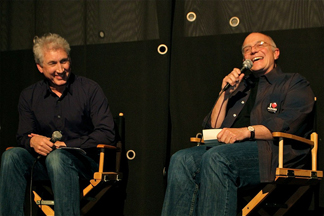 These Amazing Shadows is a movie for, about and by people who love movies. The National Film Registry was created by Congress in 1989 for the purpose of protecting and preserving important American films, those considered culturally, historically or aesthetically significant. Directors Paul Marino and Kurt Norton take us through a journey with these films that weave the American story. The films preseved by the Registry are not just the big movies that appear on most lists. While Gone With the Wind, Citizen Kane and The Godfather are on the list, these movies and others like them do not show us a complete picture of America. These Amazing Shadows takes us through the list in a way that demonstrates what culturally, historically and aesthetically significant means to the members of the National Film Preservation Board. Is The Rocky Horror Picture Show worthy of an Oscar? No. Is it a significant part of American culture? Yes. Will ducking and covering protect you from an atomic bomb? No. Are the films telling us it will an important piece of history? Yes. Censored films, films by women in the 1910’s, propaganda, commercials, newsreels: all these aspects of film are represented on the list and addressed in this captivating documentary. Following the screening, STF Artistic Director Thom Powers spoke with Director/Producers Kurt Norton and Paul Marino and National Film Preservation Board member Dan Streible. Click “Read more” below.
[Photo: from left, Kurt Norton and Paul Marino, courtesy of Simon Luethi]
Chicago Maternity Center Story visits NY
Written by STF blogger Cameron Carnegie
 Like a photograph that accidentally captures something historical, the members of the Kartemquin Films collaborative who made The Chicago Maternity Center Story initially sought to bring to light the plight of women who would be affected by the 1974 closing of the maternity center. An affiliate of Northwestern University, the center offered a low cost, midwife-attended home-birth. But a deeper reality was that the center gave the women and their children a chance to live.
In the 1970s, minority women seemed to understand that having a baby in a Chicago hospital meant they were four times more likely to “die” in childbirth, and that their babies were two times as likely to die as their white counterparts. The film’s gentle voice-over delivers that bone-chilling reality with a calm detachment. The camera, unknown as a potential adversary at the time, communicates without mistake the hospital board members’ disregard for the fragile existence of the women.
None of the board members had the slightest concern for the women, who, without a $50 midwife option, had only a $600 local or $1200 private hospital delivery available to them. Advocating for themselves in front of the board, the women never mention the statistics. But as the film evolves it catches the moment—the exact heartbeat—when health became business first, and patient-care second.
The Chicago Maternity Center supporters starkly contrast the board members who are primarily men, old and white. In a lingering video snapshot, the administrators’ callousness leaps off the screen. Smirks and eye-rolling eventually come back to haunt board members lacking the media savvy to restrain their contempt. With every dismissive gesture captured, the disdain for the women is recorded. There, for posterity to view, administrators would learn their lesson—although too late for the center.
The Chicago Maternity Center Story is a black and white snapshot that today shows us that our healthcare system hasn’t come that far. That system is still driven by profit, and not our best interests.
This film illustrates the media-suppressed reality that giving birth at home is actually desirable. The environment has fewer germs and lacks many of the compromising variables and motives that exist in a hospital. The film includes footage of a young black woman giving birth at home with a midwife from the center in attendance. It shows a difficult birth (not for the faint hearted) that is actually rendered almost commonplace by the skill of the veteran midwife. The breech is merely a fact to be dealt with not a cause for panic. The young woman is lucid and calm once the birth of her healthy baby boy is over.
With the challenge of his birth overcome, the audience learns during Q&A he only lived 17 years in the neighborhood that wouldn’t qualify as upper-class. His mother, proud to have been a part of the film could only say, according to the filmmakers, “I was glad to have him as long as I did.”
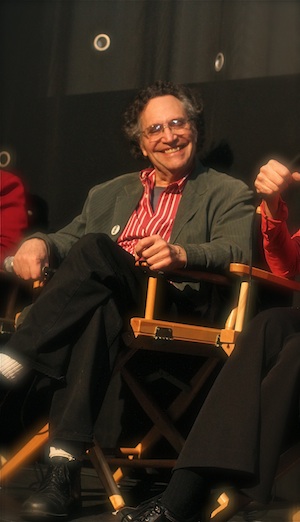
Following the screening, STF moderated a Q&A with Kartemquin filmmakers Gordon Quinn and Suzanne Davenport, and film subject Laura Newman.
[Photo: Gordon Quinn, courtesy of Simon Luethi]
In Memory of Chris Hondros
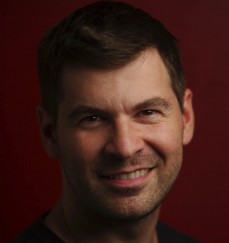 I write with shock and sadness over yesterday’s deaths of Chris Hondros and Tim Hetherington in Libya. In February, Tim showed his short film DIARY at STF and gave a thoughtful discussion afterward. We met only a few times, so others can testify to his career better than me. But I knew Chris for many years and want to add a few thoughts.
The New York Times Lens blog has published a tribute that does a fine job of getting Chris’ attributes, the way he defied the cliches of war reporting as a person. He was level-headed, neither cynical nor indulgently romantic about his profession. He took a long view of history as the son of European immigrants who had memories of WWII. He was very good with words which you can hear in his NPR interview or read in his articles. Those pieces were often written for small publications or blogs, less for career advancement than for the urge to contribute as an eyewitness. Chris had earned the security of employment at Getty Images, but he took great pleasure in side projects like setting images to music for small performances.
He was my favorite dinner companion, possessing a rare perspective on what’s happening in the world, but also a good listener. He was quick-witted. He liked teaching. He took interest in other people’s work. One of his last Facebook messages was to congratulate colleagues who had won awards.
He didn’t have the self-destructive bent that characterizes some war reporters. He could plan ahead. We were plotting an event in Toronto this June to show his Tahrir Square photos. He was going to get married in August. Outsiders might consider his whole profession foolhardy. But I think he considered it a privilege, albeit a dangerous one. He told an interviewer, “you see humanity at its worst, but to me it’s balanced by the fact that you also see humanity at its best. I’ve seen such examples of courage and human generosity.”
The urge to make sense of his death risks its own cliches of grandiosity. If Chris had a choice of where to die, I’m sure he wouldn’t have picked Misurata – a place so remote that newspapers can’t even agree on its spelling. While it may be obscure to us, for others it’s home where hundreds of Libyans have been killed in recent weeks. Chris, Tim and their colleagues were attempting to tell that story. Perhaps we don’t like the story – it doesn’t contain the right heroes or feel destined for a happy ending. But, still, there are lives at stake of people who are as dear to their families as Chris was to me. Why wouldn’t that be a story worth telling?
If you pressed Chris about the danger of his job, he’d point out that no one gets to pick where he dies. Or when. So just hunker down, do your best work and try to leave something of lasting value. That’s what he did.
Wholphin: Strange and Wonderful Shorts
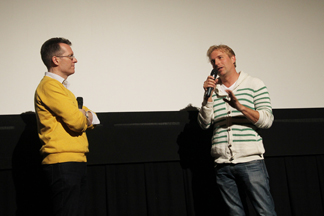 In 2005, the Dave Eggers-helmed McSweeney’s media empire was expanded to encompass lens-based media, yielding the eclectic quarterly DVD magazine Wholphin. Since then, the series has established itself as the filmic equivalent of a cabinet of curiosities for the modern age, shining a light on brilliant shorts that are too often screened at festivals, and then lost in the ether. Editions of the magazine include films that vary in category from experimental to narrative to documentary—as well as in the ill-defined spaces between. In deference to Stranger Than Fiction’s ongoing quest for truth, Wholphin curator Brent Hoff brought with him a group of short documentary films whose unifying theme seemed to be a lack thereof. But the scattershot nature of the films’ forms and topics ending up serving as a varied showcase of the elastic nature of non-fiction cinematic storytelling. Among other films, the eccentricities of an amateur chiropterist and his mother are artfully shared in the Slovenian short Arsy Varsy, while Here Comes Greatness examines a fascinating manifestation of the ennui suffered by suburban kids in Southern California. Wholphin makes one glad that someone out there is attempting to redress the short shrift given to short films. Stranger Than Fiction Artistic Director Thom Powers and Hoff gave short introductions to the films, and a Q&A followed the program. Click “Read more” below.
[Photo: From left, Thom Powers and Brent Hoff, courtesy of Cathryne Czubek]
Stolen: Shining a Light on Modern Day Slavery
 The morality issue at play in the film Stolen is Manichean in its clarity—slavery is unarguably one of the most abhorrent crimes that humanity can perpetrate against itself. But as filmmakers Dan Fallshaw and Violeta Ayala discovered, the politics of sharing the stories of slavery they encountered in Polisario Front-run refugee camps in Algeria proved to be much more complicated. After traveling to the camps to document a family reunion in verite style, Ayala and Fallshaw were forced to make a hard turn after being told tales of modern-day oppression; the second half of the film shifts into thriller territory as we watch the pair struggle to tell the film’s story, while also navigating the minefield politics engulfing the continued conflict between Morocco and the Polisario Front. The filmmakers have since come under heavy criticism from some quarters for their handling of the film’s subjects, who later withdrew their consent to appear in the film. But it’s difficult to figure out how much of this and other attacks originated with the Polisario Front itself, which was resistant to admitting to the existence of slavery traditions in their refugee camps. Stolen perhaps raises more questions than it answers, but does so in the tradition of the best sort of political art. As always, it remains to the viewer to decide exactly where the truth lies. Following the screening, STF Artistic Director Thom Powers spoke with Fallshaw and Ayala. Click “Read more” below for the Q&A.
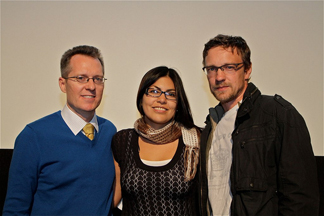
(Photo: from left, Thom Powers, Violeta Ayala and Dan Fallshaw, courtesy of Simon Luethi)