Here’s how to participate:
* Visit http://www.facebook.com/DocumentaryChallenge and click “like” so more people learn about it.
* For 10 days, post your favorite films based on the following criteria to both your personal page and to the “Doc Challenge” page:
Day 1 – Favorite documentary
Day 2 – Favorite music documentary
Day 3 – Most underrated documentary
Day 4 – Best cinematography in a documentary
Day 5 – Favorite documentary character
Day 6 – Documentary that made you angry
Day 7 – Documentary that made you laugh
Day 8 – Most thrilling documentary
Day 9 – Best historical documentary
Day 10 – Best documentary you saw in the last year
You can also find these guidelines under the Doc Challenge’s “info tab”.
It’s interesting to think of the film Resurrect Dead in terms of its debt to technology. It took the development of new, sometimes asymmetrical, communication modes unique to the Internet to allow the thinly spread followers of the Toynbee tile cult to crowdsource their investigations. The film’s ad hoc team of detectives also find each other on the web before realizing real-life relationships. And director Jon Foy made the film over a 10-year period, largely through self-financing, but turned to a web-based fundraising tool—Kickstarter—when in need of completion funds. Interestingly, the team of amateur sleuths are also participants in the creation of the film (Foy remains off camera). Colin Smith pulls double duty as film subject, and producer, while another character, tile photographer Steve Weinik, is credited as an associate producer. The blurring of subject and filmmaker seems right in line with Foy’s filmmaking philosophy. He admits to being heavily influenced by the punk DIY ethos, and it shows in Resurrect Dead. Foy one-man-banded the film, serving as director, dp and editor—and even scored the film himself. While the Internet has provided filmmakers with new tools, drive and determination remain necessary ingredients to finishing an indie doc. Lucky for us, sometimes the end result is a film like Resurrect Dead. Following the screening director Jon Foy, film subject Justin Duerr, producer and film subject Colin Smith, associate producer and film subject Steve Weinik and animator Matt Rota spoke with STF Artistic Director Thom Powers. Click “Read more” below for the Q&A.
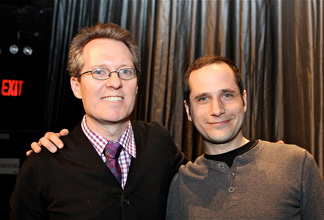
(Photo: from left STF Artistic Director Thom Powers and director Jon Foy, courtesy of Simon Luethi)
Written by STF blogger Cameron Carnegie In The Pipe, the tiny Irish town of Rossport and its colorful inhabitants are exposed through the gentle lens of Director Risteard Ó Domhnaill. The film, produced by Rachel Lysaght, gives us something resounding. In an age of commonplace political betrayal and corporate audacity, fishermen and their families turn back a corporate Goliath with the only weapons at their disposal.
Armed with fierce integrity and steadfast determination, oppressor Shell Oil finds its goal of laying a pipeline through the lush and vibrant countryside rendered impotent by its inhabitants. Using sit-ins, and even a hunger strike stretched over eight years, the townspeople manage to turn back behemoth Shell Oil repeatedly. But it is not without pain and enormous human suffering. Click “Read More” below.
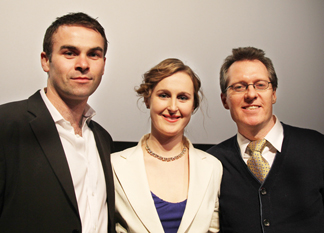
(Photo: From left, Risteard Ó Domhnaill, Rachel Lysaght and Thom Powers, courtesy of Cathryne Czubek)
In 1961, the same year in which Mooney vs. Fowle was shot, President John F. Kennedy signed into law a bill that legalized contracts between single networks and sports leagues. The following year, the one in which Mooney vs. Fowle was aired as part of the The Living Camera television series, CBS signed a $4.65 million contract guaranteeing it the right to broadcast NFL games. It was a move that would usher in a new era of popularity for professional football, which up until then was largely populated by hard-nosed working class men given little remuneration for sacrificing their bodies on the field. The prospect of a multimillion dollar professional contract waiting at the other end of four years of college play was not even a possibility for the young players at Miami High and Edison High.
The observation seems salient given the depiction of the game at the hands of an all-star Drew Associates crew—helmed by director James Lipscomb—that included D.A. Pennebaker, Richard Leacock and Bill Ray as cameramen. The film shows us the deadly seriousness with which a group of not-quite men—along with coaches that sometimes act more like overgrown children—take football, seemingly motivated by nothing more than a sense of pride. Mooney vs. Fowle also marks a point in time in which the filmmakers at Drew Associates were ushering in a radical change in the way that documentary films were produced. New camera technology allowed for mobile cameras with sync sound that took us into the locker rooms and onto the playing fields of both teams, showing us a story instead of telling us one. Following the screening, STF Artistic Director Thom Powers spoke with producer Robert Drew, director James Lipscomb, cameramen D.A. Pennebaker and Bill Ray, sound engineer Hope Ryden and Miami High football player Steve Diamond. Click “Read more” below for the Q&A.
(Photo: from left, James Lipscomb, Hope Ryden, Robert Drew and D.A. Pennebaker, courtesy of Cathryne Czubek)
The programming of Harlan County, U.S.A. seems a bit prescient in retrospect, given the union protests in Wisconsin and several other states over the past few months. Viewing it in that context, the film reminds us that the struggle of organized labor is one that’s been happening in the U.S. for a long time, and seems to reinvigorate itself in cycles lasting a few decades. Regardless of your feelings on the power and political role of unions, it’s hard not to feel a sense of awe when watching the mothers and wives of mine workers facing off against a group of armed strikebreakers. In a political landscape where the gravest confrontations occur in comments posted anonymously on the Internet, the film is a needed reminder that standing by your convictions is easy when a gun is not pointed in your face. Following the screening, STF Artistic Director Thom Powers spoke with Director Barbara Kopple and labor expert Jeffrey Grabelsky. Click “Read more” below for the Q&A.
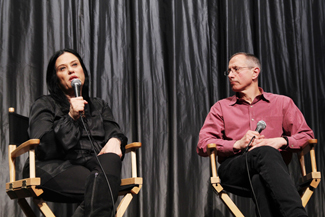
(Photo: from left, Barbara Kopple and Jeffrey Grabelsky, courtesy of Cathryne Czubek)






 Yesterday we launched a 10 Day Documentary Challenge on Facebook to learn more about people’s favorite films.
 It’s interesting to think of the film
  In
In 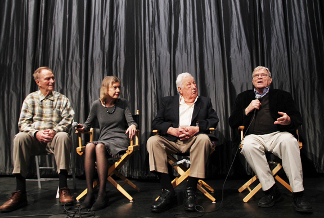 In 1961, the same year in which Mooney vs. Fowle was shot, President John F. Kennedy signed into law a bill that legalized contracts between single networks and sports leagues. The following year, the one in which Mooney vs. Fowle was aired as part of the The Living Camera television series, CBS signed a $4.65 million contract guaranteeing it the right to broadcast NFL games. It was a move that would usher in a new era of popularity for professional football, which up until then was largely populated by hard-nosed working class men given little remuneration for sacrificing their bodies on the field. The prospect of a multimillion dollar professional contract waiting at the other end of four years of college play was not even a possibility for the young players at Miami High and Edison High.
 The programming of Harlan County, U.S.A. seems a bit prescient in retrospect, given the union protests in Wisconsin and several other states over the past few months. Viewing it in that context, the film reminds us that the struggle of organized labor is one that’s been happening in the U.S. for a long time, and seems to reinvigorate itself in cycles lasting a few decades. Regardless of your feelings on the power and political role of unions, it’s hard not to feel a sense of awe when watching the mothers and wives of mine workers facing off against a group of armed strikebreakers. In a political landscape where the gravest confrontations occur in comments posted anonymously on the Internet, the film is a needed reminder that standing by your convictions is easy when a gun is not pointed in your face. Following the screening, STF Artistic Director Thom Powers spoke with Director Barbara Kopple and labor expert Jeffrey Grabelsky. Click “Read more” below for the Q&A.