Nested within the film Theater of War is a clever digression by director John Walter, in which he clearly makes reference to the alienation from labor suffered by a prop manager in the Public Theater’s 2006 staging of Mother Courage and Her Children. In another self-reflexive moment, Walter shows us Tufts literature professor Jay Cantor ostensibly working away in his home office, only to cut to a close up of his computer screen, which bears evidence of Cantor’s playful resentment at Walter for making him pretend to work for the benefit of the film. The two scenes underscore the complexity of the nebular group of subjects Walter has tackled—BertoltBrecht and his relation to Karl Marx, art and its relation to politics, theater and its relation to life—while giving a winking nod to the viewer acknowledging the criticism that Walter is opening himself and his work to.
In addition to all of this winking and nodding, Walter provides the audience with a window into the thoughts and motivations of Meryl Streep (in the role of Mother Courage), as well as translator Tony Kushner and Public Theater Artistic Director Oskar Eustis. And, throwing even more to the pot, Walter hopscotches topically between the 2006 Israeli invasion of Lebanon, protests staged by the remnants of an antiwar movement dogged in its determination to cast Bush as a war criminal, and the life of Brecht himself. At first glance, the film would appear to be too much to take in. But maybe it’s just an attempt at epic theater. I’ll leave it to the viewer to decide just how Brechtian Theater of War’s representation of reality is. Following the screening, filmmaker and STF guest host Hugo Perez spoke with Walter. Click “Read more” below for the Q&A.
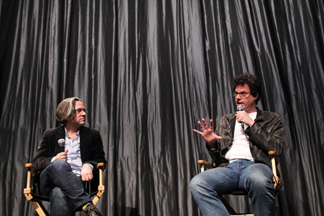
(photo: from left, Hugo Perez and John Walter, courtesy of Cathryne Czubek)
Global migration is perhaps the unseen engine driving the theme of Love on Delivery. In making the film, director Janus Metz leaned heavily on the expertise of anthropologist Sine Plambech (whose focus is on migration, and who is credited as the film’s screenwriter) in gaining access to his subjects, a group of Thai women living in Denmark, and their Danish husbands. But Love on Delivery also invokes a number of other themes—cultural assimilation, familial fidelity, exploitation and the sometimes tense relationship the developed world has with the developing world. Since establishing a beachhead in the small Danish village of Thy after marrying a Dane, Thai expat Sommai has facilitated the immigration of dozens of Thai women, most of whom leave Thailand’s rural, impoverished regions in search of a life that will provide more opportunity. What is striking is how sharply these women’s marriages contrast with the Western ideal of a romantic relationship. The Thai-Dane marriages seem born of pragmatism, with the Danish men seeking to stave off loneliness, and the Thai women searching for rescue from poverty and abuse. But the faithfulness and devotion of these couple halves also becomes apparent over the course of the film, as we see several Danish men take an active role in working to bring their wives friends and family members to Denmark. Maybe this is what love looks like in a global society. Following the screening, STF Artistic Director Thom Powers spoke with Metz and Plambach. Click “Read more” below for the Q&A.
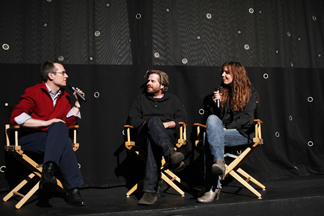
(Photo: from left, Thom Powers, Janus Metz and Sine Plambach, courtesy of Cathryne Czubek)
If there is such a thing as the physical incarnation of a thousand failed rock dreams, Paul Green must surely be it. The founder and proprietor of Paul Green’s School of Rock (note the prominent self-branding), Green seems to have made it his life’s mission to prove the adage-cum-cliche, “He who can, does. He who cannot, teaches.” In Don Argott’s incredibly captivating film, Rock School, Green finally gets his star turn. A psychoanalyst would likely have a field day with Green’s internal conflict between his obvious desire for the success for his students, and his envy toward their accomplishments. (His mental slips with pronouns make clear his proclivity for claiming his students’ achievements as his own.) Green’s Machiavellian teaching technique—in which he alternately pleads, cajoles and, finally, berates his students in diatribes liberally salted with curses—may, in fact, yield impressive student performances. But it leaves unclear the lasting developmental effect that his gregarious man-child approach to education has on his pupils. Still, Rock School also shows the side of Green that is able to push his students to accomplish things they likely thought they were not capable of. And, of course, there’s something compelling about watching a pair of 9-year-old twins channel Prince of Darkness Ozzy Osbourne in an onstage performance. Following the screening, STF Artistic Director Thom Powers spoke with Argott, editor Demian Fenton and producer Sheena Joyce. Click “Read more” below for the Q&A.
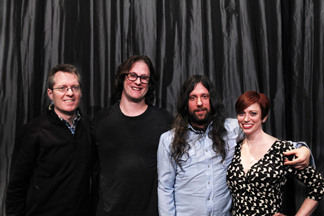
(photo: from left, Thom Powers, Don Argott, Demian Fenton and Sheena Joyce, courtesy of Cathryne Czubek)
By general consensus, the documentary film world agrees that Karen Schmeer was an incredibly talented editor, as evidenced by the flood of encomiums that followed her death early last year. But at Tuesday’s screening of Fast, Cheap & Out of Control (by all a accounts a master class in documentary film editing, and, incredibly, Schmeer’s first editing gig on a feature-length film), Schmeer’s friends and colleagues addended her list of editing credits by sharing stories of her sharp sense of humor and generous spirit of giving. In tribute to all of those aspects of Schmeer’s personality, a group of her friends and colleagues last year inaugurated the Karen Schmeer Film Editing Fellowship, a year-long program intended to nurture an emerging documentary film editor. Following the screening, STF Artistic Director Thom Powers spoke with colleagues David Schisgall, Brad Fuller, Nina Davenport, Lucia Small and Robin Hessman in a discussion on Schmeer’s life and work. Click “Read more” below for the discussion.
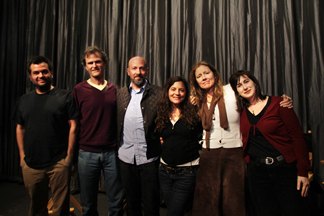
(photo: from left, colleagues of Karen Schmeer: David Schisgall, Brad Fuller, Joshua Seftel, Nina Davenport, Lucia Small and Robin Hessman, courtesy of Cathryne Czubek)
Oscar Berliner’s life story is the quintessentially American kind. The son of Polish immigrants who came to the U.S. around the turn of the 20th century, his narrative was repeated innumerable times among the families of Eastern Europeans. This seemingly ubiquitous story is granted its uniqueness by its treatment at the hands of his son, director Alan Berliner, in the film Nobody’s Business. A document of the intergenerational tension that most any father-son relationship will yield, the film’s antagonism is leavened by the underlying affection that Berliner clearly feels for his father, and an affinity between the two is readily apparent. Berliner infuses the film with a playfulness that makes the sometimes sobering reality of life easier to deal with, leaving the viewer with something that is equal parts document, cinematic essay, fine art and a love letter to his father. Following the screening STF Artistic Director Thom Powers spoke with Berliner. Click “Read more” below for the Q&A.
(photo: from left, Thom Powers and Alan Berliner, courtesy Cathryne Czubek)






 Nested within the film Theater of War is a clever digression by director John Walter, in which he clearly makes reference to the alienation from labor suffered by a prop manager in the Public Theater’s 2006 staging of Mother Courage and Her Children. In another self-reflexive moment, Walter shows us Tufts literature professor Jay Cantor ostensibly working away in his home office, only to cut to a close up of his computer screen, which bears evidence of Cantor’s playful resentment at Walter for making him pretend to work for the benefit of the film. The two scenes underscore the complexity of the nebular group of subjects Walter has tackled—BertoltBrecht and his relation to Karl Marx, art and its relation to politics, theater and its relation to life—while giving a winking nod to the viewer acknowledging the criticism that Walter is opening himself and his work to.
 Global migration is perhaps the unseen engine driving the theme of Love on Delivery. In making the film, director Janus Metz leaned heavily on the expertise of anthropologist Sine Plambech (whose focus is on migration, and who is credited as the film’s screenwriter) in gaining access to his subjects, a group of Thai women living in Denmark, and their Danish husbands. But Love on Delivery also invokes a number of other themes—cultural assimilation, familial fidelity, exploitation and the sometimes tense relationship the developed world has with the developing world. Since establishing a beachhead in the small Danish village of Thy after marrying a Dane, Thai expat Sommai has facilitated the immigration of dozens of Thai women, most of whom leave Thailand’s rural, impoverished regions in search of a life that will provide more opportunity. What is striking is how sharply these women’s marriages contrast with the Western ideal of a romantic relationship. The Thai-Dane marriages seem born of pragmatism, with the Danish men seeking to stave off loneliness, and the Thai women searching for rescue from poverty and abuse. But the faithfulness and devotion of these couple halves also becomes apparent over the course of the film, as we see several Danish men take an active role in working to bring their wives friends and family members to Denmark. Maybe this is what love looks like in a global society. Following the screening, STF Artistic Director Thom Powers spoke with Metz and Plambach. Click “Read more” below for the Q&A.
 If there is such a thing as the physical incarnation of a thousand failed rock dreams, Paul Green must surely be it. The founder and proprietor of Paul Green’s School of Rock (note the prominent self-branding), Green seems to have made it his life’s mission to prove the adage-cum-cliche, “He who can, does. He who cannot, teaches.” In Don Argott’s incredibly captivating film, Rock School, Green finally gets his star turn. A psychoanalyst would likely have a field day with Green’s internal conflict between his obvious desire for the success for his students, and his envy toward their accomplishments. (His mental slips with pronouns make clear his proclivity for claiming his students’ achievements as his own.) Green’s Machiavellian teaching technique—in which he alternately pleads, cajoles and, finally, berates his students in diatribes liberally salted with curses—may, in fact, yield impressive student performances. But it leaves unclear the lasting developmental effect that his gregarious man-child approach to education has on his pupils. Still, Rock School also shows the side of Green that is able to push his students to accomplish things they likely thought they were not capable of. And, of course, there’s something compelling about watching a pair of 9-year-old twins channel Prince of Darkness Ozzy Osbourne in an onstage performance. Following the screening, STF Artistic Director Thom Powers spoke with Argott, editor Demian Fenton and producer Sheena Joyce. Click “Read more” below for the Q&A.
 By general consensus, the documentary film world agrees that Karen Schmeer was an incredibly talented editor, as evidenced by the flood of encomiums that followed her death early last year. But at Tuesday’s screening of Fast, Cheap & Out of Control (by all a accounts a master class in documentary film editing, and, incredibly, Schmeer’s first editing gig on a feature-length film), Schmeer’s friends and colleagues addended her list of editing credits by sharing stories of her sharp sense of humor and generous spirit of giving. In tribute to all of those aspects of Schmeer’s personality, a group of her friends and colleagues last year inaugurated the
 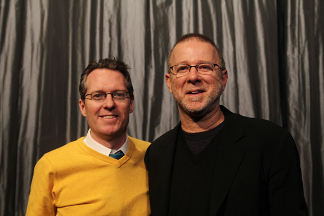 Oscar Berliner’s life story is the quintessentially American kind. The son of Polish immigrants who came to the U.S. around the turn of the 20th century, his narrative was repeated innumerable times among the families of Eastern Europeans. This seemingly ubiquitous story is granted its uniqueness by its treatment at the hands of his son, director Alan Berliner, in the film Nobody’s Business. A document of the intergenerational tension that most any father-son relationship will yield, the film’s antagonism is leavened by the underlying affection that Berliner clearly feels for his father, and an affinity between the two is readily apparent. Berliner infuses the film with a playfulness that makes the sometimes sobering reality of life easier to deal with, leaving the viewer with something that is equal parts document, cinematic essay, fine art and a love letter to his father. Following the screening STF Artistic Director Thom Powers spoke with Berliner. Click “Read more” below for the Q&A.