With the notable exception of The Hurt Locker, one is hard-pressed to cite examples of narrative cinema born of the U.S. wars in Iraq and Afghanistan that have managed to have any significant cultural impact. Much of the rhetorical work that was done a generation ago by war films like Apocalypse Now and The Deerhunter is today being shouldered by nonfiction films like Restrepo and Poster Girl, which provide viewers with insights into both the surreality of war, and the staggering cost it inflicts on both its willing and unwilling participants. The conventions of nonfiction storytelling lend themselves to an immediacy that is hard to duplicate in fictional narrative work, which may explain the wealth of astounding war-related documentary films in the past few years. (Films like Iraq in Fragments, Taxi to the Dark Side and The Oath immediately spring to mind, to cite just a few examples).
In the beautiful and emotionally striking experimental documentary Diary, we see Restrepo co-director Tim Hetherington visually processing the experiences of his own life, split between the Western world and several war-torn societies in West Africa. In Poster Girl, director Sara Nesson turns her camera on Iraq war veteran Robynn Murray as she painfully struggles with combat-related Post Traumatic Stress Disorder (PTSD), and attempts to reintegrate herself into a civilian society from which she feels completely alienated. STF Artistic Director Thom Powers spoke with Hetherington and, in a separate Q&A, with Nesson and Murray. Click “Read more” below for the Q&As.
(photo: from left, Sara Nesson and Robynn Murray, courtesy of Cathryne Czubek)
It’s impossible to pin down the cause of the collapse of the U.S.’s myriad manufacturing sectors to any one source. A host of factors have conspired to hasten the demise of the country’s industrial economy, and with it, a major source of social mobility for the thousands of immigrant laborers that once flooded U.S. shores. In Schmatta: Rags to Riches to Rags, filmmaker Marc Levin focuses his attention on a subset of one of these sectors—New York City’s garment district. Once a steady means of ingress to a solid middle class lifestyle, the city’s garment industry has contracted to a degree that leaves it a stone’s throw from extinction, with little hope for recovery. These industries are now reborn in the developing world, where labor, absent organization, is being exploited to grim result. Schmatta remains a cautionary tale about the excesses of capitalism that is easily applied to a range of other industries, and a warning of its ability to repeat its cruel brand of havoc today in sweatshops the world over. Filmmaker and writer Hugo Perez spoke with Levin following the screening. Click “Read more” for the Q&A.
(photo: from left, Hugo Perez and Marc Levin, courtesy of Cathryne Czubek)
So what hasn’t already been said about Grey Gardens? In the years since its 1975 release, the film has influenced incredibly distant corners of American culture. For instance, it has somehow managed to earn a strong following among gay men, while simultaneously spawning a cult fashion following based on Little Edie’s sublime self-styled “costumes.” Grey Gardens tells a story that resonates so deeply that, in the last five years alone, it has been reconceived not once, but twice, in eponymous homage—first as a Broadway musical in 2006, and then as an narrative film based on the Beales’ lives that premiered on HBO last year. The film has the uncanny ability to improve on repeated viewings, and it proves hard to avoid inferring deeper meaning from some of the memorable lines dropped by the Beales. A favorite bit of dialogue arrives when Little Edie, in a moment of existential musing, shares with the camera, “It’s very difficult to keep the line between the past and the present. You know what I mean? It’s awfully difficult.” Similar difficulties are faced when attempting to encapsule this incredible example of the direct cinema movement. Following the screening, STF Artistic Director spoke with Albert Maysles and Muffie Meyer, who, along with David Maysles and Ellen Hovde, directed the film. Click “Read more” below for the Q&A.
(photo: from left, Thom Powers and directors Muffie Meyer and Albert Maysles, courtesy of Ruth Somalo)
Whether you’re going to Sundance or following from afar, the line-up of 40 or so documentaries can be daunting. This year, I’ve been privileged to see roughly half the titles in private screenings. Here’s my tip sheet of 10 titles in alphabetical order:
BLACK POWER MIXTAPE 1967-1975: When Shola Lynch brought CHISHOLM 72 to STF, she talked about tapping into European archives for footage. Well, there’s more where that came from. Swedish filmmaker Göran Hugo Olsson uncovers a mother load from his country and gives us generous samplings. Like any good mixtape, this one is full of discoveries. If it arouses your interest, plunge into Henry Hampton’s EYES ON THE PRIZE II.
BOBBY FISCHER AGAINST THE WORLD: For years, the story of Bobby Fischer has beguiled and eluded filmmakers. I recall Bennett Miller, in between making THE CRUISE and CAPOTE, speaking publicly about his Fischer fascination at a Moth event devoted to “the story that got away”. Now director Liz Garbus delivers the goods. She draws out strong new interviews from Fischer’s contemporaries, combined with riveting archival footage.
THE GREATEST MOVIE EVER SOLD: Exposing product placement may not be new. Back in the late 80s, Mark Crispin Miller wrote a memorable expose, published in the anthology “Seeing Through Movies.” But Morgan Spurlock has a knack for giving us fresh and hilarious perspective on things we take for granted. His talents are well-suited to start a wider conversation about the world of sponsorship that permeates our lives.
Having garnered accolades from disparate corners of the film and critical world since its release last year, the film Enemies of the People is assuredly many things. Most importantly, it is a record of the violence ordered by the Khmer Rouge in the late 1970s that killed as many as 1.7 million people, as detailed by “Brother Number Two,” the regime’s second-in-command, Nuon Chea. But the film also functions as strong evidence of the dogged determination of investigative journalist (and the film’s co-director) Thet Sambath, who dedicated 10 years—often at the expense of his personal life and bank account—to befriending Nuon Chea, and convincing him to share his story on film for the first time. The tale is made all the more remarkable by the fact that much of Sambath’s immediate family were victims of the genocide.
It is a testament to the filmmaking skill of Sambath and co-director Rob Lemkin that the viewer is able to feel empathy for cadre-level executioners who did much of the killing, and even Nuon Chea himself, without ever losing sight of the horrific crimes that were ordered or committed. The need to place blame feels largely absent from Enemies of the People. Instead, we watch Sambath, whose beatific demeanor seems perpetual, struggle with the difficult questions of why and how the mass killings happened. The rippling effects of the Khmer Rouge are still being wrought on Cambodian society today, and the murders carried out on Killing Fields remain a moment in human history that is difficult and uncomfortable to contemplate. But what is even more disturbing is the idea that the crimes were made possible by the complicity of a culture and society that simply did not know how to stop them. Click “Read More” below for a Q&A with co-director Rob Lemkin.
(photo: co-director Rob Lemkin, courtesy of Cathryne Czubek)






 With the notable exception of The Hurt Locker, one is hard-pressed to cite examples of narrative cinema born of the U.S. wars in Iraq and Afghanistan that have managed to have any significant cultural impact. Much of the rhetorical work that was done a generation ago by war films like Apocalypse Now and The Deerhunter is today being shouldered by nonfiction films like Restrepo and Poster Girl, which provide viewers with insights into both the surreality of war, and the staggering cost it inflicts on both its willing and unwilling participants. The conventions of nonfiction storytelling lend themselves to an immediacy that is hard to duplicate in fictional narrative work, which may explain the wealth of astounding war-related documentary films in the past few years. (Films like Iraq in Fragments, Taxi to the Dark Side and The Oath immediately spring to mind, to cite just a few examples).
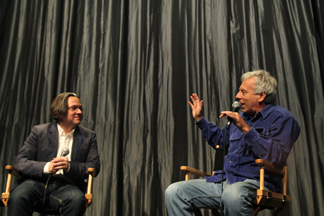 It’s impossible to pin down the cause of the collapse of the U.S.’s myriad manufacturing sectors to any one source. A host of factors have conspired to hasten the demise of the country’s industrial economy, and with it, a major source of social mobility for the thousands of immigrant laborers that once flooded U.S. shores. In Schmatta: Rags to Riches to Rags, filmmaker Marc Levin focuses his attention on a subset of one of these sectors—New York City’s garment district. Once a steady means of ingress to a solid middle class lifestyle, the city’s garment industry has contracted to a degree that leaves it a stone’s throw from extinction, with little hope for recovery. These industries are now reborn in the developing world, where labor, absent organization, is being exploited to grim result. Schmatta remains a cautionary tale about the excesses of capitalism that is easily applied to a range of other industries, and a warning of its ability to repeat its cruel brand of havoc today in sweatshops the world over. Filmmaker and writer
  So what hasn’t already been said about Grey Gardens? In the years since its 1975 release, the film has influenced incredibly distant corners of American culture. For instance, it has somehow managed to earn a strong following among gay men, while simultaneously spawning a cult fashion following based on Little Edie’s sublime self-styled “costumes.” Grey Gardens tells a story that resonates so deeply that, in the last five years alone, it has been reconceived not once, but twice, in eponymous homage—first as a Broadway musical in 2006, and then as an narrative film based on the Beales’ lives that premiered on HBO last year. The film has the uncanny ability to improve on repeated viewings, and it proves hard to avoid inferring deeper meaning from some of the memorable lines dropped by the Beales. A favorite bit of dialogue arrives when Little Edie, in a moment of existential musing, shares with the camera, “It’s very difficult to keep the line between the past and the present. You know what I mean? It’s awfully difficult.” Similar difficulties are faced when attempting to encapsule this incredible example of the direct cinema movement. Following the screening, STF Artistic Director spoke with Albert Maysles and Muffie Meyer, who, along with David Maysles and Ellen Hovde, directed the film. Click “Read more” below for the Q&A.
 Whether you’re going to Sundance or following from afar, the line-up of 40 or so documentaries can be daunting. This year, I’ve been privileged to see roughly half the titles in private screenings. Here’s my tip sheet of 10 titles in alphabetical order:
 Having garnered accolades from disparate corners of the film and critical world since its release last year, the film Enemies of the People is assuredly many things. Most importantly, it is a record of the violence ordered by the Khmer Rouge in the late 1970s that killed as many as 1.7 million people, as detailed by “Brother Number Two,” the regime’s second-in-command, Nuon Chea. But the film also functions as strong evidence of the dogged determination of investigative journalist (and the film’s co-director) Thet Sambath, who dedicated 10 years—often at the expense of his personal life and bank account—to befriending Nuon Chea, and convincing him to share his story on film for the first time. The tale is made all the more remarkable by the fact that much of Sambath’s immediate family were victims of the genocide.