In 2005, the Dave Eggers-helmed McSweeney’s media empire was expanded to encompass lens-based media, yielding the eclectic quarterly DVD magazine Wholphin. Since then, the series has established itself as the filmic equivalent of a cabinet of curiosities for the modern age, shining a light on brilliant shorts that are too often screened at festivals, and then lost in the ether. Editions of the magazine include films that vary in category from experimental to narrative to documentary—as well as in the ill-defined spaces between. In deference to Stranger Than Fiction’s ongoing quest for truth, Wholphin curator Brent Hoff brought with him a group of short documentary films whose unifying theme seemed to be a lack thereof. But the scattershot nature of the films’ forms and topics ending up serving as a varied showcase of the elastic nature of non-fiction cinematic storytelling. Among other films, the eccentricities of an amateur chiropterist and his mother are artfully shared in the Slovenian short Arsy Varsy, while Here Comes Greatness examines a fascinating manifestation of the ennui suffered by suburban kids in Southern California. Wholphin makes one glad that someone out there is attempting to redress the short shrift given to short films. Stranger Than Fiction Artistic Director Thom Powers and Hoff gave short introductions to the films, and a Q&A followed the program. Click “Read more” below.
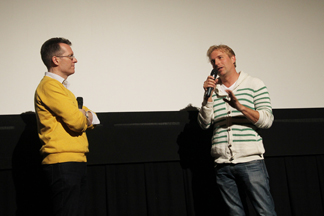
[Photo: From left, Thom Powers and Brent Hoff, courtesy of Cathryne Czubek]
The morality issue at play in the film Stolen is Manichean in its clarity—slavery is unarguably one of the most abhorrent crimes that humanity can perpetrate against itself. But as filmmakers Dan Fallshaw and Violeta Ayala discovered, the politics of sharing the stories of slavery they encountered in Polisario Front-run refugee camps in Algeria proved to be much more complicated. After traveling to the camps to document a family reunion in verite style, Ayala and Fallshaw were forced to make a hard turn after being told tales of modern-day oppression; the second half of the film shifts into thriller territory as we watch the pair struggle to tell the film’s story, while also navigating the minefield politics engulfing the continued conflict between Morocco and the Polisario Front. The filmmakers have since come under heavy criticism from some quarters for their handling of the film’s subjects, who later withdrew their consent to appear in the film. But it’s difficult to figure out how much of this and other attacks originated with the Polisario Front itself, which was resistant to admitting to the existence of slavery traditions in their refugee camps. Stolen perhaps raises more questions than it answers, but does so in the tradition of the best sort of political art. As always, it remains to the viewer to decide exactly where the truth lies. Following the screening, STF Artistic Director Thom Powers spoke with Fallshaw and Ayala. Click “Read more” below for the Q&A.
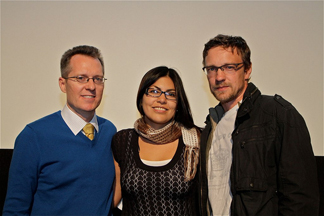
(Photo: from left, Thom Powers, Violeta Ayala and Dan Fallshaw, courtesy of Simon Luethi)
Here’s how to participate:
* Visit http://www.facebook.com/DocumentaryChallenge and click “like” so more people learn about it.
* For 10 days, post your favorite films based on the following criteria to both your personal page and to the “Doc Challenge” page:
Day 1 – Favorite documentary
Day 2 – Favorite music documentary
Day 3 – Most underrated documentary
Day 4 – Best cinematography in a documentary
Day 5 – Favorite documentary character
Day 6 – Documentary that made you angry
Day 7 – Documentary that made you laugh
Day 8 – Most thrilling documentary
Day 9 – Best historical documentary
Day 10 – Best documentary you saw in the last year
You can also find these guidelines under the Doc Challenge’s “info tab”.
It’s interesting to think of the film Resurrect Dead in terms of its debt to technology. It took the development of new, sometimes asymmetrical, communication modes unique to the Internet to allow the thinly spread followers of the Toynbee tile cult to crowdsource their investigations. The film’s ad hoc team of detectives also find each other on the web before realizing real-life relationships. And director Jon Foy made the film over a 10-year period, largely through self-financing, but turned to a web-based fundraising tool—Kickstarter—when in need of completion funds. Interestingly, the team of amateur sleuths are also participants in the creation of the film (Foy remains off camera). Colin Smith pulls double duty as film subject, and producer, while another character, tile photographer Steve Weinik, is credited as an associate producer. The blurring of subject and filmmaker seems right in line with Foy’s filmmaking philosophy. He admits to being heavily influenced by the punk DIY ethos, and it shows in Resurrect Dead. Foy one-man-banded the film, serving as director, dp and editor—and even scored the film himself. While the Internet has provided filmmakers with new tools, drive and determination remain necessary ingredients to finishing an indie doc. Lucky for us, sometimes the end result is a film like Resurrect Dead. Following the screening director Jon Foy, film subject Justin Duerr, producer and film subject Colin Smith, associate producer and film subject Steve Weinik and animator Matt Rota spoke with STF Artistic Director Thom Powers. Click “Read more” below for the Q&A.
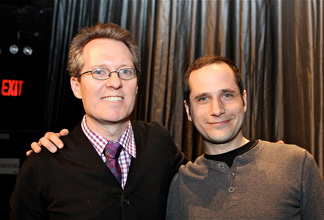
(Photo: from left STF Artistic Director Thom Powers and director Jon Foy, courtesy of Simon Luethi)
Written by STF blogger Cameron Carnegie In The Pipe, the tiny Irish town of Rossport and its colorful inhabitants are exposed through the gentle lens of Director Risteard Ó Domhnaill. The film, produced by Rachel Lysaght, gives us something resounding. In an age of commonplace political betrayal and corporate audacity, fishermen and their families turn back a corporate Goliath with the only weapons at their disposal.
Armed with fierce integrity and steadfast determination, oppressor Shell Oil finds its goal of laying a pipeline through the lush and vibrant countryside rendered impotent by its inhabitants. Using sit-ins, and even a hunger strike stretched over eight years, the townspeople manage to turn back behemoth Shell Oil repeatedly. But it is not without pain and enormous human suffering. Click “Read More” below.
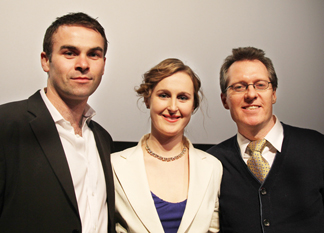
(Photo: From left, Risteard Ó Domhnaill, Rachel Lysaght and Thom Powers, courtesy of Cathryne Czubek)

 In 2005, the Dave Eggers-helmed McSweeney’s media empire was expanded to encompass lens-based media, yielding the eclectic quarterly DVD magazine Wholphin. Since then, the series has established itself as the filmic equivalent of a cabinet of curiosities for the modern age, shining a light on brilliant shorts that are too often screened at festivals, and then lost in the ether. Editions of the magazine include films that vary in category from experimental to narrative to documentary—as well as in the ill-defined spaces between. In deference to Stranger Than Fiction’s ongoing quest for truth, Wholphin curator Brent Hoff brought with him a group of short documentary films whose unifying theme seemed to be a lack thereof. But the scattershot nature of the films’ forms and topics ending up serving as a varied showcase of the elastic nature of non-fiction cinematic storytelling. Among other films, the eccentricities of an amateur chiropterist and his mother are artfully shared in the Slovenian short Arsy Varsy, while Here Comes Greatness examines a fascinating manifestation of the ennui suffered by suburban kids in Southern California. Wholphin makes one glad that someone out there is attempting to redress the short shrift given to short films. Stranger Than Fiction Artistic Director Thom Powers and Hoff gave short introductions to the films, and a Q&A followed the program. Click “Read more” below.
 The morality issue at play in the film Stolen is Manichean in its clarity—slavery is unarguably one of the most abhorrent crimes that humanity can perpetrate against itself. But as filmmakers Dan Fallshaw and Violeta Ayala discovered, the politics of sharing the stories of slavery they encountered in Polisario Front-run refugee camps in Algeria proved to be much more complicated. After traveling to the camps to document a family reunion in verite style, Ayala and Fallshaw were forced to make a hard turn after being told tales of modern-day oppression; the second half of the film shifts into thriller territory as we watch the pair struggle to tell the film’s story, while also navigating the minefield politics engulfing the continued conflict between Morocco and the Polisario Front. The filmmakers have since come under heavy criticism from some quarters for their handling of the film’s subjects, who later withdrew their consent to appear in the film. But it’s difficult to figure out how much of this and other attacks originated with the Polisario Front itself, which was resistant to admitting to the existence of slavery traditions in their refugee camps. Stolen perhaps raises more questions than it answers, but does so in the tradition of the best sort of political art. As always, it remains to the viewer to decide exactly where the truth lies. Following the screening, STF Artistic Director Thom Powers spoke with Fallshaw and Ayala. Click “Read more” below for the Q&A.
 Yesterday we launched a
  It’s interesting to think of the film
  In
In