In 1961, the same year in which Mooney vs. Fowle was shot, President John F. Kennedy signed into law a bill that legalized contracts between single networks and sports leagues. The following year, the one in which Mooney vs. Fowle was aired as part of the The Living Camera television series, CBS signed a $4.65 million contract guaranteeing it the right to broadcast NFL games. It was a move that would usher in a new era of popularity for professional football, which up until then was largely populated by hard-nosed working class men given little remuneration for sacrificing their bodies on the field. The prospect of a multimillion dollar professional contract waiting at the other end of four years of college play was not even a possibility for the young players at Miami High and Edison High.
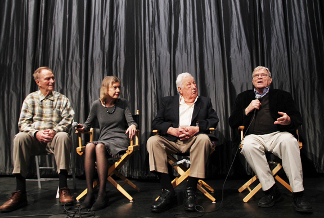
The observation seems salient given the depiction of the game at the hands of an all-star Drew Associates crew—helmed by director James Lipscomb—that included D.A. Pennebaker, Richard Leacock and Bill Ray as cameramen. The film shows us the deadly seriousness with which a group of not-quite men—along with coaches that sometimes act more like overgrown children—take football, seemingly motivated by nothing more than a sense of pride. Mooney vs. Fowle also marks a point in time in which the filmmakers at Drew Associates were ushering in a radical change in the way that documentary films were produced. New camera technology allowed for mobile cameras with sync sound that took us into the locker rooms and onto the playing fields of both teams, showing us a story instead of telling us one. Following the screening, STF Artistic Director Thom Powers spoke with producer Robert Drew, director James Lipscomb, cameramen D.A. Pennebaker and Bill Ray, sound engineer Hope Ryden and Miami High football player Steve Diamond. Click “Read more” below for the Q&A.
(Photo: from left, James Lipscomb, Hope Ryden, Robert Drew and D.A. Pennebaker, courtesy of Cathryne Czubek)
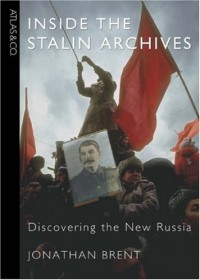
As Robin Hessman’s MY PERESTROIKA opens this week in theaters across the country (some of you may have caught it at STF last May), we thought it would be an appropriate moment to publish an interview STF conducted with author Jonathan Brent back in January 2009 about his book Inside the Stalin Archives: Discovering the new Russia. Both MY PERESTROIKA and Inside the Stalin Archives make incredible use of Russian archives to illuminate the history and reality of Russia, then and now.
Below is a transcript of the conversation between STF artistic director Thom Powers and author Jonathan Brent.
The programming of Harlan County, U.S.A. seems a bit prescient in retrospect, given the union protests in Wisconsin and several other states over the past few months. Viewing it in that context, the film reminds us that the struggle of organized labor is one that’s been happening in the U.S. for a long time, and seems to reinvigorate itself in cycles lasting a few decades. Regardless of your feelings on the power and political role of unions, it’s hard not to feel a sense of awe when watching the mothers and wives of mine workers facing off against a group of armed strikebreakers. In a political landscape where the gravest confrontations occur in comments posted anonymously on the Internet, the film is a needed reminder that standing by your convictions is easy when a gun is not pointed in your face. Following the screening, STF Artistic Director Thom Powers spoke with Director Barbara Kopple and labor expert Jeffrey Grabelsky. Click “Read more” below for the Q&A.
(Photo: from left, Barbara Kopple and Jeffrey Grabelsky, courtesy of Cathryne Czubek)
Nested within the film Theater of War is a clever digression by director John Walter, in which he clearly makes reference to the alienation from labor suffered by a prop manager in the Public Theater’s 2006 staging of Mother Courage and Her Children. In another self-reflexive moment, Walter shows us Tufts literature professor Jay Cantor ostensibly working away in his home office, only to cut to a close up of his computer screen, which bears evidence of Cantor’s playful resentment at Walter for making him pretend to work for the benefit of the film. The two scenes underscore the complexity of the nebular group of subjects Walter has tackled—BertoltBrecht and his relation to Karl Marx, art and its relation to politics, theater and its relation to life—while giving a winking nod to the viewer acknowledging the criticism that Walter is opening himself and his work to.
In addition to all of this winking and nodding, Walter provides the audience with a window into the thoughts and motivations of Meryl Streep (in the role of Mother Courage), as well as translator Tony Kushner and Public Theater Artistic Director Oskar Eustis. And, throwing even more to the pot, Walter hopscotches topically between the 2006 Israeli invasion of Lebanon, protests staged by the remnants of an antiwar movement dogged in its determination to cast Bush as a war criminal, and the life of Brecht himself. At first glance, the film would appear to be too much to take in. But maybe it’s just an attempt at epic theater. I’ll leave it to the viewer to decide just how Brechtian Theater of War’s representation of reality is. Following the screening, filmmaker and STF guest host Hugo Perez spoke with Walter. Click “Read more” below for the Q&A.
(photo: from left, Hugo Perez and John Walter, courtesy of Cathryne Czubek)
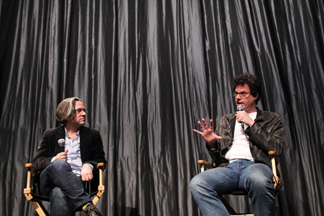
Global migration is perhaps the unseen engine driving the theme of Love on Delivery. In making the film, director Janus Metz leaned heavily on the expertise of anthropologist Sine Plambech (whose focus is on migration, and who is credited as the film’s screenwriter) in gaining access to his subjects, a group of Thai women living in Denmark, and their Danish husbands. But Love on Delivery also invokes a number of other themes—cultural assimilation, familial fidelity, exploitation and the sometimes tense relationship the developed world has with the developing world. Since establishing a beachhead in the small Danish village of Thy after marrying a Dane, Thai expat Sommai has facilitated the immigration of dozens of Thai women, most of whom leave Thailand’s rural, impoverished regions in search of a life that will provide more opportunity. What is striking is how sharply these women’s marriages contrast with the Western ideal of a romantic relationship. The Thai-Dane marriages seem born of pragmatism, with the Danish men seeking to stave off loneliness, and the Thai women searching for rescue from poverty and abuse. But the faithfulness and devotion of these couple halves also becomes apparent over the course of the film, as we see several Danish men take an active role in working to bring their wives friends and family members to Denmark. Maybe this is what love looks like in a global society. Following the screening, STF Artistic Director Thom Powers spoke with Metz and Plambach. Click “Read more” below for the Q&A.
(Photo: from left, Thom Powers, Janus Metz and Sine Plambach, courtesy of Cathryne Czubek)






 In 1961, the same year in which Mooney vs. Fowle was shot, President John F. Kennedy signed into law a bill that legalized contracts between single networks and sports leagues. The following year, the one in which Mooney vs. Fowle was aired as part of the The Living Camera television series, CBS signed a $4.65 million contract guaranteeing it the right to broadcast NFL games. It was a move that would usher in a new era of popularity for professional football, which up until then was largely populated by hard-nosed working class men given little remuneration for sacrificing their bodies on the field. The prospect of a multimillion dollar professional contract waiting at the other end of four years of college play was not even a possibility for the young players at Miami High and Edison High.
 As Robin Hessman’s
  The programming of Harlan County, U.S.A. seems a bit prescient in retrospect, given the union protests in Wisconsin and several other states over the past few months. Viewing it in that context, the film reminds us that the struggle of organized labor is one that’s been happening in the U.S. for a long time, and seems to reinvigorate itself in cycles lasting a few decades. Regardless of your feelings on the power and political role of unions, it’s hard not to feel a sense of awe when watching the mothers and wives of mine workers facing off against a group of armed strikebreakers. In a political landscape where the gravest confrontations occur in comments posted anonymously on the Internet, the film is a needed reminder that standing by your convictions is easy when a gun is not pointed in your face. Following the screening, STF Artistic Director Thom Powers spoke with Director Barbara Kopple and labor expert Jeffrey Grabelsky. Click “Read more” below for the Q&A.
 Nested within the film Theater of War is a clever digression by director John Walter, in which he clearly makes reference to the alienation from labor suffered by a prop manager in the Public Theater’s 2006 staging of Mother Courage and Her Children. In another self-reflexive moment, Walter shows us Tufts literature professor Jay Cantor ostensibly working away in his home office, only to cut to a close up of his computer screen, which bears evidence of Cantor’s playful resentment at Walter for making him pretend to work for the benefit of the film. The two scenes underscore the complexity of the nebular group of subjects Walter has tackled—BertoltBrecht and his relation to Karl Marx, art and its relation to politics, theater and its relation to life—while giving a winking nod to the viewer acknowledging the criticism that Walter is opening himself and his work to.
 Global migration is perhaps the unseen engine driving the theme of Love on Delivery. In making the film, director Janus Metz leaned heavily on the expertise of anthropologist Sine Plambech (whose focus is on migration, and who is credited as the film’s screenwriter) in gaining access to his subjects, a group of Thai women living in Denmark, and their Danish husbands. But Love on Delivery also invokes a number of other themes—cultural assimilation, familial fidelity, exploitation and the sometimes tense relationship the developed world has with the developing world. Since establishing a beachhead in the small Danish village of Thy after marrying a Dane, Thai expat Sommai has facilitated the immigration of dozens of Thai women, most of whom leave Thailand’s rural, impoverished regions in search of a life that will provide more opportunity. What is striking is how sharply these women’s marriages contrast with the Western ideal of a romantic relationship. The Thai-Dane marriages seem born of pragmatism, with the Danish men seeking to stave off loneliness, and the Thai women searching for rescue from poverty and abuse. But the faithfulness and devotion of these couple halves also becomes apparent over the course of the film, as we see several Danish men take an active role in working to bring their wives friends and family members to Denmark. Maybe this is what love looks like in a global society. Following the screening, STF Artistic Director Thom Powers spoke with Metz and Plambach. Click “Read more” below for the Q&A.