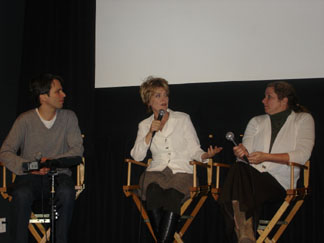
R to L: Director Ben Kempas with D-Word friends Cameron Hickey and Lauren Feeney
Last night, STF had the pleasure of welcoming director Ben Kempas all the way from Germany, with his recent documentary UPSTREAM BATTLE . The film deals with the disintegration of the Native Americans’ religion and familial culture caused by the depletion of the salmon population in Northern California’s Klamath River – a byproduct of four hydroelectric dams.
When Kempas was asked how he navigated such a closed society and competing interests, he replied, “just listen.” His tactic proved successful as he won considerable face-time with multiple sides, including the power company that operates the dams.
Kempas obviously feels sympathetic to the anti-dam campaigners, but he avoids easy moralizing by examining the complexities of the public’s demand for more electricity. Ultimately, the film shows non-traditional alliances formed between commercial fisherman, farmers and the Native-Americans. Kempas said, “I didn’t want to do a black and white documentary, telling people what to think”.
On January 16, the IFC Center will begin a week-long run of THE PERVERT’S GUIDE TO CINEMA, directed by Sophie Fiennes. You can read my description here from its North American premiere at the 2006 Toronto International Film Festival. Since then, PERVERTS has gained a cult reputation based on only a few screenings in the U.S. Yesterday, the film played for one night at the Jacob Burns Film Center in Westchester. Afterwards, I moderated a discussion with Fiennes in which she elaborates on her collaboration with Slavoj Zizek. She is currently planning a follow-up film with Zizek called THE PERVERT’S GUIDE TO IDEOLOGY. Here are a few edited excerpts from last night’s conversation…
Audience member: Can you tell us how this project originated and the background of the narrator?
Sophie Fiennes: Slavoj Zizek is a philosopher or cultural theorist, depending on how you want to name him. He is a Freudian, Lacanian philosopher, psychoanalyst – not a practicing psychoanalyst. He’s written about 30 books. I had made a documentary previous to this called HOOVER STREET REVIVAL which was about a Pentecostal church community in Los Angeles. A friend of mine said, “You should meet Slavoj Zizek cause he’s written a lot about religion.” So I started reading Slavoj and realized he was always referring to films. I read the book “Enjoy Your Symptom!” and this idea came about.
In a book you could only go so far in exploring what he was saying about films. I thought, let’s put those ideas to the films as a way of talking about them in their own form. I have a friend who is a practicing psychoanalyst in London and knew Slavoj. He made the introduction over email. We made a plan to meet in a university town where he was lecturing. He said to me, “What’s your transcendental agenda? What do you want to do?” I saw my agenda as an opportunity to look at moments in films rather than this idea of plot. If you are ever trying to make a film, everything you are told in script development is about the plot and character identification. But for me, watching a film, I always think that the narrative is there to serve critical moments where you as the audience suddenly shift psychically by what the moment delivered. That is why it has this emphasis.
Powers: Did making PERVERTS give you a new appreciation for the films it covers?
Fiennes: Everything Slavoj had to say about Hitchcock is completely riveting. And I loved what he had to say about David Lynch because he was a very important filmmaker for me. He really sheds light on the whole premise of Lynch. Throughout all of Lynch’s films you can see the duality between what he is fantasizing and what is real.
At one point, I was presenting the film to TV commissioners and felt it wasn’t enough to say it’s only going to be this Slovenian philosopher talking. We were trying to sell that we’d speak to Walter Murch, David Lynch and others. So I flew Slavoj to Los Angeles to do an interview with David Lynch. A half an hour before the interview, Lynch canceled. I mean, we’d flown all the way over there! Just the other day I said, “I’m really sorry, Slavoj. We dragged you all the way there.” And he said, “No, no, don’t worry. I was terrified to interview David Lynch.”
This past weekend, with the Oscar nominations around the corner, Tribeca Cinemas screened DOCS ON THE SHORTLIST, sponsored by the Gucci Tribeca Documentary Fund. Presenting a handful of titles from the 15 shortlist, the series gave a final spotlight before nomination ballots are due on Jan 12. Each screening was accompanied by a Q&A with people behind the films.
The screening of Man on Wire was enhanced by a Q&A with Phillipe Petit, the tightrope daredevil who staged Manhattan’s greatest bit of public theater in August 1974 when he, with the aid of several accomplices, walked between the Twin Towers 1350 feet above New York’s morning rush-hour. The Frenchman possessing infectious energy and love of life, said of his walk among the birds and skyscrapers, “this was not the world of men”.
When media coverage of Africa is repeatedly confined to military juntas, famine and recently piracy in Somalia, Pray the Devil Back to Hell stands out for its story of courageous Liberian Women who broke traditional religious customs and came together to stand for peace during civil war, while helping oust Dictator Charles Taylor. Director Gini Reticker brought heart and humor to otherwise somber subject matter. She’s pictured here in the middle with her collaborator Abigail Disney and moderator Marshal Curry.
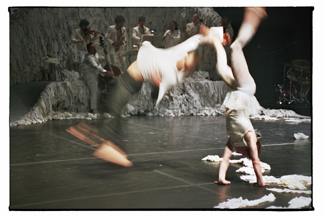
Dance on Camera, the venerable festival hosted by the Film Society at Lincoln Center, kicked off last week with an array of treats and discoveries. Director Sophie Fiennes was on hand for the New York debut of VSPRS Show and Tell, participating in a Q&A moderated by programmer Joanna Ney. Fiennes will be sticking around New York for the opening of her collaboration with Slavoj Zizek The Perverts Guide to Cinema for a week-long run at the IFC Center starting on Jan 16.
Traditionalists might be hesitant to call choreographer Alain Platel’s namesake piece “dance.” Fiennes captures a chaotic and emotionally exhaustive and sexually frenetic exploration of movement. It physically embodies and emotionally derives from those struggling with schizophrenia and other mental disorders.
STF strives to help you lead a better life while enjoying the best in non-fiction film. Starting January 13, join us for 10 Tuesday nights to strive toward these very worthy goals…
RESOLUTION #1: FIGHT THE POWER! Jan 13: UPSTREAM BATTLE (2008) Get a dose of inspiration for fighting corporate greed and environmental destruction in 2009. In UPSTREAM BATTLE, a Native American rock n’ roller-turned-activist battles to save the Klamath River’s salmon population going up against billionaire Warren Buffet. Q&A with director Ben Kempas.
RESOLUTION #2: HAVE SEX AND MAKE IT SAFE! Jan 20: THE EDUCATION OF SHELBY KNOX (2005) A high school girl in Texas shocks her conservative community by campaigning for better sex education in a culture that teaches abstinence-only. Audience Award winner at SXSW. Q&A will include Shelby Knox, who’s graduated from college and continues to campaign for feminist causes. Q&A with directors Rose Rosenblatt & Marion Lipschutz + Shelby Knox.
RESOLUTION #3: TAKE A ROAD TRIP! Jan 27: PARALLEL LINES (2003) – Nina Davenport (the director of “Operation Filmmaker” and “Always a Bridesmaid”) travels across America to uncover surprising and poignant reflections in the months after Sept 11, 2001. Q&A with director Nina Davenport.
RESOLUTION #4: CONFRONT YOUR DYSFUNCTIONAL FAMILY! Feb 3: MUST READ AFTER MY DEATH (2008) – An exploration of an unconventional family told through an enormous archive of home movies and recordings. Co-presented by Hamptons International Film Festival. Q&A with director Morgan Dews.




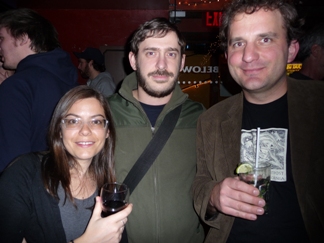 R to L: Director Ben Kempas with D-Word friends Cameron Hickey and Lauren Feeney
 On January 16, the IFC Center will begin a week-long run of THE PERVERT’S GUIDE TO CINEMA, directed by Sophie Fiennes. You can read
  Reported by Erik Guzinski
 Reported by Erik Guzinski