From left, filmmaker Corrine van der Borch and artist Bettina. Photo by Simon Luethi.
One of capitalism’s massive blind spots lies in its inability to assign proper value to a society’s social and cultural artifacts. Sometimes those artifacts are living, breathing people, as is the case with artists Bettina and Taylor Mead. Thematically, Corrine van der Borch’s GIRL WITH BLACK BALLOONS and Jeffrey Wengrofsky’s THE PARTY IN TAYLOR MEAD’S KITCHEN are linked by their devotion to those artists, who themselves are completely committed to their art. Mead, the scion of a political dynasty who transformed himself into a scion of beatnik royalty, is completely forthright about his desire to seek absolute freedom in his life, even if it meant chaining himself to poverty. Both Mead and Bettina are living examples of the costs of an artist’s single-minded devotion to their work, but also an illustration of the exquisite beauty that can be found in a life lived in service of an idea, instead of a dollar. Following the screenings, Stranger Than Fiction Artistic Director Thom Powers spoke first with Mead and Wengrofsky, and then with Bettina and van der Borch. Click “Read more” below for the Q&As.
Still from The House I Live In, by Eugene Jarecki, which took home Sundance’s documentary Grand Jury Prize.
The doc buzz was bleeding out of Park City this past week, with the Twittersphere seemingly anointing a new “Best Doc of Sundance” almost every night. At the end of it all, Eugene Jarecki left Utah with the documentary Grand Jury Prize for his film, THE HOUSE I LIVE IN, an investigation of the U.S.’s failed War on Drugs. The documentary World Cinema Jury Prize went to Ra’anan Alexandrovicz for THE LAW IN THESE PARTS, which examines the Israeli military justice system in use in the Occupied Territories and was produced under Laura Poitras’s outfit, Praxis Films. Indiewire has a complete list of festival prize winners.
While sales for docs started out strong, they tapered off soon after. Sundance Selects on January 26 picked up the North American rights for HOW TO SURVIVE A PLAGUE, the David France-directed film about AIDS activists. Brooke Barnes at the Times took a look at the solid, but not extraordinary sales deals made during Sundance’s, and the outsized expectations that had preceded the festival’s kickoff. His conclusion? Cooler heads are prevailing this year in terms of purchases. “One reason that the art house sector has gone through such a difficult retrenchment in recent years involves ever-escalating prices; as buyers started to spend more for quirky pictures, they also had to spend more on marketing to assure a bigger audience, and the economics of the business started to implode,” Barnes writes.
At Filmmaker magazine, Tom Hall says that Sundance docs show the new and profound importance that artistry in non-fiction storytelling has. “It is no longer enough to be an impassioned advocate for a cause or a subject; there are so many filmmakers who have developed into great visual storytellers that the bar has been raised to new and welcome heights,” he writes.
Malik Bendjelloul’s SEARCHING FOR SUGARMAN became the first doc sold following the start of Sundance on Thursday.
The threat of litigation wasn’t enough to scare Magnolia Pictures away from Laura Greenfield’s THE QUEEN OF VERSAILLES, which premiered at Sundance on January 19. Magnolia purchased North American distribution rights to the film on January 20, making it the second doc acquisition at the festival. The film centers on the efforts of time share mogul David Siegal and his wife, Jackie, to continue to build the U.S.’s largest single family home after the U.S. economy hits the skids. The film likely benefitted from the wave of publicity that followed the news that Siegal was suing Sundance and Greenfield for defamation just days before the doc’s premiere.
The other acquisition made early in the festival was Sony Pictures Classic’s purchase on January 20 of the North American distribution rights for SEARCHING FOR SUGAR MAN, the directorial debut of Malik Bendjelloul. The film is about the search for the Detroit-born 70s folk rock musician Sixto Rodriguez, who dropped out of the music scene and was rumored to be dead. SUGAR MAN reportedly earned several standing ovations at an early Friday morning screening, and is already considered by some to be the lead candidate for this year’s Audience Award.
HBO didn’t even wait for Sundance to get started to buy the U.S. broadcast rights to ME @THE ZOO, Chris Moukarbel and Valerie Veatch’s portrait of video blogger Chris Crocker. The cable channel pulled the trigger on ME @THE ZOO (which takes its name from the first video ever uploaded to YouTube) on January 17, a full two days before the start of the festival. HBO also jumped on the remake rights for INDIE GAME: THE MOVIE by first-time filmmakers James Swirsky and Lisanne Pajot, and is planning to use the film as the source material for a half-hour scripted comedy show.
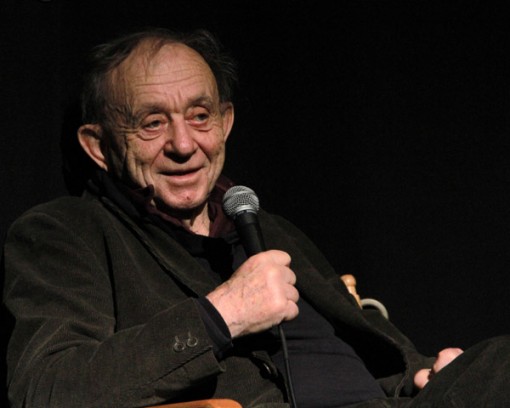
Frederick Wiseman speaks at Stranger Than Fiction. Photo by Tony Voisin.
The pattern of dehumanization and humiliation documented by Frederick Wiseman in TITCUT FOLLIES (1967) prefigures the abuses committed by the U.S. military at the Abu Ghraib prison in Iraq by some 30 years. That knowledge makes the film, already disturbing enough on its own, even more difficult to consider; it seems the brutalization of the prisoners at the Bridgewater State Hospital for the Criminally Insane plays out a power dynamic destined to be repeated time and again. Wiseman’s film is an unblinking catalog of the mistreatment that man can commit against fellow human beings who have been shorn of their free will. The most damning evidence of the complete moral failure by the state of Massachusetts to care for their charges came from the state itself, when the Massachusetts Supreme Court ordered the film banned and the negative destroyed on the grounds that Wiseman had violated obscenity laws and privacy concerns in making it. It took 25 years for that ruling to finally be fully overturned. What still remains to be resolved is how the cycle of prisoner abuse can be escaped. Following the screening, friend of Stranger Than Fiction Hugo Perez spoke with Wiseman. Click “Read more” below for the Q&A.
Steve James at the Cinema Eye Honors awards ceremony. Photo by Simon Luethi.
Steve James is having a pretty good week. Despite being overlooked by the Academy, the accolades continue to pile up for his critically lauded film, THE INTERRUPTERS. First James cleaned up at Wednesday’s Cinema Eye Honors (CEH), becoming the first filmmaker to win the awards for both best direction and best nonfiction feature. Then on Thursday, the Directors Guild of America (DGA) named him a nominee for its award for Outstanding Directorial Achievement in Documentary.
After taking the stage to accept his CEH award for best direction, James made sure to thank his subjects, two of whom were in attendance. “On this film, it was just an incredibly inspiring experience spending a year plus on the streets with the interrupters themselves,” James said. “Their courage and honesty and belief in this film, and the work that they do is one of the most inspiring experiences I’ve ever had in my life.”
The CEH crowd also honored Judith Hetherington, mother of late photojournalist and filmmaker Tim Hetherington, with a standing ovation after she accepted the award for best short film for Hetherington’s DIARY. “He’s a huge loss, and to honor his life, his friends and family and all those that he touched are committed to helping other students, fellow artists and those in the Third World so that they can benefit from his legacy,” she said.