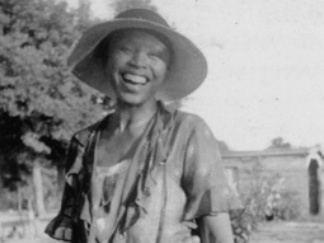
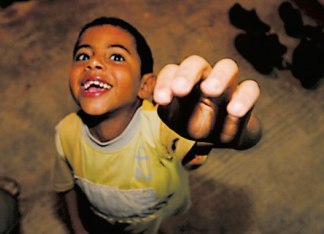
One aspect of this past weekend’s Margaret Mead Festival at the American Museum of Natural History was to celebrate the life and work of Franz Boas. Boas was a pioneer in the field of anthropology and Zora Neale Hurston was one of his students at Columbia University. Hurston was an anthropologist, folklorist and novelist in her own right and is most famous for her novel “Their Eyes Were Watching God”. The panel Visions of Zora Neale Hurston celebrated her anthropological work, showing selections of Hurston’s own footage taken in 1928-1929 in Eatonville, Florida, making Hurston one of the earliest documentarians. Hurston was most interested in every day African-American life and although most of her films are lost to us, panel member Elaine Charnov was able to show short selections of Hurston’s work. The clips showed young children playing as well as older men at work. Photographer Deborah Willis and Lonnie Graham also shared their work on Hurston and their own photographic documentation of life in Eatonville, Florida, Hurston’s home town. Professor Willis included in her presentation, an excerpt of a correspondence between Hurston and Boas while Hurston was working on her book “Of Mules and Men”. She wrote, “Is it safe for me to say that baptism is an extension of water worship as a part of pantheism just as the sacrament is an extension of cannibalism? Isn’t the use of candles in the Catholic church a relic of fire worship?” One wishes that more of Hurston’s films had been preserved and that there had been more time to hear about her work.
Written by Nicole Alicia Watson
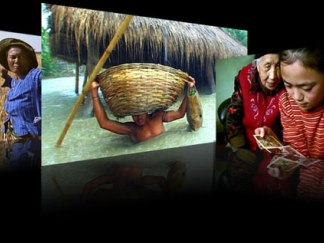
If waiting until Tuesday seems like a long time to get your next documentary fix, STF recommends the Margaret Mead Film and Video Festival. The Festival runs through November 16 at the American Museum of Natural History. This international film festival screens films on a wider range of topics. Two films, PEACE WITH SEALS and MARCH POINT deal with climate change and environmental protection. David MacDougall’s film GANDHI’S CHILDREN, follows the lives of 181 orphans at The Prayas Children’s Home for Boys. The festival includes NY premiers of films such as THROW DOWN YOUR HEART, a film about banjo great Bela Fleck and his travels throughout Tanzania, Uganda, Mail and the Gambia in search of the African roots of the banjo and Edward S. Curtis’ 1914 silent film, IN THE LAND OF THE HEAD HUNTERS. The film depicts the lives of First Nation people before their encounters with Europeans. This film will be accompanied by the Coast Orchestra, a Native American classical ensemble conducted by Timothy Long. On Sunday, I will be going to see VISIONS OF ZORA NEALE HURSTON, a presentation and panel discussion on Hurston’s own work as a filmmaker. See you there.
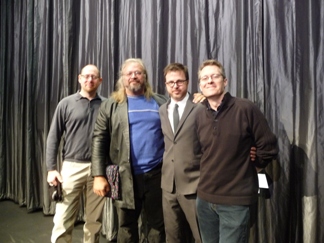
A sold-out crowd welcomed Keven McAlester’s film THE DUNGEON MASTERS to the IFC last night. Audience members included film subject Scott Corum, members of the band Blonde Redhead (who provided the film’s score) and many avid film-lovers and “D&D”ers.
The Q&A included producer Jeff Levy-Hinte of Antidote Films, Corum, McAlester (L to R, see photo) discussing their different perspectives on the filmmaking. Watching over a year of his life compressed into the 90 minute film, Corum said: “it was like a trip to Disney Land in 5 minutes, and a car crash that lasts 2 hours.”
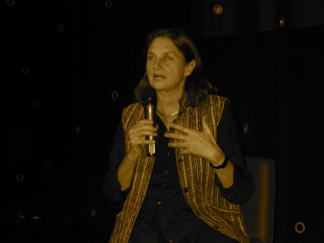
Last night the IFC Center screened PICTURES FROM A REVOLUTION by Susan Meiselas (see photo) as part of their Still to Film: Moving Images by Documentary Photographers series. The film begins with Meiselas’ gentle voice leading us down the road of the Nicaraguan countryside, her car a visiting shadow upon the landscape. She speaks slowly and deliberately and as she explains her project – to return to Nicaragua a decade after the Final Insurrection and find the men and women she had photographed ten years earlier – I got a sense that she had a deep connection to her subject matter and a need to understand her role as a documentary photographer within the war-torn country.
Starting today and running through November 13, The 2nd Annual Other Israel Film Festival will take place at The Jewish Community Center (JCC) in Manhattan and Cinema Village. The purpose of the festival is to present films that celebrate the diversity of Israeli life, with a specific focus on the daily lives of the Arab Citizens who are rarely seen outside the context of the Israeli-Palestinian conflict.