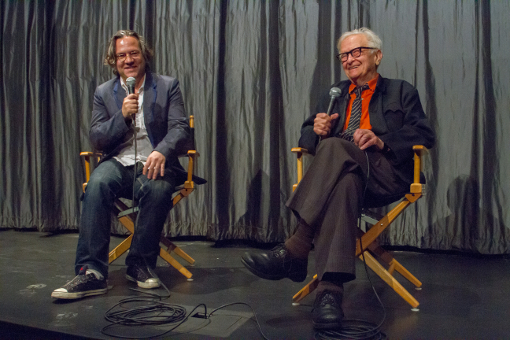
From left, Hugo Perez and the inimitable Albert Maysles. Photo by Simon Luethi.
In choosing a focal point for their seminal direct cinema film SALESMAN, directors the Maysles Brothers and Charlotte Zwerin could not have picked a more compelling protagonist than Bible salesman Paul “The Badger” Brennan. A textbook example of a tragic hero, Brennan’s fatal flaw is that he’s a salesman who lacks the ability to close a sale. Over the course of the film, The Badger’s hangdog look becomes his default mode of expression, the corners of his mouth perpetually pulling down the rest of his face as he slides deeper into depression. His failures eventually culminate in an emotional outburst directed toward a pair of prospective Bible buyers resistant to his hard-sell technique. The scene encapsulates the complexities of life that the Maysles Brothers so masterfully captured on film, reading as equal parts tragedy and black comedy. Following the screening, friend of Stranger Than Fiction Hugo Perez spoke with director Albert Maysles. Click “Read more” below for the Q&A.
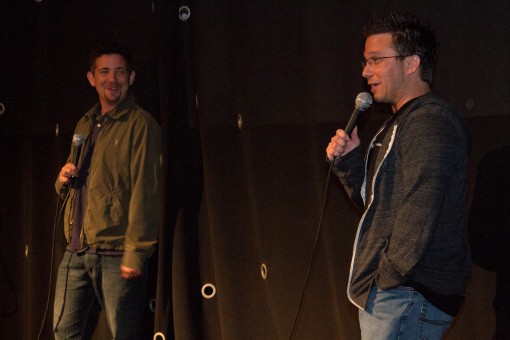
COCAINE COWBOYS producer Alfred Spellman and director Billy Corben. Photo by Simon Luethi.
Originally titled “City Made of Snow”, director Billy Corben’s COCAINE COWBOYS makes use of archival television reports chronicling the bloodshed and mayhem between rival Columbian and Cuban cocaine distribution cartels on the streets of Miami in the early 1980s. With its darkly humorous intercutting of tourist TV spots and grisly file footage, the film plots a methodical time line of illicit activity in the Miami region, beginning with the shift from Marijuana importing to the more lucrative cocaine trade.
Cocaine trafficker John Roberts, professional pilot Mickey Munday and Columbian enforcer Jorge “Rivi” Ayala tell the tales of their roles in the cocaine industry from three distinct standpoints. Roberts as the New Yorker relocating to Miami for a new start and on the run from the mob, Munday as local boy and technical brains behind the operation and Ayala as hired killer for the head of one of the fiercest Columbian cartels in Miami.
To counter these three major personalities, several members of law enforcement and local government tell a similar tale of the transformation of a once-sleepy retirement haven to the wide open criminal haven that eventually gained notoriety as “the most dangerous place on earth.” Adding a 1980’s revival soundtrack supplied by Jan Hammer—composer of the original Miami Vice theme—the place and purpose of the era is successfully recreated stylistically.
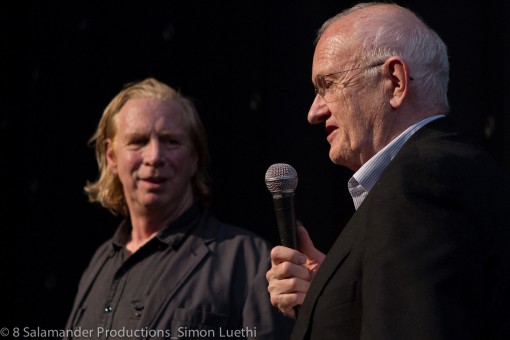
From left, FEED directors Kevin Rafferty and James Ridgeway. Photo by Simon Luethi.
Jerry Brown angrily fusses with his hair, Bill Clinton practices his petulant bottom-lip biting and George H.W. Bush glibly chats with off-screen staffers as they all prepare for their closeup in 1992’s FEED by directors James Ridgeway and Kevin Rafferty. The film combines traditional media footage from interviews, photo ops, general campaign hand-shaking and baby-hoisting with a behind-the-scenes window into candidates’ makeup application and review of talking points.
After first working together on BLOOD ON THE FACE, the critically-acclaimed 1991 adaptation of Ridgeway’s book of the same title, Ridgeway and Rafferty headed to New Hampshire to begin work on FEED. Citing his love of the documentary work of Frederick Wiseman, Rafferty recalled the inspiration he received after watching BASIC TRAINING for the first time in 1972. After watching the work of Wiseman, Rafferty embarked on a career in film and documentary.
FEED’s main element is the B-roll or off-camera moments that are deftly captured by Brian Springer from his satellite monitoring in Buffalo, NY, combined with Rafferty’s on the ground footage from New Hampshire. Springer during the 1988 presidential campaign had come up with the technique of pirating the satellite uplink material footage from the major television networks. Because these bits of material were cut from broadcast, they were essentially “electronic garbage” and were free to be used in the film.
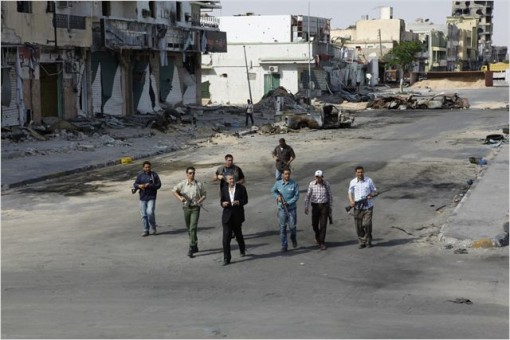
The Weinstein Co. bought the U.S. rights to the Bernard-Henri Levi doc THE OATH OF TOBRUK about the 2011 Libyan revolution at Cannes.
It’s that time of year when the filmic-minded turn their thoughts to the French Riviera, specifically the French commune of Cannes. Indiewire’s Anne Thompson noted that Cannes this year focused its attention on Hollywood docs and big names like Ken Burns in an effort to boost its star power. Elsewhere, there seemed to be critical consensus that Laurent Bouzereau’s doc ROMAN POLANSKI: A MEMOIR was something of a disappointment. The Guardian’s Peter Bradshaw found that it focused too much on the 1977 incident in which Polanski was alleged to have had sex with an underage girl. David Rooney at The Hollywood Reporter described the film as both “workmanlike” and “pedestrian.” Perhaps that tepid critical response is good news for filmmaker Marina Zenovich, who is now working on ROMAN POLANSKI: ODD MAN OUT, which will focus on the efforts to have Polanski extradited to the U.S. to face the statutory rape charges.
Fatih Akin’s POLLUTING PARADISE, about the ecological perils faced by a Turkish village, also received a mixed reception from critics after its Cannes screening. At Screen Daily, Dan Fainaru said the film could have benefitted from “a tighter cut, focusing much more on the issues at hand and a bit less on local colour, would deliver a much more meaningful punch, possibly shaking the complacency out of some official boots.” Neil Young of The Hollywood Reporter found the film to be “heartfelt,” but also “formally conventional small-screen fare.”
Ken Burns is also using Cannes to premiere his latest film, THE CENTRAL PARK FIVE. Our own Thom Powers is set to interview Burns on Wednesday, May 23 at Cannes. Burns this week was also the subject of a short film by Sarah Klein and Tom Mason, called KEN BURNS: ON STORY, that premiered on The Atlantic’s website.
The big doc news this week came on Wednesday, May 9, when it was announced that PBS had agreed to reschedule its doc shows POV and Independent Lens, moving them from the viewing hinterlands of Thursday night to Monday evenings at 10 p.m. In addition, PBS said it would develop a new multimedia film fest that would showcase films from both programs, set to launch in mid-2013. For the season beginning in June, POV would still air on Thursdays, but both would make the switch to Mondays starting with Independent Lens’ new season in October. In a blog post, POV described the announcement as a “great day.” And the New York Times’ Media Decoder Blog spoke to Gordon Quinn of Kartemquin Films, the production house that led the lobbying effort to get the shows moved from Thursday nights, where Independent Lens’ ratings had declined precipitously.
PBS on May 2 had also announced that it would produce a three-episode, six-hour series chronicling the experiences of Latinos in the U.S. from 1800 until the 21st century. Emmy Award winner Adriana Bosch was tapped as the series producer.
The POV blog also had the time this week to recap the Twitterthon hosted by SundanceNOW on May 9, which featured our own Thom Powers (@ThomPowers), along with @SundanceNOW, Programmer and doc blogger Basil Tsiokos (@1basil1) and Christopher Bell of Indiewire’s The Playlist (@ThePlaylist). The conversation should still be archived and searchable on Twitter under the #SundanceNow hashtag.