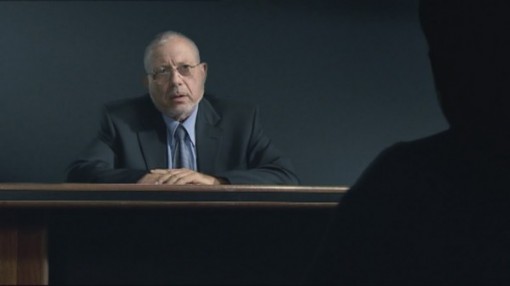
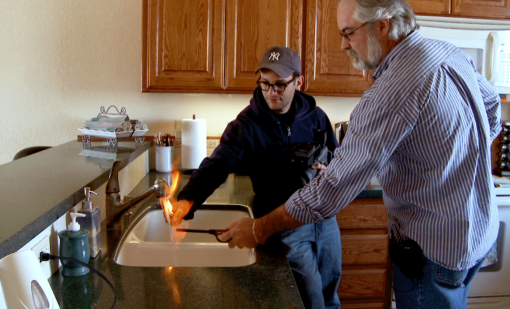
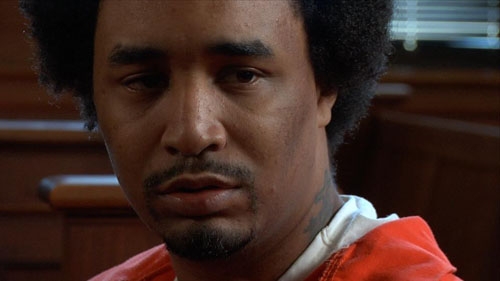
A still from THE LAW IN THESE PARTS, which won Sundance’s world cinema grand jury documentary prize.
In our second roundup of reviews coming out of Sundance, we’ll take a look at THE HOUSE I LIVE IN; THE LAW IN THESE PARTS; and THE IMPOSTER. But first we wanted to point out the running diary of BBC Storyville editor Nick Fraser’s Sundance experience at Britain’s The Guardian newspaper. Fraser during a panel discussion spoke on whether docs are able to change the world. “I say they don’t, or rarely, and probably only in ways we can’t measure, though that doesn’t mean that we shouldn’t want them to do so,” he writes.
Eugene Jarecki’s THE HOUSE I LIVE IN, a look at the wide-ranging effects of the U.S.’s failed War on Drugs, impressed Sundance jurors enough to take home the festival’s documentary grand jury prize.
Writing for The Hollywood reporter, John DeFore said the film balances “big-picture stats with personal perspectives, it should connect solidly with viewers at a moment when it seems possible to change public attitudes.”
Working methodically, Jarecki’s nearly two-hour film views the war from a number of perspectives too great to summarize here. Crucially, while he speaks to academics who have long argued for drug-law reform, he also goes to those most directly involved in enforcing the laws: a U.S. District Court judge in Iowa, an Oklahoma corrections officer who’s an avowed law-and-order man; numerous narcotics officers. They tell him variations of the same thing: Our laws aren’t working to decrease drug use; we’re putting too many people away for too long and doing too much harm to their families.
GASLAND director Josh Fox (left) was arrested attempting to videotape a House subcommittee meeting on fracking.
Documentary news this week was dominated by the arrest of Oscar-nominated director Josh Fox at a House subcommittee meeting on Wednesday. Fox was reportedly shooting the meeting as part of his work on the sequel to GASLAND, his investigation of the environmentally destructive practice of hydraulic fracturing, or “fracking,” used to extract natural gas. The congressional hearing was held to discuss an Environmental Protection Agency report on the effect of fracking practices in Pavillion, Wyoming. According to media reports, Fox has had increasing trouble attending congressional meetings on the controversial practice of fracking ever since the Republicans seized control of the House in the 2010 elections. Raw footage of his arrest is below.
Fox, who was charged with unlawful entry, and was processed and released later that day. He subsequently released a statement to the press which read, in part:
As a filmmaker and journalist I have covered hundreds of public hearings, including Congressional hearings. It is my understanding that public speech is allowed to be filmed. Congress should be no exception. No one on Capitol Hill should regard themselves exempt from the Constitution. The First Amendment to the Constitution states explicitly “Congress shall make no law…that infringes on the Freedom of the Press”. Which means that no subcommittee rule or regulation should prohibit a respectful journalist or citizen from recording a public hearing.
One of the most talked about docs out of Sundance was Lauren Greenfield’s THE QUEEN OF VERSAILLES.
We thought we’d take a look at some of the recent reviews of Sundance docs that came out over the past few weeks. Even before the festival had begun, Lauren Greenfield’s THE QUEEN OF VERSAILLES was grabbing press coverage after she and Sundance were sued by one of her subjects, David Siegel, who alleged that he had been defamed in the festival’s promotional descriptions of the film. All the publicity may have helped the film, about the rise and fall of one family’s economic fortune, snag its North America distribution deal with Magnolia Pictures.
The Hollywood Reporter’s John DeFore described the film as “a particularly lurid look at pathological excess.”
To a certain extent, Greenfield gives her subjects enough rope to hang themselves as they moan over their diminished economic clout: David paints a picture of callous bankers who, having made him addicted to cheap credit, are now yanking the rug out; Jackie whines that she thought the federal bank bailout was supposed to eventually benefit “the common people … us.” The lack of self-awareness is staggering. But it’s also clear that on some level Greenfield likes these boors—that she gives them more credit than they deserve for small virtues, and bizarrely views their hyperbolic selfishness as a crystallization of the American Dream.
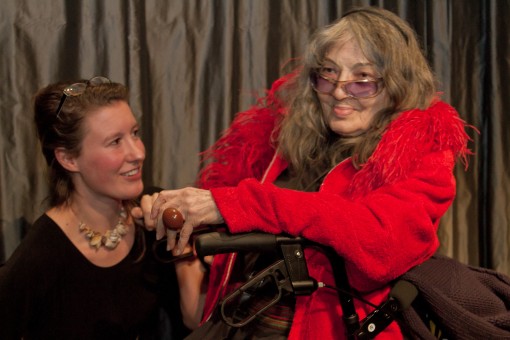
From left, filmmaker Corrine van der Borch and artist Bettina. Photo by Simon Luethi.
One of capitalism’s massive blind spots lies in its inability to assign proper value to a society’s social and cultural artifacts. Sometimes those artifacts are living, breathing people, as is the case with artists Bettina and Taylor Mead. Thematically, Corrine van der Borch’s GIRL WITH BLACK BALLOONS and Jeffrey Wengrofsky’s THE PARTY IN TAYLOR MEAD’S KITCHEN are linked by their devotion to those artists, who themselves are completely committed to their art. Mead, the scion of a political dynasty who transformed himself into a scion of beatnik royalty, is completely forthright about his desire to seek absolute freedom in his life, even if it meant chaining himself to poverty. Both Mead and Bettina are living examples of the costs of an artist’s single-minded devotion to their work, but also an illustration of the exquisite beauty that can be found in a life lived in service of an idea, instead of a dollar. Following the screenings, Stranger Than Fiction Artistic Director Thom Powers spoke first with Mead and Wengrofsky, and then with Bettina and van der Borch. Click “Read more” below for the Q&As.
Still from The House I Live In, by Eugene Jarecki, which took home Sundance’s documentary Grand Jury Prize.
The doc buzz was bleeding out of Park City this past week, with the Twittersphere seemingly anointing a new “Best Doc of Sundance” almost every night. At the end of it all, Eugene Jarecki left Utah with the documentary Grand Jury Prize for his film, THE HOUSE I LIVE IN, an investigation of the U.S.’s failed War on Drugs. The documentary World Cinema Jury Prize went to Ra’anan Alexandrovicz for THE LAW IN THESE PARTS, which examines the Israeli military justice system in use in the Occupied Territories and was produced under Laura Poitras’s outfit, Praxis Films. Indiewire has a complete list of festival prize winners.
While sales for docs started out strong, they tapered off soon after. Sundance Selects on January 26 picked up the North American rights for HOW TO SURVIVE A PLAGUE, the David France-directed film about AIDS activists. Brooke Barnes at the Times took a look at the solid, but not extraordinary sales deals made during Sundance’s, and the outsized expectations that had preceded the festival’s kickoff. His conclusion? Cooler heads are prevailing this year in terms of purchases. “One reason that the art house sector has gone through such a difficult retrenchment in recent years involves ever-escalating prices; as buyers started to spend more for quirky pictures, they also had to spend more on marketing to assure a bigger audience, and the economics of the business started to implode,” Barnes writes.
At Filmmaker magazine, Tom Hall says that Sundance docs show the new and profound importance that artistry in non-fiction storytelling has. “It is no longer enough to be an impassioned advocate for a cause or a subject; there are so many filmmakers who have developed into great visual storytellers that the bar has been raised to new and welcome heights,” he writes.