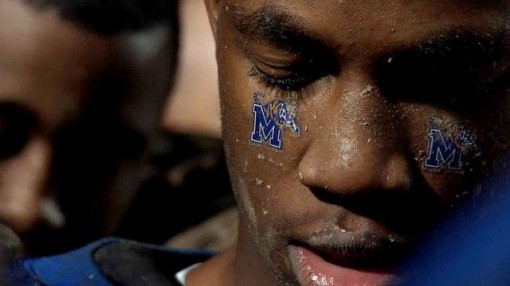
T.J. Martin and Dan Lindsay’s football doc UNDEFEATED took home the Oscar for best documentary feature yesterday.
Stranger Than Fiction and DOC NYC alums T.J. Martin and Dan Lindsay emerged from the Oscars with the statuette for best documentary feature for UNDEFEATED (hopefully guaranteeing them entry to the infamous Vanity Fair party). The pair no doubt benefited from distribution through The Weinstein Company (TWC), well known for its Oscar campaigns. UNDEFEATED was considered something of an underdog against Joe Berlinger and Bruce Sinofsky’s PARADISE LOST 3: PURGATORY, which documented the release of the West Memphis Three. The Oscar win caps off a great start to 2012 for Martin and Lindsay, who picked up Sean “Diddy” Combs as an executive producer on the film a few weeks ago, and also got word that plans for a narrative remake of UNDEFEATED was in the works.
Also last night, Sharmeen Obaid-Chinoy and Daniel Junge won the Oscar for best documentary short for their film SAVING FACE, about a plastic surgeon who helps women in Pakistan attacked with acid recover from their injuries. With the win, Obaid-Chinoy became the first Pakistani to receive an Academy Award.
In other awards news, Steve James continued to add to his pile of accolades for THE INTERRUPTERS, winning the Film Independent Spirit Award for best documentary on Saturday. James said he felt the award was “a great endorsement from the independent film community on the value of the film.”
The Motion Picture Association of America (MPAA) on February 23 denied an appeal made by the The Weinstein Company (TWC) that the rating for Lee Hirsch’s doc BULLY be changed from R to PG-13. The MPAA cited the film’s use of “some language” in its rationale. TWC co-chairman Harvey Weinstein harshly criticized the decision, which would prevent it from being shown in schools. Weinstein later released a statement saying TWC was “considering a leave of absence from the MPAA for the foreseeable future,” adding that the BULLY decision was “a bridge too far.” The ratings disagreement brings to the fore criticisms regarding what some see as the MPAA’s arbitrary ratings criteria, a position explored in the Kirby Dick-directed doc THIS FILM IS NOT YET RATED.
TOOTIE’S LAST SUIT director Lisa Katzman. Photo by Ruth Somalo.
The photographer Michael P. Smith once described the Mardi Gras Indians of New Orleans as “a classic example of a submerged culture quietly serving the spiritual needs and interests of a tightly knit traditional community.” The Indians have always existed foremost for their immediate neighborhoods, a seeming anachronism of hyperlocality in the interconnected global age. But Lisa Katzman’s TOOTIE’S LAST SUIT shows us that everyone has a tremendous amount to learn from the Mardi Gras Indians, some of whom trace their artistic lineage to the Yorubas of West Africa. Centering on Big Chief Allison “Tootie” Montana of the Yellow Pocahontas tribe—known in the Crescent City as the chief of chiefs—Katzman’s film delves beyond the anthopological, exploring the generational tension between Tootie and his son, Darryl, the ostensible successor to his mantle. The film also works as a stand-in conversation for the complicated issues of class and race that New Orleans is struggling with post-Katrina. Following the screening, Stranger Than Fiction Artistic Director Thom Powers spoke with Katzman. Click “Read more” below for the Q&A.
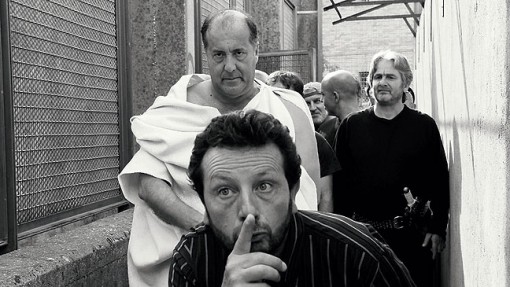
CAESAR MUST DIE, by brothers Paolo and Vittorio Taviani, won the Golden Bear Award at this year’s Berlinale.
Documentaries made a decent showing at the Berlin International Film festival. Brothers Paolo and Vittorio Taviani left the Berlinale with the festival’s top prize, the Golden Bear, for their documentary CAESAR MUST DIE, a look at inmates in a Roman prison rehearsing for a performance of Shakespeare’s Julius Caesar.
At Movieline, Stephanie Zacharek wrote of CAESAR MUST DIE, “The picture is stark and alive in its simplicity; rendered mostly in black-and-white, it’s gorgeous to look at—you could practically use it as an illustrated textbook on framing and composition.”
Sometimes the Tavianis draw the parallels between art and life a little too starkly. We don’t really need to hear the inmates reflecting on how Julius Caesar speaks to them when we can see how, in their proto-method-acting way, they bring every scrap of their experience to rehearsal: They touch each other warily but tenderly; when it’s time for a character to draw a knife, you can tell the actors respect it as both a weapon and a symbol, even though it’s presumably made out of plastic. You can bet these guys know a lot about duplicity and betrayal and power struggles, and they bring all of that to bear as they tangle with this challenging material, and with each other.
Woody Allen’s mockumentary ZELIG and Dana O’Keefe’s AARON BURR, PART 2 have in common a dedication to characters lost to history. ZELIG is prescient in its foretelling of a person lacking any defining characteristic who is nonetheless celebrated as an artifact of mass culture, then discarded and forgotten about (Jon and Kate, anyone?). O’Keefe, for his part, in AARON BURR, PART 2 explores a revisionist history of his titular character, but displaces period setting in favor of the present. Both films question the criteria by which our society celebrates its heroes, and defames its villains. After watching them, one can’t help but consider that what might be of paramount importance today, in 100 years might just be a parking lot in Weehawken. Following the screening, Stranger Than Fiction Artistic Director Thom Powers spoke with Dana O’Keefe and actor/score composer Alex Kliment. Click “Read more” below for the Q&A.
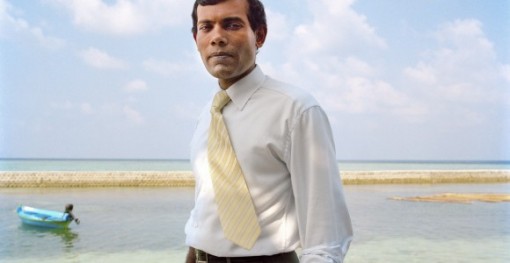
President Mohamed Nasheed, the subject of THE ISLAND PRESIDENT, was deposed this week.
Jon Shenk’s well-received film THE ISLAND PRESIDENT took on an urgent relevance this week, after news broke that Mohamed Nasheed, the president of the archipelego nation of the Maldives, had resigned on February 7, reportedly at gunpoint. Shenk’s film center’s on the struggles of Nasheed, a former rights activist and the first democratically elected leader of the Maldives, to draw attention to the threat posed to his country by rising sea levels resulting from climate change. News reports out of the Maldives indicate that officials loyal to former dictator Maumoon Abdul Gayoom have since effectively seized control of the government. The New York Times has an overview of the turmoil here.
The Times on February 8 published on its website an op-doc by Shenk containing excerpts from THE ISLAND PRESIDENT that can be viewed here. Shenk also released a statement to the press about Nasheed’s ouster, which read in part, “This is not the first time that Nasheed has suffered a political setback in his fight for justice in the Maldives. We expect this is just the next chapter. We are deeply concerned for Nasheed’s safety, we stand in solidarity with him and hope others will join us.”
In news closer to home, Documentary Fortnight 2012, the Museum of Modern Art’s nonfiction film festival, is set to begin February 16 and run until February 28. MOMA describes the program as a “selection of international feature-length and short documentaries from around the world represents the wide range of creative categories that extend the idea of the documentary form and reflect on new areas of nonfiction practice.” The complete eclectic schedule can be found here. (Hardcore doc watchers may want to consider springing for a MOMA membership.)