When United States Marine Corps Master Sgt. Jerry Ensminger’s daughter Janey fell ill and died of leukemia at the age of nine, he was devastated. For years after, he found himself seeking answers to how such a sudden illness could occur in a healthy child. After watching a local news broadcast detailing possible water contamination during his family’s time at Camp Lejune, the largest military installation on the east coast and home base of the U.S. Marine Corps, he began to dig for answers and uncovered one of the largest water contamination incidents in U.S. history.
After years of painstaking research, and relying on only a second-hand computer and a dial-up modem, Ensminger built his case and eventually brought it to Washington. Venturing from his single-wide trailer to Capitol Hill for the first time, he recalled that he “felt like a vacuum cleaner salesman.” His initial efforts led to a full-page article in the Washington Post, and a slot testifying before Congress in 2004. The film, Semper Fi, which follows his journey, is a intensely crafted narrative that captures the raw emotion of the loss of loved ones to a completely preventable tragedy, the fight against government bureaucracy and one father’s search for truth. To continue reading, click “Read more” below.
[Photo: from left, director Rachel Libert and Jerry Ensminger, courtesy of Simon Luethi]
Initially uninterested in attending what he surmised would be a boring dance recital, a 1985 performance of Pina Bausch’s “Cafe Mueller” changed filmmaker Wim Wenders’ preconceptions about dance. Wenders was soon proposing a film collaboration with her company, but felt he lacked the technical skill to capture the movements on-screen. Twenty years later, in 2007, he finally discovered the technology that would allow him to capture the enchanting and engrossing performances he had seen decades earlier on film.
Intercutting archival footage of Bausch in performance and in her studio with solo and group performances, Wenders’ film Pina allows the length and intensity of the pieces to follow the tone that each of his interviews takes with members of Bausch’s dance troupe. We watch as they reminisce, celebrate and exalt the woman who had drawn so much from them, and given so much back to them as performers and as people.
The dancers are shot in locales as varied as the precipice of a massive canyon in Germany’s Bergisches Land region, to the Wuppertal suspension railway for the solos in “Kontakthof.” All the while, Alain Derobe’s 3-D sterographic cameras move effortlessly from the interior stages at the Wuppertal Opera House to the exterior expositions with an eye to movement, sound and pacing that only Wenders could produce.
Renowned dance critic Deborah Jowitt joined Stranger Than Fiction Artistic Director Thom Powers for the post-screening audience question and answer, and said that what was most unique about Bausch was that “she was created worlds on stage.” Bauch’s introduction to U.S. audiences occurred during a period in which modern dance had moved away from narrative, but the worlds that she created were different than any Jowitt had previously seen.
When asked what her reaction to Bausch’s initial New York appearances was, Jowitt explained, “I thought it was alarming, I thought it was playful, I didn’t really know what I thought about it at first. I was apprehensive, but there was so much strangeness and humor in it, right away you could see that she had certain structural ideas that you can see in how Wenders uses it in the film.”
Jowitt gave details on how exactly Pina was able to master “the idea of bringing stories out of her dancers,” by drawing on the experiences of each individual performer. “She would say, ‘Tell me the worst birthday you ever had,’ and she would then weave that into something, with talking, singing or gesturing.”
With regard to the challenge of capturing dance on film, Jowitt remarked that the success and strength of Wenders’ work lies in the fact that “he wanted to bring the audience into it, he wanted you to feel that you were in it. I think that is particularly suitable to Pina, because she does create these specific environments on stage.”
IFC opens “PINA” in limited release December 23.
You can read Deborah Jowitt’s article on Pinahere.
What happens when Frank Gehry wants to, as he says, “build a community from scratch,” on top of your existing community? Battle for Brooklyn chronicles that struggle as Prospect Heights residents wake up to find themselves living in the footprint of the planned Atlantic Yards development, a subsidy-soaked high profile construction project backed by a veritable whos-who of New York heavy hitters: Mayor Bloomberg, Chuck Schumer, Marty Markowitz, Jay-Z and the megaproject firm Forest City Ratner. The film serves as an important study of just how the lumbering juggernaut of crony capitalism moves through economic, social and political realms, flattening all opposition.
What drives the film are the machinations of these soundbite-dropping familiar faces, and the strong characters on both sides who lay out the facts as they see them. On the side of the long-time neighborhood residents, the cameras track Daniel Goldstein as he fights the strange battle that comes when powerful people want to take your home and build a stadium on top of it with your tax dollars. Bruce Bender, Executive VP at Forest Ratner, ostensibly makes the other side’s case, but somehow ends up making a pretty good argument that the dealings with those being driven from their homes are far from ethical. Bender looks close to winking when he’s singing the praises of the jobs to be created in telemarketing, VIP services and concessions by relieving small business owners in the project’s path of their property and livelihood. There’s also a meta-character hovering around in the background—Eminent Domain—that is both seen and unseen, a figure with nearly limitless potential to destroy that only shows up in the text of court rulings and the cute jokes that elected officials make about stealing property.
There’s an implicit honesty to the film’s lack of slickness. The camera shakes, the audio drops out at times or gets drowned by the truck horns and demolition crews. These flaws mark it as a document made by a situation, a response to a crisis, and not a detached eye hovering above the little people. Flawed in no way means inept: I challenge any other filmmaker to eke as much tension out of a shot of a man sitting at his computer, hitting ‘refresh’ on a web browser over and over. It all adds up to a careful, patient refutation of the claim made by Bloomberg at the film’s midpoint, “You have Bruce Ratner’s word; that should be good enough.”
After the film, primary subject Daniel Goldstein described the film as being essentially about the government and developers “working together to deny people their rights…. an issue that cuts across the political spectrum.” Director Michael Galinsky concurred, citing the strange allies the struggle brought together. (Both conservative columnist George Will and civil liberties attorney Norman Siegel appear in the film.) “It’s not left, it’s not right. It’s just wrong.”
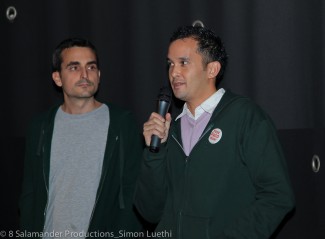
[Photo: from left, director Michael Galinsky and producer David Beilinson, courtesy of Simon Luethi]
Viewers of Mila Turajlic’s film Cinema Komunisto might be surprised to learn that Yugoslavia’s state-run Avala Film Studios was not dedicated solely to enlarging the cult of personality surrounding Joseph Broz Tito, although it certainly did not shrink from that task. Relying on copious amounts of research and a trove of archival material, Truajlic’s film shows us Comrade Tito the cinephile—one who watched a film almost every day, and transformed his Yugoslavia into a prolific locus of filmmaking, for both artistic and propagandistic purposes. The heart of the film lies in the scenes bearing Tito’s personal projectionist, Leka Konstantinovic. In a powerful moment, Konstantinovic is shown arriving at Tito’s old estate in Belgrade for the first time in decades, where he ceremoniously hands over his key to the property to its current caretaker, who receives the gift with relative indifference. From the front, the house, though lacking a door, appears to be relatively intact. It’s only when Konstantinovic goes inside that he, and the viewer, discover that the projected reality of the edifice’s facade masks a hollowed out shell of little substance. Following the screening, Stranger Than Fiction Artistic Director Thom Powers spoke with David Leitner, a scholar and filmmaker, and Bosnian artist Shoba. Click “Read more” below for the Q&A.
[Photo: from left, David Leitner and Shoba, courtesy of Simon Luethi]
Give Up Tomorrow follows in the tradition of some of the most powerful documentaries ever made, those dedicated to the exoneration of individuals convicted of crimes they did not commit. In the film, director Michael Collins and producer Marty Syjuco tell the story of Paco Larrañaga, a self-admitted juvenile delinquent accused of raping and murdering two young women in the Philippine island of Cebu in 1997. The only problem? Larrañaga was about 350 miles away from Cebu, in Manila, at the time he was supposed to have carried out the murders, as attested to by some 35 peers and instructors at the culinary institute where he studied at the time. Larrañaga found himself facing a government conspiracy of murky origins, intent on not only imprisoning him for his accused crimes, but on taking his life as well. He was also quickly convicted in the court of public opinion thanks to sensationalist media coverage that focused less on doing any investigation, and more on prurient details spoonfed to them by a compromised Philippine criminal justice system. Following the screening, Stranger Than Fiction Artistic Director Thom Powers spoke with Collins and Syjuco. Click “Read more” below for the Q&A.
[Photo: from left, director Michael Collins and producer Marty Syjuco, courtesy of Simon Luethi]






 When United States Marine Corps Master Sgt. Jerry Ensminger’s daughter Janey fell ill and died of leukemia at the age of nine, he was devastated. For years after, he found himself seeking answers to how such a sudden illness could occur in a healthy child. After watching a local news broadcast detailing possible water contamination during his family’s time at Camp Lejune, the largest military installation on the east coast and home base of the U.S. Marine Corps, he began to dig for answers and uncovered one of the largest water contamination incidents in U.S. history.
 Initially uninterested in attending what he surmised would be a boring dance recital, a 1985 performance of Pina Bausch’s “Cafe Mueller” changed filmmaker Wim Wenders’ preconceptions about dance. Wenders was soon proposing a film collaboration with her company, but felt he lacked the technical skill to capture the movements on-screen. Twenty years later, in 2007, he finally discovered the technology that would allow him to capture the enchanting and engrossing performances he had seen decades earlier on film.
 What happens when Frank Gehry wants to, as he says, “build a community from scratch,” on top of your existing community?
  Viewers of Mila Turajlic’s film