Oscar-winner Alex Gibney’s latest doc, The Last Gladiators, opens with a close-up of hockey enforcer Chris Nilan’s scarred, broken hands. In a matter-of-fact voiceover, Nilan systematically ticks through the injuries his fleshy mitts saw over the course of his career, hammering home the casual relationship the former Montreal Canadien developed with violence early in life. The role of enforcer is unique in the world of U.S. professional sports, lacking an analog in any of the other major professional leagues. Charged with provoking violence to deter the game plan of their opponents, or to protect the interests of star players on their own team, enforcers are a rare breed, and it could be argued that Nilan is their beau ideal. But the lifestyle of being a hired gun on the ice clearly takes its toll on the psyches of these men. There’s an eerie parallel between the enforcers of the NHL and soldiers at war. Both are trained to cultivate their most aggressive character traits, thereby improving their chances of survival in their respective environments. But neither is taught how to reintegrate into wider society when the fighting is over, maybe because no one knows how. Following the screening, Stranger Than Fiction Artistic Director Thom Powers spoke with director Alex Gibney and producer Larry Weitzman. Click “Read more” below for the Q&A.
[Photo courtesy of Jigsaw Productions]
STF is having a special eight-week fall season that kicks off next Tues. Sept. 27 and runs through Nov. 22 (note – we skip a week on Nov. 8 for DOC NYC). Early-bird season passes are available through Sept. 27 and cost $80 ($60 for IFC members). We hope you join us!
Full line-up below:
THE LAST GLADIATORS (2011)
FALL SEASON OPENING NIGHT – Tues. Sept. 27 @ 8pm
Q&A with director Alex Gibney
The Dixie Chicks were at the height of their popularity in 2003, when lead singer Natalie Maines told a London audience that she was ashamed that President George W. Bush was from Texas, sparking a controversy that would leave the trio taking heavy fire on the battlefield of the U.S.’s culture wars. Barbara Kopple and Cecilia Peck’s expertly helmed film, Shut Up & Sing, shows us the fallout from that off-cuff remark—which fundamentally changed the lives of the performers—examining what happens when art produced for a mass audience runs full-bore into the overheated rhetoric of the political world. As the conservative country music industry turns to eat its young, Maines seems genuinely confused and angry, but not enough to stop her from apologizing for her comment and dismissing it as a blatant attempt to pander to an anti-war audience. On the other side, we see Dixie Chick decriers denouncing Maines’s statement as—what else?—an assault on American ideals, oblivious to both the uselessness and irony of their protests. In a stunningly sharp insight, band member Martie Maguire crystallizes the controversy surrounding the Chicks, noting that it was perfect, allowing conservative demagogues a focal point at which jingoists could direct their vitriol, and providing the anti-war movement with a potent symbol of patriotic dissent from heartland America. Shut Up & Sing raises interesting questions about our expectations of our entertainers, and makes a solid case that—at least for musicians—unfettered economic success and freedom of speech are, at times, mutually exclusive. Following the screening Stranger Than Fiction friend Hugo Perez spoke with co-director Barbara Kopple, editors Bob Eisenhardt and Jean Tsien, and producer David Cassidy. Click “Read more” below for the Q&A.
[Photo: from left, editor Jean Tsien and director Barbara Kopple, courtesy of Simon Luethi]
Soul Power plays like a 70s R&B/Soul field trip to Africa, intermittently meandering through the shadow of the delayed Ali-Foreman fight and the kleptocratic rule of Zairean strongman Mobutu Sésé Seko. B.B. King, The Spinners, Bill Withers, James Brown and too many others to list all came to Kinshasa in 1974 for a three day concert, an event that was supposed to coincide with Muhammed Ali’s comeback fight with George Foreman, which was chronicled in Soul Power‘s big brother, the 1996 documentary When We Were Kings. It has the flashbulbs, press conferences, backstage camaraderie and amazing performances that a concert film with a narrative arc promises and does it better than most. There’s plenty of bright spots of pure entertainment—backstage cultural exchange and flirtation, the goofy candidness of watching a shirtless Bill Withers dig into his breakfast steak next to Ali pontificating on freedom—but the film doesn’t flinch from putting images front and center that remind you that this carnival is taking place under an authoritarian regime—lines of soldiers, four-story high portraits of Mobutu, the faces of the front row viewed through barbed wire.
What we’re all showing up for, though, is James Brown. We know it, the film knows it, and the first thing you get is a long piece of The Great Black Leader and the opening shouts of Soul Brother Number One. This is rhinestones and mustache era James Brown, a year after The Payback and backed up by the J.B.s., seeming at the same time to be fully in command of his talents and a little distant from the machinery of fame that swirls around him. The closing shot (by Albert Maysles) that follows J.B. from the stage to his dressing room perfectly captures this transformation from World Touring Superstar Sex Machine to tired man who just wants to have a few moments to himself right now, thank you.
Soul Power came about after director Jeffrey Levy-Hinte had the “nagging feeling we were committing some sort of cultural crime” in putting aside so much great footage of the music of Zaire 74 after editing When We Were Kings. Serendipity helped too, with film stock choices back in ‘74 resulting in a nearly miraculous incorruptibility of the original negative 30 years later, giving Levy-Hinte 177 hours of footage to pore over and select. He claims there may even be a third documentary in there from all the verite sequences of life in Kinshasa that have so far gone unused.
[Photo: Director Jeffrey Levy-Hinte, courtesy of Simon Luethi]
Stringing together a narrative that scans like a solid heist flick, the film Better This World by directors Katie Galloway and Kelly Duane de la Vega explores the actions of David McKay and Bradley Crowder, a pair of young, idealistic radical activists who, in the leadup to the 2008 Republican National Convention in Minneapolis-St. Paul, constructed several gasoline bombs that they never used. Following an early morning police raid, the pair were arrested and labeled domestic terrorists by the government, then prosecuted as such. Clearly sympathetic to McKay and Crowder, Duane de la Vega and Galloway laudably grant federal investigators and prosecutors ample screen time in which they present a reductive picture of the two defendants as domestic terrorists. But it’s a picture that doesn’t gibe with the evidence uncovered by the filmmakers, which bolsters the claim that McKay and Crowder were led to potentially violent action by an undercover FBI informant. What makes the film truly chilling is the questions it raises regarding the role the government itself plays in creating these so-called terrorists, and the complicity of law enforcement informants acting as agents provocateur. Following the screening, friend of Stranger Than Fiction Hugo Perez spoke with director Katie Galloway. Click “Read more” below for the Q&A.
[Photo: Director Katie Galloway, courtesy of Simon Luethi]






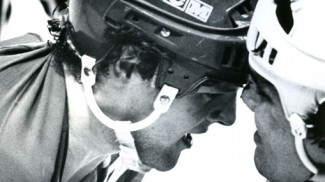 Oscar-winner Alex Gibney’s latest doc, The Last Gladiators, opens with a close-up of hockey enforcer Chris Nilan’s scarred, broken hands. In a matter-of-fact voiceover, Nilan systematically ticks through the injuries his fleshy mitts saw over the course of his career, hammering home the casual relationship the former Montreal Canadien developed with violence early in life. The role of enforcer is unique in the world of U.S. professional sports, lacking an analog in any of the other major professional leagues. Charged with provoking violence to deter the game plan of their opponents, or to protect the interests of star players on their own team, enforcers are a rare breed, and it could be argued that Nilan is their beau ideal. But the lifestyle of being a hired gun on the ice clearly takes its toll on the psyches of these men. There’s an eerie parallel between the enforcers of the NHL and soldiers at war. Both are trained to cultivate their most aggressive character traits, thereby improving their chances of survival in their respective environments. But neither is taught how to reintegrate into wider society when the fighting is over, maybe because no one knows how. Following the screening, Stranger Than Fiction Artistic Director Thom Powers spoke with director Alex Gibney and producer Larry Weitzman. Click “Read more” below for the Q&A.
 The Dixie Chicks were at the height of their popularity in 2003, when lead singer Natalie Maines told a London audience that she was ashamed that President George W. Bush was from Texas, sparking a controversy that would leave the trio taking heavy fire on the battlefield of the U.S.’s culture wars. Barbara Kopple and Cecilia Peck’s expertly helmed film,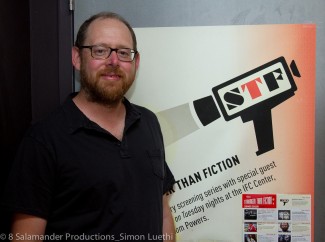
 Stringing together a narrative that scans like a solid heist flick, the film