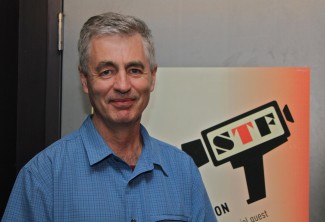
Several times in Stevie, director Steve James directly acknowledges his own ethical precariousness in making the film, and the line-straddling he does between self-professed benefactor to subject Stevie Fielding, and exploitative filmmaker. The access gained by James allows for an incredibly full picture of Fielding, which has the unsettling effect of blurring empathy and sympathy for the film’s central character—who is both the perpetrator of heinous sexual crimes and a victim of them. In the film, blame for the emotional damage that leaves Fielding remorseless for his offenses is spread thin. There is Fielding himself, who shows little reflection on his crime and declines to seek treatment for his problems. There is his mother, who physically abused him before emotionally (and literally) abandoning him. There is his grandmother, who manipulates Fielding’s emotions as a proxy battlefield from which to launch blows at his mother, an archrival. And there is the state foster care system that failed to protect him, leaving him vulnerable to sexual assaults that likely planted the seeds for his own predation. James too, gets in on the action, self-flagellating when admitting that he abandoned a young Fielding when his filmmaking pursuits required it. A minor character in the film invokes truth, as well as cliche, in noting that it takes a village to raise a child. Stevie shows us an disturbing picture of what it looks like when that village reacts to the vulnerable with something too close to indifference, allowing the cycles of abuse to continue unbroken. Following the screening, Stranger Than Fiction Artistic Director Thom Powers spoke with James. Click “Read more” below for the Q&A.
[Photo: Director Steve James, courtesy of Simon Luethi]
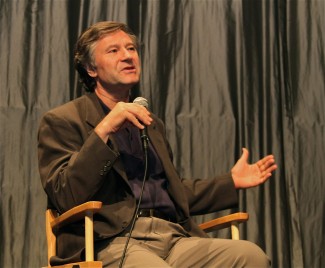
I look at the human sciences as poetic sciences in which there is no objectivity, and I see film as not being objective, and cinema verite as a cinema of lies that depends on the art of telling yourself lies. If you’re a good storyteller then the lie is more true than reality, and if you’re a bad one, the truth is worse than a half lie.
-Jean Rouch
It would be interesting to learn what the subjects of 16 In Webster Groves, if asked today, think of the storytelling skills of Arthur Barron, the film’s producer. Alone, the film is an interesting portrayal of a prototypical upper middle class, largely white American suburb of a certain time period. But in tandem with 16 In Webster Groves Revisited, Barron’s project takes on a self-reflexiveness that is also an examination of the documentary process, particularly that sort practiced by network news film crews of the era. In the latter film, Barron examines the effect that observation has had on both the observed and the observer. The films shun the traditional “objective” model of journalism, as well as the strict observational direct cinema practices being pioneered by the Drew Associates production company around the same time. Seen as one unit, the films have more in common with the French cinema verite approach, in which the filmmaker is an actor (though not necessarily on-camera) whose presence and influence is made clear to the viewer. In 16 in Webster Groves Revisited, narrator/reporter Charles Kuralt pulls back the production curtain to show viewers still photos of the cameraman in action, a technique intended to draw attention to the filmmakers’ manipulation of reality. Barron uses the setting of Webster Groves High School to implicitly criticize attitudes about class stratification, the perils of capitalism, political apathy, and racial segregation. For Barron, investigating the high school as an analogy for Webster Groves’ wider society is something like pulling apart a matryoshka doll—piercing one layer yields another almost identical to its precursor, only smaller in scale. Following the screening, Stranger Than Fiction Artistic Director Thom Powers spoke with Ron Simon, a curator at the Paley Center for Media. Click “Read more” below for the Q&A.
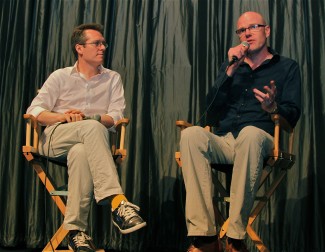
If anyone ever needed further proof of Donald Trump’s narcissism, greed and inflated self-regard, You’ve Been Trumped will supply the necessary evidence in spades. In the film, director Anthony Baxter set out to document Trump’s development of a massive golf resort in an ecologically sensitive sand dune region in Scotland, and returned with a chronicle of his outright hostility to the plight of a small group of nearby property owners deemed by the business tycoon as a threat to his development. If Trump, during his quixotic quest for the presidency, ever pledged support for the American ideal that life, liberty and the pursuit of happiness are rights to be enjoyed by all, the film has certainly provided testimony for the opposite. Baxter’s film several times references the fictional narrative Local Hero, a film by Scottish director Bill Forsyth released in 1983 that foresaw the deleterious effects that American greed might have on the Scottish coast. However, in that film, the developer has a change of heart, and agrees to relocate an oil refinery to preserve a coastal town. One can’t hold out much hope that life will imitate art in Trump’s case. Following the screening, Stranger Than Fiction Artistic Director Thom Powers spoke with Baxter. Click “Read more” below for the Q&A.
[Photo: From left, Thom Powers and director Anthony Baxter, courtesy of Simon Luethi]
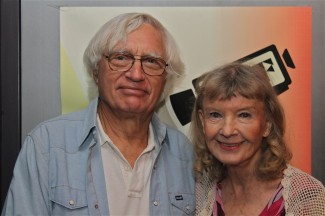
Seeking to combat the growing tide of anti-American sentiment overseas, President John F. Kennedy in 1961 founded the Peace Corps in part to present an alternative vision of the ”Ugly American” stereotype that had taken root in several corners of the world. By 1963, the year the film Mission to Malaya was shot, the Peace Corps had already dispersed some 6,500 volunteers across 46 countries. In the film, Drew Associates producer Hope Ryden zeroed in on two of these volunteers—one young woman who was finishing a two-year stint working as a nurse in a remote corner of Malaysia, and another who was to replace her. A rarely screened example of the nascent direct cinema movement of the time, the film functions both as a snapshot of the earnestness of the era, and a cinematic portrait of the idealism of youth. Following the screening, Stranger Than Fiction Artistic Director Thom Powers spoke with Ryden, along with the film’s cinematographer, Sidney Reichman. Click “Read more” below for the Q&A.
[Photo: from left, Sidney Reichman and Hope Ryden, courtesy of Simon Luethi]
From San Francisco to New York to Jerusalem, the film Between Two Worlds covers half the globe in the scope of its investigation into American Jewish identity. The filmmakers, Alan Snitow and Deborah Kaufman, begin the film with an incident registering as both personal and public, as they are battered by forces on the left and the right seeking to censor the San Francisco Jewish Film Festival, founded by Kaufman in 1980. From there, they explore a battle in public and private over Jewish identity and even what questions can be asked. Who gets to speak for a community? Who qualifies for inclusion in the tribe? How does one reconcile a strong tradition of advocating for social justice with support for the state of Israel? Does it make you a traitor to even ask that question?
Throughout the film’s 70 minute running time, we hear from scholars, rabbis, activists and others engaged in these debates, while also taking a guided tour through the family histories of Kaufman and Snitow. The personal touch argues for nuance and variety in America Jewishness, folding into the same family a Zionist arms smuggler, a convert to Islam and a suburban ex-Communist.
In a Q&A where the audience had more statements than questions, Snitow said the primary purpose of Between Two Worlds was to encourage young people to speak up, ask questions, and not feel silenced or inauthentic when entering the conversation about Jewish identity and Israel. Kaufman concurred, outlining the film’s aim—and the aim of all documentary filmmaking—as “undermining absolutes” and arguing for more complexity rather than the black and white world pushed by bullies and censors.
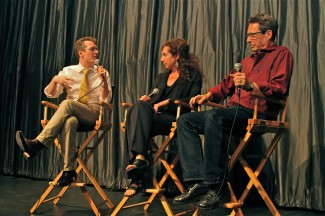
[Photo: From left, Stranger Than Fiction Artistic Director Thom Powers and directors Deborah Kaufman and Alan Snitow, courtesy of Simon Luethi]






 Several times in Stevie, director Steve James directly acknowledges his own ethical precariousness in making the film, and the line-straddling he does between self-professed benefactor to subject Stevie Fielding, and exploitative filmmaker. The access gained by James allows for an incredibly full picture of Fielding, which has the unsettling effect of blurring empathy and sympathy for the film’s central character—who is both the perpetrator of heinous sexual crimes and a victim of them. In the film, blame for the emotional damage that leaves Fielding remorseless for his offenses is spread thin. There is Fielding himself, who shows little reflection on his crime and declines to seek treatment for his problems. There is his mother, who physically abused him before emotionally (and literally) abandoning him. There is his grandmother, who manipulates Fielding’s emotions as a proxy battlefield from which to launch blows at his mother, an archrival. And there is the state foster care system that failed to protect him, leaving him vulnerable to sexual assaults that likely planted the seeds for his own predation. James too, gets in on the action, self-flagellating when admitting that he abandoned a young Fielding when his filmmaking pursuits required it. A minor character in the film invokes truth, as well as cliche, in noting that it takes a village to raise a child. Stevie shows us an disturbing picture of what it looks like when that village reacts to the vulnerable with something too close to indifference, allowing the cycles of abuse to continue unbroken. Following the screening, Stranger Than Fiction Artistic Director Thom Powers spoke with James. Click “Read more” below for the Q&A.
 I look at the human sciences as poetic sciences in which there is no objectivity, and I see film as not being objective, and cinema verite as a cinema of lies that depends on the art of telling yourself lies. If you’re a good storyteller then the lie is more true than reality, and if you’re a bad one, the truth is worse than a half lie.
 If anyone ever needed further proof of Donald Trump’s narcissism, greed and inflated self-regard,
  Seeking to combat the growing tide of anti-American sentiment overseas, President John F. Kennedy in 1961 founded the Peace Corps in part to present an alternative vision of the ”Ugly American” stereotype that had taken root in several corners of the world. By 1963, the year the film Mission to Malaya was shot, the Peace Corps had already dispersed some 6,500 volunteers across 46 countries. In the film,
  From San Francisco to New York to Jerusalem, the film