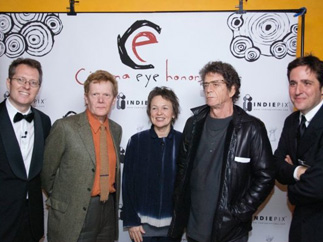
Cinema Eye Honors pulled off its third annual event celebrating documentary craft and innovation in multiple categories. The ceremony, held at the auditorium in the New York Times building, was co-hosted by AJ Schnack and Esther Robinson and featured an array of doc luminaries as presenters including Barbara Kopple, Albert Maysles and Peter Davis. The night’s big winners were THE COVE (Best Feature, Cinematography, Production), Agnes Varda (Best Director), THE SEPTEMBER ISSUE (Audience Award), and OCTOBER COUNTRY (Best Debut, Composer). See Indiewire for the full list of winners.
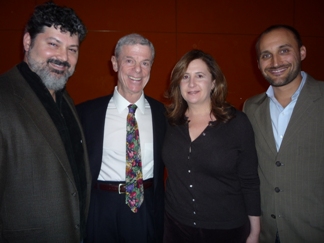
After the ceremony, the party moved down 41st Street to the Arena nightclub. Pictured on top are presenters Carl Deal and Tia Lessin (TROUBLE THE WATER), flanking Peter Davis (HEARTS & MINDS) with Amir Bar-Lev (THE TILLMAN STORY) on right.
This month brings so many Top 10 film lists, it makes me nostalgic for the days of media monopolies. When only a few critics had a platform, I recall more passionate debate about neglected or over-rated films. Nowadays when venues like Indiewire are polling over 100 critics, there is scarcely a film that won’t end up on somebody’s list. Sure, the proliferation of list-making spreads around more recognition. But I wonder if it carries us further away from serious reflection. Rarely, do I see critics elaborate on how they arrived at their choices. In his book “Reverse Angle,” John Simon lamented the whole enterprise:
There is something antithetical to the very notion of criticism in the concept of a ten-best list: it is almost as deplorable as reviewing a movie by meting out to it one of four stars….
Criticism at best, of course, is only a set of subjective opinions. But it is opinions expounded at some length: explained, illustrated with examples and quotations, supported with comparisons and contrasts to other works, related to certain standards of aesthetics and even ethics, and viewed in a larger context of human life.
Having aired this misgiving, I’ll now proceed to flout it with my own list. For me, half of the experience of a film is to discuss it afterwards. So, continuing my tradition from last year, I’ve adapted the exercise of list-making to recall my favorite events in 2009 where those conversations took place.
1) SUNDANCE FILM FESTIVAL (January) – I was privileged to be a juror for the World Documentary Competition and wrote about that experience here. Over the course of the year, STF audiences got to enjoy a few stand out titles from that section: THE GLASS HOUSE, TIBET IN SONG, and BIG RIVER MAN.
2) WILLIAM GREAVES TRIBUTE AT STF (February) – No STF show ever caused as much of a ticket frenzy as the tribute to the pioneering filmmaker William Greaves. On the Monday before the show, when there were no more tickets to be had, I spent the day fielding desperate calls from luminaries trying various means to coax or bully an extra ticket. The most tactless was a downtown festival programmer who was an exemplar of entitlement and ingratitude. Much more gracious was Steve Buscemi who expected no special treatment and purchased a ticket in advance. At one point, I answered the phone to be greeted by the voice of Sidney Poitier. For him, I would have found a ticket. But he was in Los Angeles and merely wanted to send a note to be read in his absence. The lucky ticket holders were treated to clips from several of Greaves’ works including EMERGENCY WAR, THE FIGHT and SYMBIOPSYCHOTAXIPLASM: TAKE ONE, followed by a conversation with Elvis Mitchell, Orlando Bagwell and Thomas Allen Harris.
STF’s Winter Season features sneak previews of new films such as SNOWBLIND and THE ART OF THE STEAL combined with classic revivals such as the RUNNING FENCE (1978) and DAVID HOLZMAN’S DIARY (1967). The revelations begin with two pre-season screenings of films honored on “the shortlist”, WHICH WAY HOME about child migrants traveling through Mexico on freight trains (on Jan 5); and VALENTINO: THE LAST EMPEROR, chronicling the end of an era in fashion (on Jan 11). As always at STF, the directors will be in attendance for a Q&A and the conversation continues afterward at a nearby bar.
The official 10-week Winter Season begins on Jan 12 with the Opening Night presentation of SNOWBLIND, directed by Vikram Jayanti, following its audience-pleasing premiere at the Toronto International Film Festival. Jayanti has a long and diverse documentary career with credits as co-producer of WHEN WE WERE KINGS and director of JAMES ELLROY’S FEAST OF DEATH and GAME OVER: KASPAROV AND THE MACHINE. In this new work, he follows Rachel Scdoris, a 23-year-old adventurer who competes in the grueling Iditarod dogsled race despite her handicap of being legally blind. Jayanti, who normally divides his time between London and Los Angeles, will join us to recount the incredible stories behind the making of this film.
When Allan King died at the age of 79 last May, I was struck by how difficult it was to find opportunities to screen his films. MoMA curator Laurence Kardish gave him an excellent retrospective in 2007, but other opportunities are hard to come by – at least in the United States. (In Canada, King’s native country, he has a more prominent reputation). After his death, I was contacted by the Canadian filmmaker Astra Taylor (EXAMINED LIFE) who graciously offered to help coordinate a King tribute for Stranger Than Fiction. We chose his breakthrough title A MARRIED COUPLE (1969) that looks at the lives of a middle class pair trying to muddle through the social upheavals of their times. The film is a significant precursor to other documentary observations of domestic life such as AN AMERICAN FAMILY; SECOND TIME AROUND and so much of reality television.
For the post-screening discussion, Taylor was joined by film critic Dennis Lim who contributes to the New York Times and edits the indispensable on-line magazine Moving Image Source. In his remarks, Lim placed A MARRIED COUPLE in the context of John Cassavetes’ FACES which came out the year before. As for the ever vexing documentary question of whether the camera causes subjects to “perform,” Lim felt it was irrelevant since people are always performing whether its for a camera or each other.
Prior to the screening, I was concerned whether such an old film could attract an audience in the midst of holiday party season. Those fears were allayed by an enthusiastic crowd that filled nearly all of the seats in the IFC Center’s Theater 2. Audience members included Nancy Gerstman (Zeitgeist Films), David Sampliner (director of DIRTY WORK), and Michel Negroponte (whose latest film I’M DANGEROUS WITH LOVE will screen at STF on Dec 15).
STF’s house photographer Joshua Weinstein (director of FLYING ON ONE ENGINE) pronounced A MARRIED COUPLE “one of the best films screened this year.”
Director Amanda Micheli gave STF goers a special treat during the Q&A on Tuesday by phoning up the stunt woman-turned actress Zoe Bell. In Micheli’s film DOUBLE DARE, she follows the New Zealand native Bell in her early days as the stunt double for Lucy Lawless in XENA, then transitioning to a career in Hollywood under the mentorship of Jeannie Epper (best known for her stunts in WONDER WOMAN). Micheli reached Bell on the west coast and put her on speaker phone to participate in the Q&A. Recently, Bell has been transitioning to more acting roles, appearing in Quentin Tarantino’s GRINDHOUSE, Drew Barrymore’s WHIP IT!, and a new film with Wesley Snipes that just finished production. As part of this new phase of her career, Bell has been put in the unexpected position of having to use a stunt double, as she explained, to satisfy the “insurance” concerns of producers.






 Cinema Eye Honors pulled off its third annual event celebrating documentary craft and innovation in multiple categories. The ceremony, held at the auditorium in the New York Times building, was co-hosted by AJ Schnack and Esther Robinson and featured an array of doc luminaries as presenters including Barbara Kopple, Albert Maysles and Peter Davis. The night’s big winners were THE COVE (Best Feature, Cinematography, Production), Agnes Varda (Best Director), THE SEPTEMBER ISSUE (Audience Award), and OCTOBER COUNTRY (Best Debut, Composer). See Indiewire for the full list of winners.
 This month brings so many Top 10 film lists, it makes me nostalgic for the days of media monopolies. When only a few critics had a platform, I recall more passionate debate about neglected or over-rated films. Nowadays when venues like Indiewire are polling over 100 critics, there is scarcely a film that won’t end up on somebody’s list. Sure, the proliferation of list-making spreads around more recognition. But I wonder if it carries us further away from serious reflection. Rarely, do I see critics elaborate on how they arrived at their choices. In his book “Reverse Angle,” John Simon lamented the whole enterprise:
 STF’s Winter Season features sneak previews of new films such as SNOWBLIND and THE ART OF THE STEAL combined with classic revivals such as the RUNNING FENCE (1978) and DAVID HOLZMAN’S DIARY (1967). The revelations begin with two pre-season screenings of films honored on
  When
When 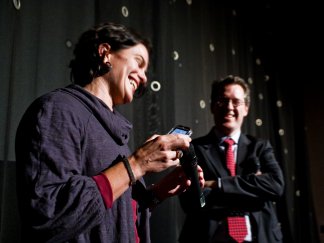 Director Amanda Micheli gave STF goers a special treat during the Q&A on Tuesday by phoning up the stunt woman-turned actress Zoe Bell. In Micheli’s film