The corners of the world populated by Formula 1 adherents were once rife with rumors of efforts to make a biopic of Ayrton Senna, with an actor serving as the famed driver. I, for one, am glad such a film was never made, as it might have prevented the production of director Asif Kapadia’s Senna, a gorgeous portrait of a complex and captivating man. Kapadia and his crew did some incredibly heavy lifting in making the film, combing through hundreds of hours of archival footage of Senna and his races in order to present a seamless edit of his life on and off the track, as well as his untimely death in 1994 during the Mexico Grand Prix. Senna is unarguably a champion—a rare melding of talent, charisma, drive and passion who transmutes himself into a people’s hero through a blending of achievement and circumstance. Following the screening, Stranger Than Fiction Artistic Director Thom Powers spoke with auto sports journalist Tom O’Keefe on the film and Senna’s life. Click “Read more” below for the Q&A.
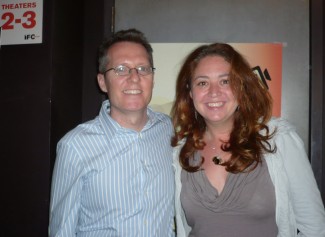
[Photo: Sports journalist Tom O’Keefe, courtesy of Simon Luethi]
You can add Bobby Fischer’s 1972 World Chess Championship match against Boris Spassky to the litany of proxy battles waged between the U.S. and Soviet Union during the Cold War. But despite being hailed as a national hero in the U.S. following his victory, one gets the sense from Liz Garbus’s film Bobby Fischer Against The World that Fischer played chess not in service of any particular political ideology. According to those interviewed in the film, Fischer’s motivation was simply the desire to be considered the best chess player in the world. Undeniably a complicated person, Fischer’s accomplishments and potential were later obscured by his declining mental health and tirades that were increasingly vitriolic in their anti-Semitism and anti-Americanism. But Garbus’s treatment of her subject is intimate enough to remind the viewer that at one point in time, Fischer was responsible for a wave of chess fever in the U.S. that even had broadcast networks dedicating their resources to covering the decidedly intellectual practice. It’s hard to imagine something like that happening today. Following the screening, STF Artistic Director Thom Powers spoke with Liz Garbus. Click “Read more” below for the Q&A.
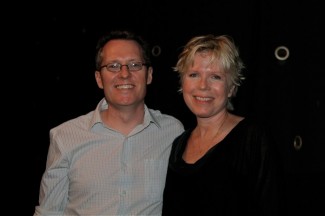
[Photo: From left, Thom Powers and Liz Garbus, courtesy of Cheree Dillon]
Like the film’s subject and namesake, the camerawork in Buck expertly captures the horses in the film as thinking creatures with their own emotional worlds by shooting them at eye level. It’s a telling technique that underscores the main thrust of what the film’s characters are trying to understand as they work with their horses. It’s the humans, though, that get the best lines and arguably the most transformative experiences in working with Buck Brannaman, who teaches clinics in Natural Horsemanship, an approach that replaces violently “breaking” a horse with “starting” a horse by establishing trust and building a true union between horse and rider.
Buck chronicles Brannaman’s path from a six-year-old professional trick roper in Corn Pops commercials to success running riding clinics worldwide—and even serving as the inspiration for the book and film The Horse Whisperer. It’s a story that comes out naturally, interspersed with Brannaman’s daily teachings in his clinics, and with archival film and photographs pulling in hints of his dark days as an abused child performer. The film’s structure handles this beautifully, building empathy while teaching, bringing in pieces of the story at just the right moments and lingering on the natural beauty of the horse and wide open spaces where Brannaman plies his trade.
Amazingly, this is director Cindy Meehl’s first film. Meehl first met Brannaman as a horse owner, recommended to one of his clinics by friends who vouched for his ability to transform not only the rider-horse relationship, but one’s approach to life too. While his approach stresses gentleness, “He is not easy on anybody,” Meehl said. “And we all like that.” Some of that drive and discipline no doubt paid off in the process of editing down the 300 hours of footage her crew shot over two and a half years.
[Photo: From left, Stranger Than Fiction Artistic Director Thom Powers and Director Cindy Meehl, courtesy of Simon Luethi]
In 1996, the well-financed developer juggernaut Pyramid Companies broke ground on a massive mall development project in West Nyack, New York, a tiny hamlet off the Hudson River. In Megamall, filmmakers Vera Aronow, Roger Grange and Sarah Mondale document the resulting tale of corporate tyranny writ small, and the efforts of a group of activists who arose to stop Pyramid from running roughshod over their community. The film’s subtext is one that’s become all too familiar since the 2008 economic downturn: what happens when the darker drives of capitalism begin to work at odds with the Democratic principles this country was founded upon? And what is the result on our cities and communities when the unbridled consumption of resources and goods is given free rein? All too often, it seems, it’s the little guy who is left to pay the costs. Following the film, Stranger Than Fiction Artistic Director Thom Powers spoke with Aronow, Grange and Mondale. Click “Read more” below for the Q&A.
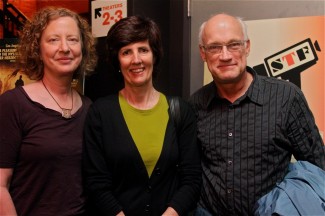
[Photo: From left, Directors Vera Aronow, Sarah Mondale and Roger Grange, courtesy of Simon Luethi]
The chronicle of American wars contains many smaller conflicts wedged in between the marquee names of World War II, Vietnam and Iraq. Director Barbara Trent’s film The Panama Deception reminds us that for the people being bombed, shot and terrorized by the invading war machine, there are no small wars. Using footage of explosions, charred bodies, and the leveled neighborhoods of the poor, The Panama Deception turns again and again back to the U.S. media’s sanitized version of the “intervention” that omitted everything but the U.S. government’s carefully controlled narrative. Interviews with ex-CIA analysts, investigative journalists, and Panamanians caught in the crossfire put the lie to that narrative, revealing the operation as a live-fire rehearsal for the wars of the 21st century, during which the U.S. tested new weapons on real people.
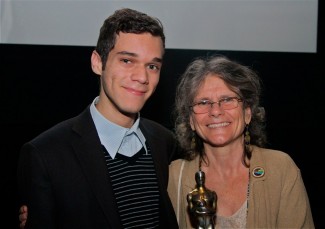
Barbara Trent was on hand, passing her Oscar statuette around, to provide the audience with context of the true goals of the Panama invasion, and to describe the fierce censorship she and her collaborators faced from an occupying force that sought to dodge the bad P.R. of collateral damage in moves that resulted in mass graves and media blackouts. Special guest Jean-Manuel Beauchamp—grandson of the invasion’s target, Panamanian President Manuel Noriega—also took questions from the audience about growing up in the aftermath of invasion and occupation, and the game of international politics that has kept his grandfather imprisoned.
[Photo: From left, Jean-Manuel Beauchamp and director Barbara Trent, courtesy of Simon Luethi]






 The corners of the world populated by Formula 1 adherents were once rife with rumors of efforts to make a biopic of Ayrton Senna, with an actor serving as the famed driver. I, for one, am glad such a film was never made, as it might have prevented the production of director Asif Kapadia’s Senna, a gorgeous portrait of a complex and captivating man. Kapadia and his crew did some incredibly heavy lifting in making the film, combing through hundreds of hours of archival footage of Senna and his races in order to present a seamless edit of his life on and off the track, as well as his untimely death in 1994 during the Mexico Grand Prix. Senna is unarguably a champion—a rare melding of talent, charisma, drive and passion who transmutes himself into a people’s hero through a blending of achievement and circumstance. Following the screening, Stranger Than Fiction Artistic Director Thom Powers spoke with auto sports journalist Tom O’Keefe on the film and Senna’s life. Click “Read more” below for the Q&A.
 You can add Bobby Fischer’s 1972 World Chess Championship match against Boris Spassky to the litany of proxy battles waged between the U.S. and Soviet Union during the Cold War. But despite being hailed as a national hero in the U.S. following his victory, one gets the sense from
  Like the film’s subject and namesake, the camerawork in
  In 1996, the well-financed developer juggernaut Pyramid Companies broke ground on a massive mall development project in West Nyack, New York, a tiny hamlet off the Hudson River. In
  The chronicle of American wars contains many smaller conflicts wedged in between the marquee names of World War II, Vietnam and Iraq. Director Barbara Trent’s film