Last night STF hosted a sold-out screening of Lucia Small and Ed Pincus’ documentary film THE AXE IN THE ATTIC. Lured by the added bonus of a free boxed DVD set of “THE KATRINA EXPERIENCE” (courtesy of Indiepix), patrons showed up an hour before the screening started.
The film was followed by a fun reception at 99 Below, featuring a tasty “Axe In The Attic Cocktail” which helped keep us going till the wee hours of the morning. Here are some pictures:
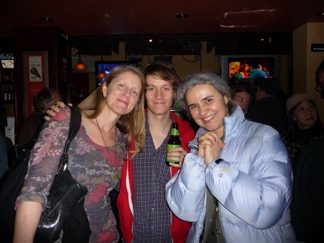
L to R: Director Lucia Small, filmmaker Robert Hatch-Miller and Pola Rapaport, director of WRITER OF O.
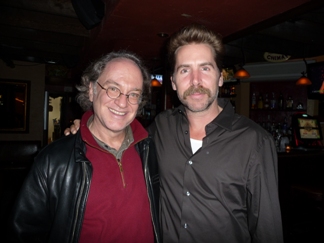
David Leitner and Ian Vollmer – coincidentally both have worked as DPs for Alan Berliner (Leitner on NOBODY’S BUSINESS and Vollmer on WIDE AWAKE). Berliner’s film INTIMATE STRANGER shows at STF on February 24.
Last night’s Stranger Than Fiction was Morgan Dews’ MUST READ AFTER MY DEATH, “a documentary about documentation” or in other words, Dews took his late Grandmother Allis’ home movies and audio tapes from the 1960s and constructed them into one cohesive story arc dealing with Allis’ unconventional relationship with her husband Charley and the psychological effects it had on their four children. The entire film is told through these documentations without any narration or talking heads. MUST READ AFTER MY DEATH, which debuted last fall at the Hamptons International Film Festival, will be distributed by Gigantic Releasing and opens Feb. 20 at Quad Cinema in New York. David Nugent, head programmer of HIFF, moderated last night’s discussion. Below are some of the highlights. (I have not included any of the audience Q&A because most of those questions pertain to specific things that go on in the film, and I don’t want to give too much away. You just have to see it for yourself.)
Nugent: How did you come across the tapes and what was it like the first time for you to listen to them?
Dews: I actually found out about the tapes really late. I always knew about the films, but my uncle’s ex-wife told me about the tapes…It was kind of shocking actually. I was very close to my grandmother…I was born about the end of the story. She in fact never really talked with me about Charley. She would talk with me about lots of other things…It was really crazy to hear this life that she had that I had no idea about.
Each summer as I review submissions for the Toronto International Film Festival, I look forward to receiving a big package of screeners from Sandra Buchta, who leads documentary promotion for German Films. Last year, she turned me on to HEART OF JENIN, a co-production of Germany and Israel. In addition, I receive German titles from other sources, such as UPSTREAM BATTLE that came straight from the director. It’s a healthy sign for a country’s output when the official organization can’t keep track of everything. Given so much production happening in Germany, Sandra does a fine job with staying on top of the national scene. Here’s how she responded to my three questions…
DESCRIBE THE TRADITION OF GERMAN DOCUMENTARY MAKING.
Sandra Buchta: In Germany there are two traditions of modern documentary filmmaking: one evolved in Eastern Germany, the other one in Western Germany. In the former GDR most documentary films were produced by the state-owned DEFA studio. Among the notable directors who created a distinct style are such names as Volker Koepp, Jürgen Böttcher and Thomas Heise. In Western Germany the documentary production was closely linked to the public broadcasters. The 60s and 70s were particularly fruitful and produced the rise of filmmakers such as Werner Herzog, Alexander Kluge or Hartmut Bitomsky, to mention a few. After 1989 these two traditions of documentary filmmaking crossed – and a new generation of filmmakers has been emerging since then.
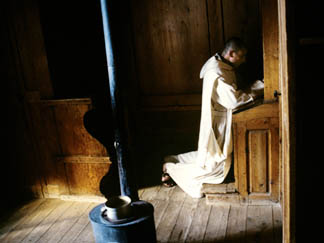
Three German documentary filmmakers who have had an impact on the documentary world: Werner Herzog – no comment necessary or if so, watch his latest film ENCOUNTERS AT THE END THE WORLD (by the way, not a German production). Volker Koepp – from his Wittstock-series in the 70s up to his last two films SONS and ELDER BLOSSOM in 2007, he has been exploring unknown Eastern territories and has introduced us to unforgettable protagonists such as Mr. Zwilling and Mrs. Zuckermann in a very unique and human approach. Philip Gröning – for creating a 3-hour-documentary about Carthusian monks which turned out to become not only an international festival-hit, but one of the most successful German documentaries in cinemas at home and abroad (INTO GREAT SILENCE, pictured).
My awakening to Brazil’s documentary scene came when I first saw Jose Padilha’s gripping BUS 174 (pictured) at the 2003 Sundance Film Festival. Since then, I’ve seen a smattering of other Brazilian docs and heard great things about the country’s festival It’s All True named after Orson Welles’ unfinished work. My colleague Diana Sanchez who programs Latin American films for the Toronto International Film Festival suggested that I reach out to the scholar Jose Carlos Avellar, who’s written extensively on Brazilian film and literature. (If you read Portuguese, visit his website escrevercinema.com).
In answering my simple questions, Avellar opens up a robust national cinema movement full of directors who were new to me, but whose work I’m eager to explore. I’ve linked several names and titles to other resources below to encourage further exploration.
DESCRIBE THE TRADITION OF DOC MAKING IN BRAZIL
Jose Carlos Avellar: Let me exaggerate a little: the tradition of modern Brazilian cinema is documentary. It goes beyond documentary films. Documentaries created the basis for the invention of Cinema Novo and its hand held camera narrative, where the filmmaker more or less improvised action as a kind of reporter. That is why many Cinema Novo directors cross between documentary and fiction. Among the documentaries from the sixties, we can keep the ones by the late Leon Hirszman and Joaquim Pedro de Andrade (who received a retrospective at the 2007 New York Film Festival); and most of the 28 films from the series “A Condição Brasileira” produced by Thomas Farkas – for example VIRAMUNDO and VIVA CARIRI! by Geraldo Sarno; and MEMORIES OF THE CANGAÇO by Paulo Gil Soares.
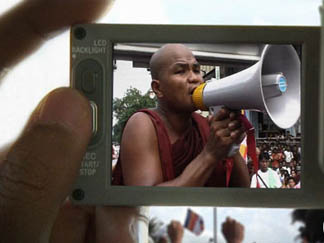
The Copenhagen festival CPH: DOX, run by Tine Fischer and Tine Mosegaard, has won enthusiastic reviews. I count myself among its admirers after serving on the fest’s 2007 jury. For such a small country, Denmark has made a big impact on the world documentary scene, most recently with BURMA VJ (pictured) which racked up awards at IDFA and Sundance after its November debut at CPH: DOX.
I asked the two Tines for their take on the Danish scene…
DESCRIBE THE TRADITION OF DOCUMENTARY MAKING IN DENMARK.
Tine Fischer & Tine Mosegaard: Thanks to a fantastic and exclusively Scandinavian history of public artistic support schemes, Denmark has an old and large tradition of documentary film making that has been – and is – in constant development. Supernovas in this ongoing development have been – and still are – filmmakers Jørgen Leth and Anne Wivel with the new generation coming from the Danish Film School. Pernille Rose Gørnkjær (THE MONASTERY); Phie Ambo (FAMILY and MECHANICAL LOVE); Eva Mulvad (ENEMIES OF HAPPINESS); Asger Leth (GHOSTS OF CITE SOLEIL); Max Kestner (THE WORLD IN DENMARK); and Mikael Noer (VESTERBRO). are all names within this generation.
If there is one filmmaker and one film we would like to point out though, it would have to be Lars von Trier and THE IDIOTS. A filmmaker working with cinema, not genres, a filmmaker who thinks through his films – and a film that radically pushes and breaks with boundaries between fiction and documentary.






 L to R: Director Lucia Small, filmmaker Robert Hatch-Miller and Pola Rapaport, director of WRITER OF O.
 David Leitner and Ian Vollmer – coincidentally both have worked as DPs for Alan Berliner (Leitner on NOBODY’S BUSINESS and Vollmer on WIDE AWAKE). Berliner’s film INTIMATE STRANGER shows at STF on February 24.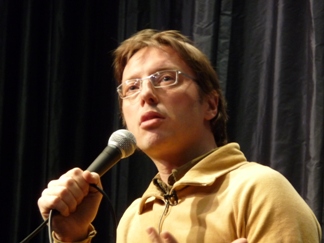
 Each summer as I review submissions for the Toronto International Film Festival, I look forward to receiving a big package of screeners from Sandra Buchta, who leads documentary promotion for
  My awakening to Brazil’s documentary scene came when I first saw Jose Padilha’s gripping BUS 174 (pictured) at the 2003 Sundance Film Festival. Since then, I’ve seen a smattering of other Brazilian docs and heard great things about the country’s festival
  The Copenhagen festival