If anyone ever needed further proof of Donald Trump’s narcissism, greed and inflated self-regard, You’ve Been Trumped will supply the necessary evidence in spades. In the film, director Anthony Baxter set out to document Trump’s development of a massive golf resort in an ecologically sensitive sand dune region in Scotland, and returned with a chronicle of his outright hostility to the plight of a small group of nearby property owners deemed by the business tycoon as a threat to his development. If Trump, during his quixotic quest for the presidency, ever pledged support for the American ideal that life, liberty and the pursuit of happiness are rights to be enjoyed by all, the film has certainly provided testimony for the opposite. Baxter’s film several times references the fictional narrative Local Hero, a film by Scottish director Bill Forsyth released in 1983 that foresaw the deleterious effects that American greed might have on the Scottish coast. However, in that film, the developer has a change of heart, and agrees to relocate an oil refinery to preserve a coastal town. One can’t hold out much hope that life will imitate art in Trump’s case. Following the screening, Stranger Than Fiction Artistic Director Thom Powers spoke with Baxter. Click “Read more” below for the Q&A.
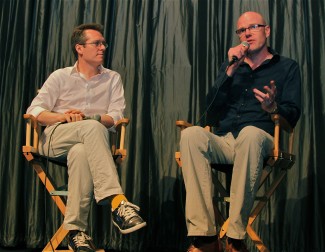
[Photo: From left, Thom Powers and director Anthony Baxter, courtesy of Simon Luethi]
Seeking to combat the growing tide of anti-American sentiment overseas, President John F. Kennedy in 1961 founded the Peace Corps in part to present an alternative vision of the ”Ugly American” stereotype that had taken root in several corners of the world. By 1963, the year the film Mission to Malaya was shot, the Peace Corps had already dispersed some 6,500 volunteers across 46 countries. In the film, Drew Associates producer Hope Ryden zeroed in on two of these volunteers—one young woman who was finishing a two-year stint working as a nurse in a remote corner of Malaysia, and another who was to replace her. A rarely screened example of the nascent direct cinema movement of the time, the film functions both as a snapshot of the earnestness of the era, and a cinematic portrait of the idealism of youth. Following the screening, Stranger Than Fiction Artistic Director Thom Powers spoke with Ryden, along with the film’s cinematographer, Sidney Reichman. Click “Read more” below for the Q&A.
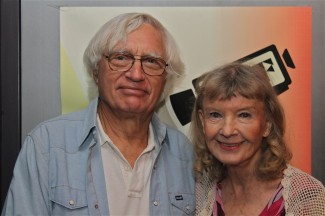
[Photo: from left, Sidney Reichman and Hope Ryden, courtesy of Simon Luethi]
From San Francisco to New York to Jerusalem, the film Between Two Worlds covers half the globe in the scope of its investigation into American Jewish identity. The filmmakers, Alan Snitow and Deborah Kaufman, begin the film with an incident registering as both personal and public, as they are battered by forces on the left and the right seeking to censor the San Francisco Jewish Film Festival, founded by Kaufman in 1980. From there, they explore a battle in public and private over Jewish identity and even what questions can be asked. Who gets to speak for a community? Who qualifies for inclusion in the tribe? How does one reconcile a strong tradition of advocating for social justice with support for the state of Israel? Does it make you a traitor to even ask that question?
Throughout the film’s 70 minute running time, we hear from scholars, rabbis, activists and others engaged in these debates, while also taking a guided tour through the family histories of Kaufman and Snitow. The personal touch argues for nuance and variety in America Jewishness, folding into the same family a Zionist arms smuggler, a convert to Islam and a suburban ex-Communist.
In a Q&A where the audience had more statements than questions, Snitow said the primary purpose of Between Two Worlds was to encourage young people to speak up, ask questions, and not feel silenced or inauthentic when entering the conversation about Jewish identity and Israel. Kaufman concurred, outlining the film’s aim—and the aim of all documentary filmmaking—as “undermining absolutes” and arguing for more complexity rather than the black and white world pushed by bullies and censors.
[Photo: From left, Stranger Than Fiction Artistic Director Thom Powers and directors Deborah Kaufman and Alan Snitow, courtesy of Simon Luethi]
What is perhaps most shocking about director Chad Freidrichs’ excellent film The Pruitt-Igoe Myth is how strongly the St. Louis Public Housing Authority’s policies toward the residents of the Pruitt-Igoe public housing projects smack of paternalism and social engineering of the worst sort. As the film shows us, the warped morality exuded by the authority yielded policies that tore fathers from their families, and even denied residents the freedom to own televisions. Part of President Harry Truman’s New Deal program, the Housing Act of 1949 sowed the seeds of the tower block public housing projects like Pruitt-Igoe that began to litter American cities following World War II. Often rationalizing the destruction of slums populated by the destitute as an effort to improve the “hygiene” of a city, the federal Public Housing Authority gave rise to the possibility of massive housing projects constructed according to Swiss architect Le Corbusier’s vein of modernist architecture. The failure of Pruitt-Igoe has often been presented as a failure of that architectural movement, but Freidrichs builds a compelling case that the causes of Pruitt-Igoe’s demise were multiple, complicated and likely unavoidable. Some were certainly the result of botched, top-down policymaking, but others were the fruit of the inexorable forces of economics. While Freidrich shines a light on the too-often ignored macro-level factors, where the film shines is in its dedication to telling the stories of those people whose lives were altered forever by them—the residents of Pruitt-Igoe themselves. Following the screening, Stranger Than Fiction Artistic Director spoke with Freidrichs. Click “Read more” below for the Q&A.
[Photo: Director Chad Freidrichs, courtesy of Simon Luethi]
The specter of Acapulco native Hilario “Long Dog” Martinez looms large over the characters in Carlos Hagerman’s film Vuelve A La Vida (Back to Life), but luckily for all involved, he is a benevolent spirit. A celebration of the late Martinez’s lust for life, the film is instilled with a number of themes that transcend the social constructs of culture and nationality—family, identity and belonging, to name a few. Vuelve A La Vida is also a story about stories, an acknowledgement of the power of communal narrative and the deep and prolonged impact that stories can have, even long after the storyteller is gone. Following the screening, Stranger Than Fiction Artistic Director Thom Powers spoke with Hagerman and Associate Producer Martha Sosa Elizondo. Click “Read more” below for the Q&A.
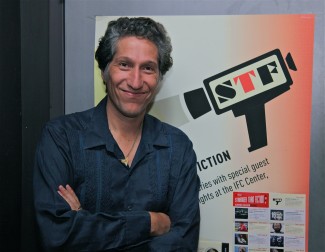
[Photo: Director Carlos Hagerman, courtesy of Simon Luethi]





 If anyone ever needed further proof of Donald Trump’s narcissism, greed and inflated self-regard, You’ve Been Trumped will supply the necessary evidence in spades. In the film, director Anthony Baxter set out to document Trump’s development of a massive golf resort in an ecologically sensitive sand dune region in Scotland, and returned with a chronicle of his outright hostility to the plight of a small group of nearby property owners deemed by the business tycoon as a threat to his development. If Trump, during his quixotic quest for the presidency, ever pledged support for the American ideal that life, liberty and the pursuit of happiness are rights to be enjoyed by all, the film has certainly provided testimony for the opposite. Baxter’s film several times references the fictional narrative Local Hero, a film by Scottish director Bill Forsyth released in 1983 that foresaw the deleterious effects that American greed might have on the Scottish coast. However, in that film, the developer has a change of heart, and agrees to relocate an oil refinery to preserve a coastal town. One can’t hold out much hope that life will imitate art in Trump’s case. Following the screening, Stranger Than Fiction Artistic Director Thom Powers spoke with Baxter. Click “Read more” below for the Q&A.
 Seeking to combat the growing tide of anti-American sentiment overseas, President John F. Kennedy in 1961 founded the Peace Corps in part to present an alternative vision of the ”Ugly American” stereotype that had taken root in several corners of the world. By 1963, the year the film Mission to Malaya was shot, the Peace Corps had already dispersed some 6,500 volunteers across 46 countries. In the film,
  From San Francisco to New York to Jerusalem, the film
  What is perhaps most shocking about director Chad Freidrichs’ excellent film
  The specter of Acapulco native Hilario “Long Dog” Martinez looms large over the characters in Carlos Hagerman’s film Vuelve A La Vida (Back to Life), but luckily for all involved, he is a benevolent spirit. A celebration of the late Martinez’s lust for life, the film is instilled with a number of themes that transcend the social constructs of culture and nationality—family, identity and belonging, to name a few. Vuelve A La Vida is also a story about stories, an acknowledgement of the power of communal narrative and the deep and prolonged impact that stories can have, even long after the storyteller is gone. Following the screening, Stranger Than Fiction Artistic Director Thom Powers spoke with Hagerman and Associate Producer Martha Sosa Elizondo. Click “Read more” below for the Q&A.