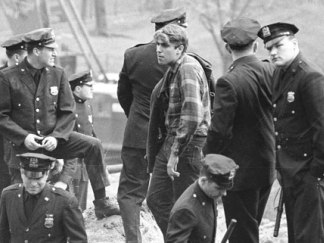
Last night flying to Copenhagen (where I hope to blog a report from CPH:DOX), I took the time to read Mark Rudd’s excellent memoir in anticipation of him coming to STF on Monday, Nov 16 for a special screening of THE WEATHER UNDERGROUND where he’ll be joined by filmmaker Bill Siegel. Last year, I had the chance to interview Rudd at the Toronto International Film Festival in conjunction with the epic work-in-progress documentary about the 1968 Columbia University student strike A TIME TO STIR. So I knew him to be thoughtful and self-critical. His book is full of lacerating reflections such as this:
After catching COPYRIGHT CRIMINALS at the Toronto International Film Festival this past September, it was great to have a chance to see it again at STF last night. Yesterday’s screening was introduced by POV series producer Yance Ford. She discussed the Community Cinema screening events that are taking place all across the country in support of COPYRIGHT CRIMINALS national broadcast on Independent Lens in January 2010. To learn more about these nationwide screenings, click here.
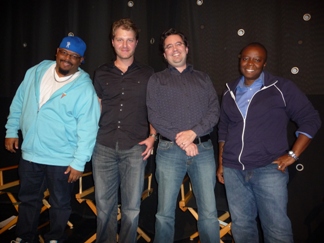
The film was followed by a lively 30 minute Q&A that delved into many issues surrounding copyright, including the creative and commercial value of musical sampling. Yance was joined on stage by director Benjamin Franzen, executive producer Kembrew McLeod and DJ/musician/producer Mr. Len. Benjamin and Kembrew spoke about the complex legal process that has governed even their own filmmaking – working with a lawyer, they are in the midst of clearing all referenced clips – either by presenting a “fair use” argument or by licensing the material. Unfortunately, the “fair use” clause that has recently emerged as a savior in documentary filmmaking has yet to be accepted in the music world. When the panel was asked by an audience member whether they would mind their own film or music being sampled in the future – they said the details were still being worked out, but that was the spirit of the project.
(Photo – L to R: Mr. Len, Benjamin Franzen, Kembrew McLeod and Yance Ford)
“How many people here have never seen HOOP DREAMS?” asked STF host Thom Powers to the crowd gathered for the 15th anniversary screening at the IFC Center. About half the room raised their hands. Among the other half included several people with close connections to the film, starting with cinematographer Peter Gilbert who flew in from Chicago to present the film. He paid tribute to three key figures in the audience:
1) Ira Deutchman, who was a key member of the team that released the film at Fine Line. Deutchman has written his own reminiscence on his blog at www.iradeutchman.com
2) Barbara Kopple, who had previously used Gilbert as a cameraman on her Academy Award winning film AMERICAN DREAM. In the Q&A, Gilbert said it was partly the longitudinal experience of working on AMERICAN DREAM that inspired his team to consider following the characters in HOOP DREAMS for four years.
3) Gilbert’s son Leo, who was born during the production of HOOP DREAMS and is now in the midst of his freshman year at NYU studying – what else? – film.
For more on HOOP DREAMS, read the recent 15th anniversary reflections of Roger Ebert who calls it “the great American documentary.”
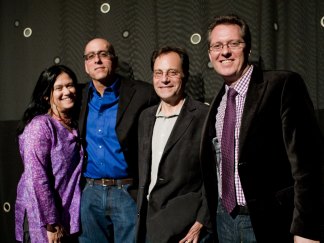
(photos courtesy of Joshua Z Weinstein, above L to R: Barbara Kopple, Peter Gilbert, Ira Deutchman and Thom Powers. )
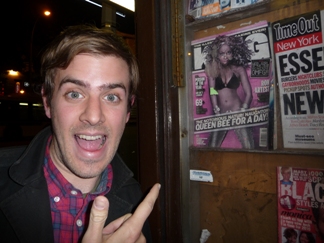
New York City was a swarm with different kinds of bees on Tuesday night, as COLONY co-director Carter Gunn poses here at the Sixth Avenue newsstand outside the IFC Center. Inside the theater, it was a packed hive of activity for the film’s first sneak preview since its acclaimed world premiere at the Toronto International Film Festival. The New York Times Urban Eye gave the following plug:
You’ve probably heard about the mass death of the world’s honeybees. Scientists are still debating how much to worry about it; filmmakers, though, are acting. The documentary “Colony” tackles the subject, shifting “seamlessly from macroimages of the swarming bees to close-ups of their fretting keepers who are struggling with the devastation,” Manohla Dargis writes. With its “attention to beauty, interview style and even pacing,” she compares the film to the works of Errol Morris.
In the Q&A, Gunn talked about the hazards of making the film, including 35 bee stings in one day. The screening attracted many STF newcomers, several of whom joined for the regular post-film celebration at the bar 99 Below.
LOOT made a sensational debut last night at Stranger Than Fiction with director Darius Marder in attendance. Not even the World Series stopped the theater from filling up. Winner of the jury prize at the 2008 Los Angeles Film Festival, the film was introduced at STF by one of those jurors, Esther Robinson who praised the film for being full of surprises. Indeed, the most frequent comment heard after the show is that audience members didn’t think the film’s synopsis does justice to its splendors. Rather than dwell on the plot-line about World War II veterans going in search of buried wartime treasure, perhaps it’s better to take Sam Shepard’s word that it’s “a powerful evocation of fathers, sons, war and time, that sneaks up on you like a thief in the night.” Or as Michael Tully wrote yesterday in HAMMER TO NAIL: “Darius Marder’s LOOT isn’t just proof that truth is stranger than fiction; in this case, it is infinitely richer than the very best of fiction.” LOOT will open later this month at the IFC Center.

 Last night flying to Copenhagen (where I hope to blog a report from CPH:DOX), I took the time to read Mark Rudd’s excellent memoir
  After catching
  “How many people here have never seen
  New York City was a swarm with different kinds of bees on Tuesday night, as