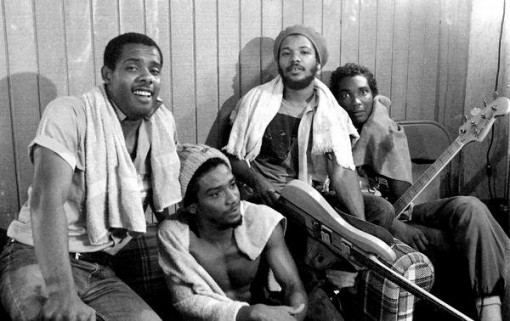
This year’s Silverdocs will feature the film BAD BRAINS: A BAND IN DC by Mandy Stein and Benjamen Logan.
The Silverdocs Documentary Festival on Tuesday, May 29 announced the lineup for its 2012 festival, set to take place June 18-24. Now in its 10th year, the festival will showcase 114 films and honor filmmakers Joe Berlinger and Bruce Sinofsky as 2012 Guggenheim Honorees. The Washington Post’s Ann Hornaday rounded up some of her picks from the festival, which included BAD BRAINS: A BAND IN DC, about the hardcore punk band Bad Brains, and DON’T STOP BELIEVIN’, about a Filipino fan’s transformation into the lead singer of the band Journey. Kelly Anderson at Reelscreen also took an in-depth look at the festival’s slate.
Directors Heidi Ewing and Rachel Grady grabbed some digital ink this week after launching a kickstarter campaign to independently distribute their film DETROPIA. The pair are looking to raise $60,000 “into regions, theaters and venues that want to see the movie but can’t—unless we bring it directly to them with your help.” Tom Roston talked to the filmmaking duo for the POV blog about their decision to take on the task of distribution.
Freelance film writer Anthony Kaufman started a new documentary column on the SundanceNOW blog titled Docutopia. In his inaugural post, Kaufman took a look at the films 5 BROKEN CAMERAS and THE LAW IN THESE PARTS, both of which examine the ongoing tensions between Israel and the Occupied Territories.
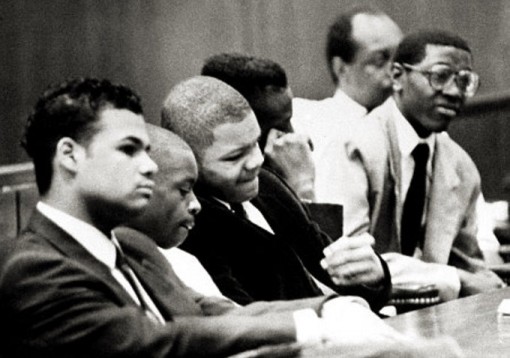
Ken Burns’ new film THE CENTRAL PARK FIVE premiered at this year’s Cannes.
Cannes’ storied Camera d’Or may have left France with BEASTS OF THE SOUTHERN WILD filmmaker Benh Zeitlin, but there was still plenty of doc-related news going down at the French Riveria. David Rooney of The Hollywood Reporter reviewed the Ken Burns doc THE CENTRAL PARK FIVE, which premiered at Cannes, finding it “relatively conventional in style and structure,” but conveying “a shocking story in eloquent, even-handed and affecting terms.” At the LA Times, Kenneth Turan dug into the obstacles Burns, who made the film with his daughter Sarah and David McMahon, faced in making the film.
Jordan Mintzer of The Hollywood Reporter took a look at another doc that screened at Cannes, JOURNAL DE FRANCE. an examination of filmmaker and photographer Raymond Depardon by the man himself. Mintzer describes the film as an “engaging and somewhat droll self-study.” In another review for The Hollywood Reporter, David Rooney writes up LES INVISIBLES, Sebastian Lifshitz’s take on the changes faced by gay men and lesbians entering middle age. Lifshitz found the film to have “a real coziness to the interviews and some gorgeous pastoral imagery to punctuate them,” but that it’s “repetitive at two hours and could stand to lose as much as 30 minutes.”
Also, French intellectual Bernard-Henri Lévy spoke with Britain’s The Guardian newspaper about his film THE OATH OF TOBRUK, which premiered at Cannes and documents the overthrow of Col. Muammar Gaddafi in Libya. Stephen Dalton of The Hollywood Reporter also reviewed the film, describing it as “a more engaging experience than it may sound on paper.” And at Indiewire, Peter Belsito provided a breakdown of The Doc Corner at Cannes, which links prospective buyers with documentaries screening at the festival.
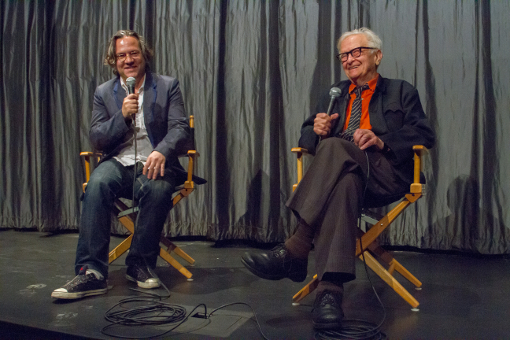
From left, Hugo Perez and the inimitable Albert Maysles. Photo by Simon Luethi.
In choosing a focal point for their seminal direct cinema film SALESMAN, directors the Maysles Brothers and Charlotte Zwerin could not have picked a more compelling protagonist than Bible salesman Paul “The Badger” Brennan. A textbook example of a tragic hero, Brennan’s fatal flaw is that he’s a salesman who lacks the ability to close a sale. Over the course of the film, The Badger’s hangdog look becomes his default mode of expression, the corners of his mouth perpetually pulling down the rest of his face as he slides deeper into depression. His failures eventually culminate in an emotional outburst directed toward a pair of prospective Bible buyers resistant to his hard-sell technique. The scene encapsulates the complexities of life that the Maysles Brothers so masterfully captured on film, reading as equal parts tragedy and black comedy. Following the screening, friend of Stranger Than Fiction Hugo Perez spoke with director Albert Maysles. Click “Read more” below for the Q&A.
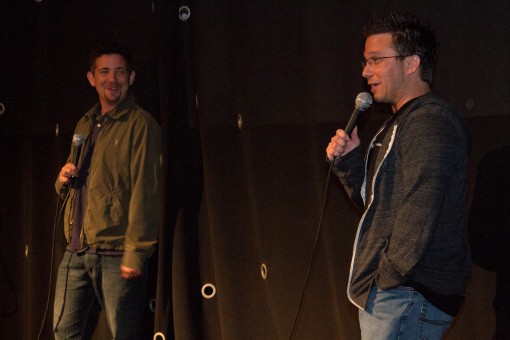
COCAINE COWBOYS producer Alfred Spellman and director Billy Corben. Photo by Simon Luethi.
Originally titled “City Made of Snow”, director Billy Corben’s COCAINE COWBOYS makes use of archival television reports chronicling the bloodshed and mayhem between rival Columbian and Cuban cocaine distribution cartels on the streets of Miami in the early 1980s. With its darkly humorous intercutting of tourist TV spots and grisly file footage, the film plots a methodical time line of illicit activity in the Miami region, beginning with the shift from Marijuana importing to the more lucrative cocaine trade.
Cocaine trafficker John Roberts, professional pilot Mickey Munday and Columbian enforcer Jorge “Rivi” Ayala tell the tales of their roles in the cocaine industry from three distinct standpoints. Roberts as the New Yorker relocating to Miami for a new start and on the run from the mob, Munday as local boy and technical brains behind the operation and Ayala as hired killer for the head of one of the fiercest Columbian cartels in Miami.
To counter these three major personalities, several members of law enforcement and local government tell a similar tale of the transformation of a once-sleepy retirement haven to the wide open criminal haven that eventually gained notoriety as “the most dangerous place on earth.” Adding a 1980’s revival soundtrack supplied by Jan Hammer—composer of the original Miami Vice theme—the place and purpose of the era is successfully recreated stylistically.
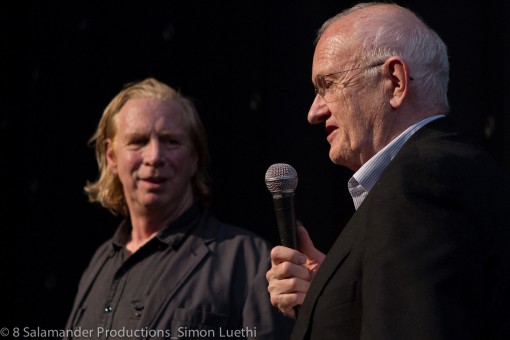
From left, FEED directors Kevin Rafferty and James Ridgeway. Photo by Simon Luethi.
Jerry Brown angrily fusses with his hair, Bill Clinton practices his petulant bottom-lip biting and George H.W. Bush glibly chats with off-screen staffers as they all prepare for their closeup in 1992’s FEED by directors James Ridgeway and Kevin Rafferty. The film combines traditional media footage from interviews, photo ops, general campaign hand-shaking and baby-hoisting with a behind-the-scenes window into candidates’ makeup application and review of talking points.
After first working together on BLOOD ON THE FACE, the critically-acclaimed 1991 adaptation of Ridgeway’s book of the same title, Ridgeway and Rafferty headed to New Hampshire to begin work on FEED. Citing his love of the documentary work of Frederick Wiseman, Rafferty recalled the inspiration he received after watching BASIC TRAINING for the first time in 1972. After watching the work of Wiseman, Rafferty embarked on a career in film and documentary.
FEED’s main element is the B-roll or off-camera moments that are deftly captured by Brian Springer from his satellite monitoring in Buffalo, NY, combined with Rafferty’s on the ground footage from New Hampshire. Springer during the 1988 presidential campaign had come up with the technique of pirating the satellite uplink material footage from the major television networks. Because these bits of material were cut from broadcast, they were essentially “electronic garbage” and were free to be used in the film.