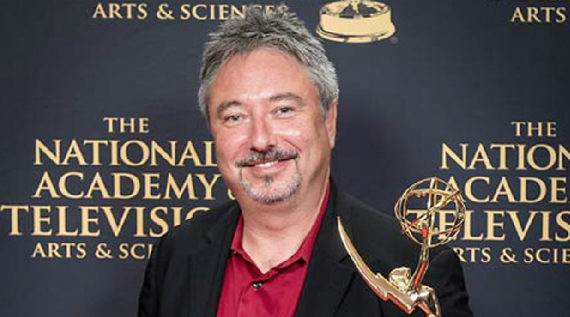
Nisha Pahuja’s THE WORLD BEFORE HER was named the best documentary feature at the Tribeca Film Festival.
The parallel narrative structure employed by director Nisha Pahuja in THE WORLD BEFORE HER is both brilliant and beguiling. It immediately lulls viewers into seeing her subjects—the women participating in the 2011 Miss India beauty pageant, and a fundamentalist Hindus in a girls camp—as binary, opposing forces. But as Pahuja unspools her story, nuances emerge that challenge such a reductive reading of these groups. Both the pageanteers and Hindutva nationalists are searching for their place in a patriarchal society with a deep-running strain of misogyny. The women are also linked by individual struggles with issues spanning the scope of humanity—class, religion, race, sexual identity, individuality and freedom, to name a few. Later in the film, Pahuja shows both aspiring beauty queens and Hindu militants in more candid moments expressing ambivalence toward their own extreme positions. Thoughtful viewers may be surprised to find themselves doing the same. Following the screening, Pahuja fielded questions from the audience. Click “Read more” below for the Q&A.
Storey attempted to write off costs related to the production of her film SMILE TIL IT HURTS: THE UP WITH PEOPLE STORY.
Filmmaker Lee Storey scored a rare win against the Internal Revenue Service this week, after a federal tax court judge ruled on Thursday, April 19 ruled that she could write off tens thousands of dollars in costs related to her documentary filmmaking. Last year, U.S. tax court Judge Diane Kroupa questioned whether her filmmaking efforts could be considered a business, or should be categorized as a hobby for tax purposes. Kroupa’s decision affirmed that a filmmaking enterprise, even if it earned no profit, was a legitimate business that might take a longer period of time to see any revenue. Storey had been supported by the International Documentary Association and other film institutions in the case.
This week saw the passing of direct cinema Anne Drew after a prolonged battle with lung cancer. Drew, a Brooklyn native, edited and produced films that examined such topics as ballet and former Indian leader Indira Gandhi. Drew’s husband, Robert Drew, whose husband, Robert Drew, shared some elements of his wife’s legacy with the Indiewire audience. Christopher Cambpell also recalled the influence of Anne Drew in a post at the Documentary Channel Blog.
Francophiles no doubt rejoiced this week when the lineup for Cannes was released. The folks over at Doc Geeks saved us all some work, pulling out a list of the seven docs that are going to be screened at the festival. Among the films to be shown are THE CENTRAL PARK FIVE, Ken Burns’ take on the notorious Central Park Jogger case.
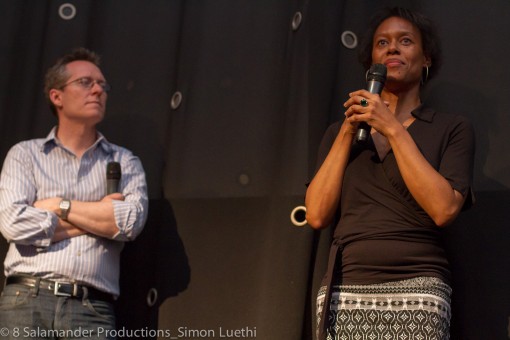
From left, Stranger Than Fiction Artistic Director Thom Powers and director/producer Laurens Grant. Photo by Simon Luethi.
Jesse Owens’ sporting career will forever be defined by his stunning performance at the 1936 Olympics held in Berlin, Germany. Owens’ domination proved to be a timely finger in the eye of Hitler, who had hoped to use the sporting event to showcase his theory of Aryan supremacy. As Laurens Grant’s film JESSE OWENS shows, Owens embodied not only the era’s pinnacle of sporting performance, but also a strength of character rarely seen in sports today. The irony was that Owens returned from his victories abroad to a segregated United States that treated him as a second class citizen. While Hitler was roundly condemned in the press for refusing to congratulate Owens’ after his wins, little attention was paid to the fact that FDR neglected to acknowledge his feats with a phone call or invitation to the White House. Years later Owens would recall, “When I came back, after all those stories about Hitler and his snub, I came back to my native country, and I couldn’t ride in the front of the bus. I had to go to the back door. I couldn’t live where I wanted. Now what’s the difference?” Following the screening, Stranger Than Fiction Artistic Director spoke with director and producer Laurens Grant. Click “Read more” below for the Q&A.
Fernand Melger’s SPECIAL FLIGHT (VOL SPECIAL) won Full Frame’s Grand Jury Prize this year.
The Full Frame Documentary Film Festival on Sunday, April 15—the final day of the festival—announced the recipients of its awards. Taking home the Grand Jury Award was SPECIAL FLIGHT (VOL SPECIAL), Fernand Melger’s look at migrants being held in Switzerland’s Frambois detention center. A special jury award was also given to THE LAW IN THESE PARTS, directed by Ra’anan Alexandrowicz. Andrew Garrison’s TRASH DANCE took home the Audience Award, while the Jury Award for Best Short went to THE TIME WE HAVE (DEN TID VI HAR), directed by Mira Jargil. The Garrett Scott Documentary Development Grant was also awarded to two recipients at Full Frame this year: Ben Powell for BARGE and Jason Osder for LET THE FIRE BURN. The grant provides filmmakers with money for travel and lodging to attend Full Frame, and gives them access to master classes and mentorship.
The New York Times on Monday April 9 reported that the National Endowment for the Arts (NEA) had proposed budget cuts that would strip PBS shows of $1 million in production aid. According to the report, “The independent documentary series Independent Lens was told it would get $50,000, down from $170,000, while the documentary series POV learned it would receive $100,000, down from $250,000.” However, the cuts would not officially take effect until April 25, according to the Times. The article sparked a Twitter back-and-forth between Chicago production house Kartemquin Films and Alyce Myatt of the NEA over comments Myatt had previously made regarding the term “documentary.” On a related note, the Center for Social Media on Tuesday, April 10 released a report on the public’s reaction to changes in PBS scheduling credited for resulting in a sharp ratings drop for Independent Lens.
Canada’s storied National Film Board (NFB) on Wednesday, April 4 had announced that it would suffer C$6.68 million in budget cuts and the loss of 73 full-time positions. The news sparked a number of protests in Canada, and many of which were centered in Montreal, Quebec.
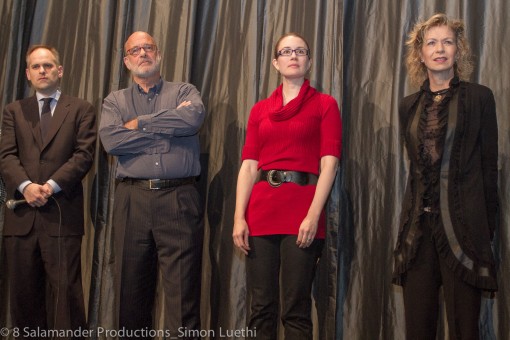
From left, Jesse Drucker, James Henry, director Karin Hayes and Lee Sheppard. Photo by Simon Luethi.
It’s unlikely that you’ll ever hear Grover Norquist admit it, but Scottish philosopher Adam Smith in his seminal 1776 text, The Wealth of Nations, actually makes an argument in favor of a progressive tax. “It is not very unreasonable that the rich should contribute to the public expense, not only in proportion to their revenue, but something more than in that proportion,” Smith wrote. Laissez-faire adherents happy to adopt Smith’s free market arguments seem to have conveniently forgotten that element of his philosophy over the last 200 years. In WE’RE NOT BROKE, directors Karin Hayes and Victoria Bruce show how that might finally be changing. The film spells out the effects of a regressive U.S. tax policy so riddled with loopholes that multinational corporations with billions of dollars in annual revenue are somehow able to get away with paying no federal taxes. Thanks in part to the Occupy Wall Street movement, tax inequalities—admittedly not the world’s sexiest issue—are finally gaining attention in public discourse. Reasonably informed people have likely heard that Republican presidential candidate Mitt Romney paid an effective tax rate of about 15% last year, well below the roughly 35% rate applied to most working stiffs. WE’RE NOT BROKE makes the argument that there exists the untapped political will to change that. Following the screening Stranger Than Fiction Artistic Director Thom Powers spoke with Hayes, along with film subjects Lee Sheppard, James Henry and Jesse Drucker. Click “Read more” below for the Q&A.