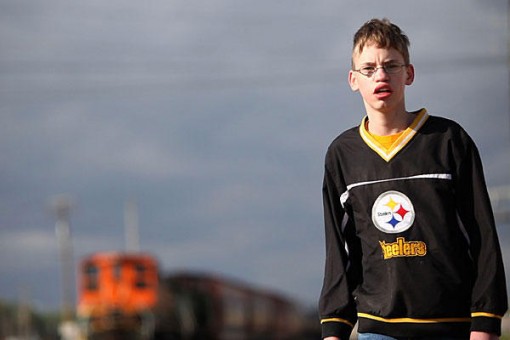
BROOKLYN CASTLE is among the docs screening at the inaugural Montclair Film Festival.
The inaugural Montclair Film Festival, programmed by the STF team of Raphaela Neihausen and Thom Powers, announced its line-up today with 45+ films and 50+ guests. Scheduled to attend are: Kathleen Turner, Oliver Platt, Michael Moore, Olympia Dukakis, among others. Naturally, the festival has a strong documentary line-up including BROOKLYN CASTLE; PREP SCHOOL NEGRO; a tribute to Montclair resident Bruce Sinofsky with a screening of METALLICA: SOME KIND OF MONSTER; and a special screening of UNDEFEATED with Oscar-winning directors Dan Lindsay and T.J. Martin in person.
BULLY distributor The Weinstein Co. (TWC) on Thursday, April 5 said they had gotten a PG-13 rating from the MPAA, after submitting a revised cut of the film that had eliminated several curse words. The Lee Hirsch-directed doc has gained a lot of attention from its battle with the MPAA over the R rating it initially received from the association. TWC and Hirsch had argued that the R rating would make it difficult for the teenagers who would benefit the most from seeing the film from being able to view it in a movie theater without their parents’ permission. The new rating was issued just in time for BULLY’s expanded release to 55 markets on April 13, leading some to wonder if the whole ratings campaign was an effort to drum up media attention for the film.
If it was a marketing plan, it looks like the ploy worked. Indiewire reported on Sunday, April 1 that BULLY had scored the best opening weekend for a non-fiction film thus far in 2012, in terms of per-theater-average. (The film had initially opened in five theaters in New York City and Los Angeles.) At a minimum, the controversy over the BULLY rating has led to a critical reexamination of the MPAA’s ratings system. The Chicago Tribune’s Michael Phillips noted that BULLY’s inclusion of f-bomb heavily dialogue had earned it the same rating as the torture-porn flicks SAW and HOSTEL.
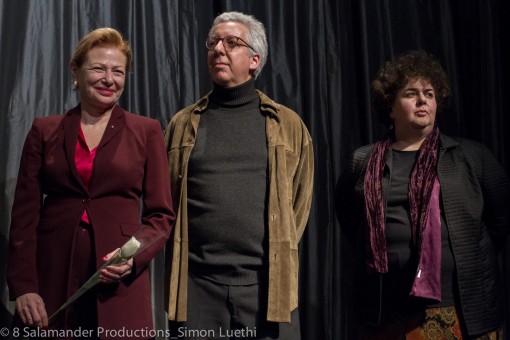
From left, Nina Rosenblum, Daniel Allentuck and Mary Engel. Photo by Simon Luethi.
Rooted in the radicalism of the era, the Photo League was founded in 1936 for the purpose of recording trade union activities and political protests. But, as shown in Dan Allentuck and Nina Rosenblum’s ORDINARY MIRACLES: THE PHOTO LEAGUE’S NEW YORK, the group’s work eventually evolved into a wide-ranging documentation of life in New York City. The League also managed to play a fundamental role in establishing documentary photography practices in the U.S.; much of its work was done with an eye to cataloging political and social strife that was otherwise ignored. However, the League’s Marxist beginnings would eventually prove to be the reason for its demise—the group fell apart under the strident anticommunism of the Cold War era. Following the screening, Stranger Than Fiction Artistic Director Thom Powers spoke with Producer/Director Nina Rosenblum, Producer/Director/Writer Daniel Allentuck and Contributing Producer Mary Engel. Click “Read more” below for the Q&A.
From left, director Christian Delage and friend of STF Basil Tsiokos. Photo by Simon Luethi.
Screening in conjunction with an exhibition now on display at the Museum of Jewish Heritage, FROM HOLLYWOOD TO NUREMBERG is an essential look at how the machinery of the war effort and the machinery of Hollywood filmmaking combined to provide documentation of the horrors of war.
After receiving a Fulbright grant to study the archival footage stored in the Library of Congress for his 2007 film, NUREMBERG: THE NAZIS FACING THEIR CRIMES, director, curator and film historian Christian Delage became inspired to portray the stories of the three filmmakers, and to highlight the professionalism and preparation of their outfits.
In the post-screening question and answer session, Delage described the goal of his film: “This is not only telling a story of war and liberation of camps, this is definitely a story of three filmmakers. They realized immediately what was at stake. They worked as professionals, they had precise instructions and took their roles very seriously.” He received the full cooperation from the families of Ford, Fuller and Stevens to get access to the notebooks and personal artifacts of each director and discovered a shared friendship, made possible through their efforts in very different positions during the war.
Lee Hirsch’s film BULLY opened in theaters without a rating from the MPAA.
The Weinstein Company co-President Harvey Weinstein saw fit to stick his finger in the eye of the MPAA on Monday, when he announced that the company would release Lee Hirsch’s doc BULLY without a rating from the trade association. Weinstein’s decision followed a weeks-long effort to get the MPAA to reduce its R rating to PG-13, in order to make it easier for adolescents to see the film’s anti-bullying message. Hirsch had argued that eliminating the foul language that was the cause of the R rating would diminish the authenticity of the film.
The decision to allow BULLY to go to theaters unrated left some wondering whether kids would be able to see it. Theater chain AMC posted a note on its website saying that kids 17 or younger would be allowed to watch the film if accompanied by a guardian, or if they presented a signed permission slip. The U.S.’s largest movie theater chain, Regal Cinemas, for its part said it would also play the film, but treat it the same way it treated R-rated films. Bully opened at five locations in New York and Los Angeles on Friday, March 30, and is scheduled to go into wider release on April 13.
Reviews of the film thus far have been relatively strong. The New York Times’ A.O. Scott anointed the film as a NYT Critic’s Pick, calling it a “moving and troubling documentary about the misery some children inflict upon others.” At NPR.com, Bob Mondello said the film was “ a wrenching, potentially transformative look at an epidemic of adolescent cruelty and adult paralysis in the nation’s public schools.” Kenneth Turan of the Los Angeles Times said a “theme of parental difficulty in getting satisfactory responses from those in authority positions in schools is one of BULLY’s constant refrains.”
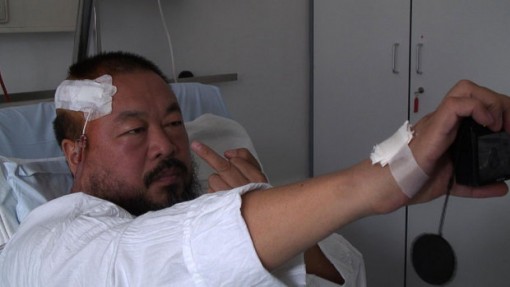
Alison Klayman’s AI WEIWEI: NEVER SORRY was announced as the opening film for Hot Docs last week.
The Hot Docs Canadian International Documentary Festival on March 20 announced the lineup for its 19th iteration, with 189 films from 51 different countries. Alison Klayman’s AI WEIWEI: NEVER SORRY is set to open the festival, which runs from April 26 – May 6 in Toronto, Canada. In honor of the festival, the folks at the D-Word will be hosting a five-day discussion with Hot Docs programmer Charlotte Cook, along with festival staffers Elizabeth Radshaw and Sarah Lancaster (D-Word registration required).
The Full Frame Documentary Festival, set to run April 12-15 in Durham, North Carolina, on March 20 also made several announcements. The two recipients of the Garrett Scott Documentary Development Grant are Jason Osder, for his film LET THE FIRE BURN, and Ben Powell for BARGE. The festival also announced additional programming celebrating the 40th anniversary of groundbreaking distro company New Day Films, as well as films celebrating the festival’s own 15th anniversary.
A campaign led by the revered distro/production house Kartemquin Films scored a win this week, after PBS on March 22 agreed to change the scheduling of the well-regarded independent doc series “Independent Lens” and “POV.” Kartemquin launched its crusade after news broke that the ratings for the new season for “Independent Lens” had dropped about 40%, after the show was moved from Tuesday to Thursday nights. The campaign to have the shows moved received a huge boost after esteemed journalist Bill Moyers gave it his backing. However, it still remains to be seen where, exactly, PBS will place the shows in its new schedule.