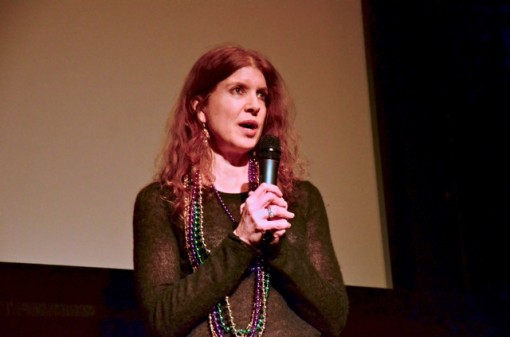
A Q&A session following a screening at the True/False Film Festival. Photo by Maureen Scarpelli, courtesy of True/False.
The True/False Film Fest, Columbia, Missouri’s most famous documentary festival, concluded yesterday after four days of screenings (and at least one parade). The festival launched with a screening of UNDEFEATED that honored the recent Oscar win of co-director Dan Lindsay, an alumnus of the University of Missouri. Christine Benedict at Indiewire’s Press Play blog also had highlights from days one and two of the festival. The transportation-conscious minds behind the festival this year also debuted a new bike-sharing system to facilitate the flow of doc heads around Columbia’s streets.
Efforts to combat the Motion Picture Association of America’s R rating for Lee Hirsch’s doc BULLY hit the grassroots this week, after self-professed bullying victim Kay Butler, 17, started a petition at Change.org asking the MPAA to change the rating to PG-13. As of March 4, the petition had drawn more than 198,400 signatures, and was drawing ever-closer to its goal of 200,000 signatures. The MPAA’s decision had drawn criticism from those who said it would limit the ability of teachers and administrators at high schools and middle schools to share the film’s anti-bullying message with students. The Weinstein Company (TWC) Co-President Harvey Weinstein, who is distributing the film, had previously threatened to withdraw its films from the MPAA rating process.
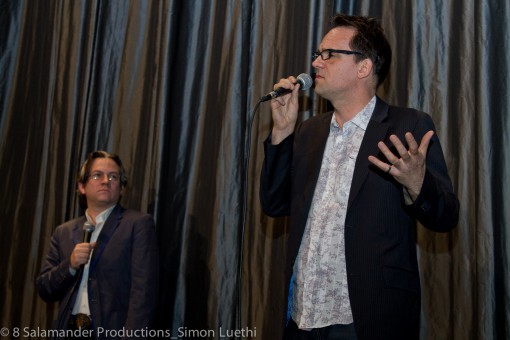
From left, Hugo Perez and director Thom Zimny. Photo by Simon Luethi.
Bruce Springsteen spent part of the three years following the 1975 release of “Born to Run” mired in a legal battle with former friend and manager Mike Appel, and forging a new approach to studio work with his E Street Band compatriots. Relying on footage shot by Springsteen friend Barry Rebo back in ‘75 as well as contemporary interviews, director Thom Zimny in THE PROMISE: THE MAKING OF DARKNESS ON THE EDGE OF TOWN manages to encapsulate Springsteen’s new, iterative songwriting approach. Rebo’s footage is not only a boon in its ability to provide exposition, but also in its dreamy aesthetic—the footage was shot on ¾ inch video that looks as if it exists outside of time. Zimny complements the video with a variety of filmic textures that make THE PROMISE a pleasure to watch. The filmmaker also provides Springsteen fans with the gift of a rare window into the creative process of an artist searching for the right way to record for posterity the poetry his American experience. Following the screening, Stranger Than Fiction friend Hugo Perez spoke with Zimny. Click “Read more” below for the Q&A.
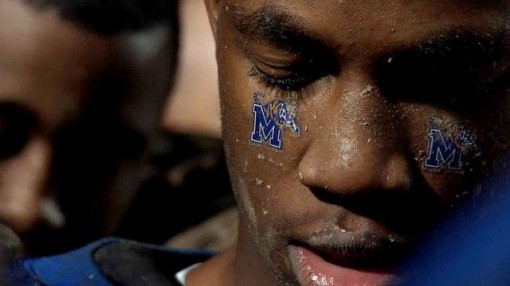
T.J. Martin and Dan Lindsay’s football doc UNDEFEATED took home the Oscar for best documentary feature yesterday.
Stranger Than Fiction and DOC NYC alums T.J. Martin and Dan Lindsay emerged from the Oscars with the statuette for best documentary feature for UNDEFEATED (hopefully guaranteeing them entry to the infamous Vanity Fair party). The pair no doubt benefited from distribution through The Weinstein Company (TWC), well known for its Oscar campaigns. UNDEFEATED was considered something of an underdog against Joe Berlinger and Bruce Sinofsky’s PARADISE LOST 3: PURGATORY, which documented the release of the West Memphis Three. The Oscar win caps off a great start to 2012 for Martin and Lindsay, who picked up Sean “Diddy” Combs as an executive producer on the film a few weeks ago, and also got word that plans for a narrative remake of UNDEFEATED was in the works.
Also last night, Sharmeen Obaid-Chinoy and Daniel Junge won the Oscar for best documentary short for their film SAVING FACE, about a plastic surgeon who helps women in Pakistan attacked with acid recover from their injuries. With the win, Obaid-Chinoy became the first Pakistani to receive an Academy Award.
In other awards news, Steve James continued to add to his pile of accolades for THE INTERRUPTERS, winning the Film Independent Spirit Award for best documentary on Saturday. James said he felt the award was “a great endorsement from the independent film community on the value of the film.”
The Motion Picture Association of America (MPAA) on February 23 denied an appeal made by the The Weinstein Company (TWC) that the rating for Lee Hirsch’s doc BULLY be changed from R to PG-13. The MPAA cited the film’s use of “some language” in its rationale. TWC co-chairman Harvey Weinstein harshly criticized the decision, which would prevent it from being shown in schools. Weinstein later released a statement saying TWC was “considering a leave of absence from the MPAA for the foreseeable future,” adding that the BULLY decision was “a bridge too far.” The ratings disagreement brings to the fore criticisms regarding what some see as the MPAA’s arbitrary ratings criteria, a position explored in the Kirby Dick-directed doc THIS FILM IS NOT YET RATED.
TOOTIE’S LAST SUIT director Lisa Katzman. Photo by Ruth Somalo.
The photographer Michael P. Smith once described the Mardi Gras Indians of New Orleans as “a classic example of a submerged culture quietly serving the spiritual needs and interests of a tightly knit traditional community.” The Indians have always existed foremost for their immediate neighborhoods, a seeming anachronism of hyperlocality in the interconnected global age. But Lisa Katzman’s TOOTIE’S LAST SUIT shows us that everyone has a tremendous amount to learn from the Mardi Gras Indians, some of whom trace their artistic lineage to the Yorubas of West Africa. Centering on Big Chief Allison “Tootie” Montana of the Yellow Pocahontas tribe—known in the Crescent City as the chief of chiefs—Katzman’s film delves beyond the anthopological, exploring the generational tension between Tootie and his son, Darryl, the ostensible successor to his mantle. The film also works as a stand-in conversation for the complicated issues of class and race that New Orleans is struggling with post-Katrina. Following the screening, Stranger Than Fiction Artistic Director Thom Powers spoke with Katzman. Click “Read more” below for the Q&A.
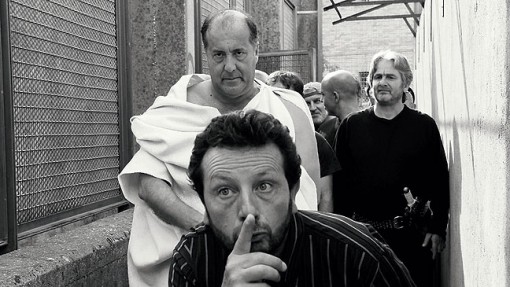
CAESAR MUST DIE, by brothers Paolo and Vittorio Taviani, won the Golden Bear Award at this year’s Berlinale.
Documentaries made a decent showing at the Berlin International Film festival. Brothers Paolo and Vittorio Taviani left the Berlinale with the festival’s top prize, the Golden Bear, for their documentary CAESAR MUST DIE, a look at inmates in a Roman prison rehearsing for a performance of Shakespeare’s Julius Caesar.
At Movieline, Stephanie Zacharek wrote of CAESAR MUST DIE, “The picture is stark and alive in its simplicity; rendered mostly in black-and-white, it’s gorgeous to look at—you could practically use it as an illustrated textbook on framing and composition.”
Sometimes the Tavianis draw the parallels between art and life a little too starkly. We don’t really need to hear the inmates reflecting on how Julius Caesar speaks to them when we can see how, in their proto-method-acting way, they bring every scrap of their experience to rehearsal: They touch each other warily but tenderly; when it’s time for a character to draw a knife, you can tell the actors respect it as both a weapon and a symbol, even though it’s presumably made out of plastic. You can bet these guys know a lot about duplicity and betrayal and power struggles, and they bring all of that to bear as they tangle with this challenging material, and with each other.