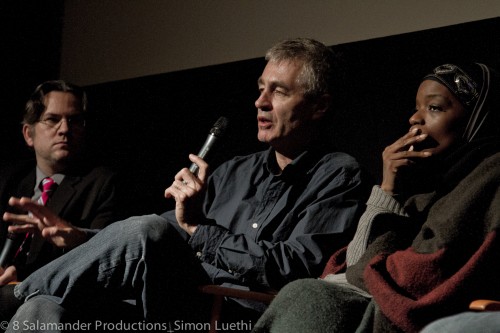
From left, Hugo Perez, director Steve James and subject Ameena Matthews. Photo by Simon Luethi.
The conflict mediators that work for the nonprofit CeaseFire are exceedingly literal in describing themselves as interrupters. CeaseFire’s model treats violence like a disease, and their work is centered on stopping the transference of violence at its source. For the interrupters, that often means their work puts them directly in harm’s way—sometimes directly between an armed assailant and their intended victim. In his film, THE INTERRUPTERS, director Steven James shows us that the mediators are driven to do their work by something deeper than a simple desire to do good. Many interrupters carry around with them the weight of their crimes, committed in former lives as stick up kids, gangbangers and thieves. For those, conflict mediation is a way to attempt to exorcise the demons while staying true to the code of the streets. For other interrupters, the work is an attempt to save a younger generation from the pain they had to suffer growing up hard on the block. There’s no easy solution for solving the problem of endemic violence that besieges the Chicago South Side neighborhood of Englewood. Residents have been suffering from an unraveling of the social fabric for far too long. The lack of employment opportunity accompanying the U.S.’s wider recession is not news to them, it’s a reality that they have been forced to deal with for years. Following the screening friend of Stranger Than Fiction Hugo Perez spoke with James and film subjects Ameena Matthews and Cobe Williams. Click “Read more” below for the Q&A.
Michael Moore at the Cinema Eye Honors award ceremony. Photo by Simon Luethi.
At Wednesday’s Cinema Eye Honors (CEH) awards, filmmaker Michael Moore, attending as a presenter, took a few minutes to speak to the audience about his push for changes to the Academy’s method of nominating and voting for documentary feature films:
When I got on the board of governors, I said I’m here representing our branch of documentary filmmakers. I’d like to do two things. I’d like to introduce a democracy movement to this branch and end the old system of committees, secret committees, byzantine numbering systems, and just make it open and let everybody vote. After a year and a half of studying it and discussing it, the 20-member executive committee of the documentary branch voted unanimously to finally end this system that I think, personally, has kept so many great filmmakers from even being nominated. We sit here in the room tonight with Frederick Wiseman and Al Maysles. Or Steve James, the most famous case being Hoop Dreams. So this has needed to be fixed for a long time.
Beginning next year, everybody in the branch will pick the five nominees, and then the entire Academy will be able to vote for best documentary. They don’t have to show up on those two nights in the two theaters, when they show all five films. It ends up 200 people pick the Oscar winner. I said to the board of governors, when the presenter comes out on the stage, in my case it was Diane Lane, and says that the Academy has decided the best documentary this year is such and such film, it really isn’t the Academy, is it? It’s less than five percent of the Academy, and that really should change. We should be like the other branches, and we should have more involvement. And we should have more documentary filmmakers in the documentary branch. So the rules got passed, and now it will be opened up.
This year’s Cinema Eye Honors are set to take place Wednesday, January 11 at the Museum of the Moving Image in Queens.
The doc world was set abuzz after the New York Times on Sunday, January 8, broke news that the Academy of Motion Picture Arts and Sciences was substantially changing its submission requirements for documentary films, beginning in 2013. Under the new rules, set to be formally announced this week, documentary films would need to have been reviewed in either the New York Times or the Los Angeles Times in order to qualify for consideration for an Oscar, as part of efforts to cut down on the number of films submitted to the Academy. The changes are expected to make it much harder for films lacking a commercial distributor, as well as docs screened as part of the International Documentary Association’s DocuWeeks program, from contending for awards, since those films usually failed to secure reviews in either of the papers.
The Times also reported that the Academy was going to abolish the complicated committee-based method by which documentaries received Oscar nominations, and would open up voting on documentary awards to all Academy members, instead of limiting it only to those who had attended specific screenings. IndieWire took a look at some of the fallout from the decision, and rounded up a few responses. Michael Moore, reportedly one of the forces behind the moves, later gave a more complete rundown of the planned changes to IndieWire.
The Oscar changes might have the unintended effect of bolstering the importance of the Cinema Eye Honors for Nonfiction Filmmaking, the fifth installment of which is set to take place Wednesday, January 11 at the Museum of the Moving Image in Astoria, Queens. (Tickets for the awards show are $75, but Stranger Than Fiction followers can get them for the discounted price of $40 with the code momicineeye. For more info and to buy tickets go here.)
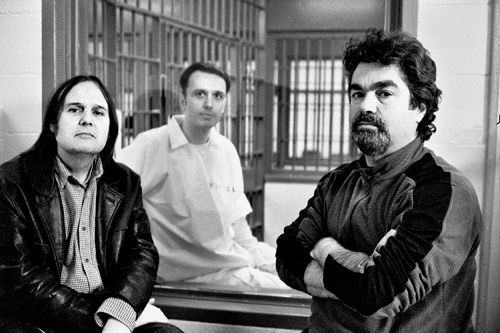
The Paradise Lost trilogy by filmmakers Bruce Sinofsky (left) and Joe Berlinger (right) helped free the West Memphis Three in 2011
Happy New Year! Welcome to Stranger Than Fiction’s inaugural Monday Memo, a new weekly feature in which we plan to bring you up to speed on the last week’s events in the world of documentary filmmaking, and take a look at what’s coming up on the horizon. We hope to provide an online space where you can get caught up on the news, hear about the latest trends and developments, and maybe even have a conversation with other documentary fiends looking for their fix. The Memo is likely to evolve as we make our way through its gestational phases, but we’d encourage you to send any tips or ideas you might have to .(JavaScript must be enabled to view this email address)
Although the new year is only two days old, Tom Roston at POV’s Doc Soup has already turned his attention to the ten releases he’s looking most forward to seeing in 2012, most eagerly anticipating SALINGER, a rumored two-hour film about reclusive author J.D. Salinger, who passed away in January 2010. Let’s hope the effort is not crumby.
A review of 2011 box office receipts showed that Jon Chu’s concert film, JUSTIN BIEBER: NEVER SAY NEVER, sent tweens (and in all likelihood, their poor parents as well) to the theaters in droves, taking in an astounding $73 million, making it the year’s highest grossing documentary. It must be the hair. IndieWIRE gives a complete list of the top grossing docs of the year, all of which managed to surpass the $1 million mark.
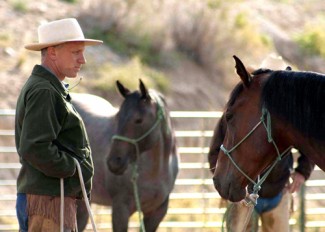
Buck is the story of Buck Brannaman, childhood rodeo star who has taken the pain of his early years and transformed himself into a gifted trainer of horses and teacher to thousands in the art of horsemanship. Cindy Meehl’s first film captures the silent pain experienced by Brannaman, the youngest of two sons who suffered horrific physical and mental abuse at the hands of his alcoholic father. The film uses interviews and archival footage to show his rebirth as a man others could trust, and a champion for the animals he trains.
Using non-violent techniques unfamiliar to most in the industry, Brannaman explains that “a lot of times I am not helping people with horse problems, I am helping horses with people problems.” Brannaman served as the inspiration for author Nicholas Evans’ 1995 book “The Horse Whisperer,” and advisor to the 1998 film of the same name. Director Robert Redford describes how he incorporated “the humanity and gentleness I got from Buck I used in the film.” We witness the calm and non-threatening ethos of his techniques that bring instantaneous changes in a previously skittish colt in front of an audience in a round corral. We also meet Brannaman’s foster mother, who raised 23 children on her ranch in Montana, and life-long friends that recall the shy, quiet boy who would not look anyone in the eye. Click “Read more” below to continue reading.