Stranger Than Fiction screens seven films co-presented with DOC NYC’s “Short List” section. See all these award contenders for FREE with the purchase of a STF Winter Season pass; or purchase tickets to individual shows.
The official Winter Season will run Jan. 31 – March 20.
Buy a Season Pass now, and get all 15 films for $100 ($80 for IFC members), free popcorn at all shows, and a free DVD from Docurama.
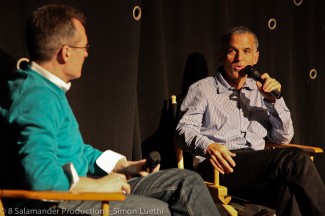
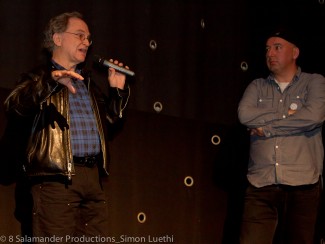
Viewers of Mila Turajlic’s film Cinema Komunisto might be surprised to learn that Yugoslavia’s state-run Avala Film Studios was not dedicated solely to enlarging the cult of personality surrounding Joseph Broz Tito, although it certainly did not shrink from that task. Relying on copious amounts of research and a trove of archival material, Truajlic’s film shows us Comrade Tito the cinephile—one who watched a film almost every day, and transformed his Yugoslavia into a prolific locus of filmmaking, for both artistic and propagandistic purposes. The heart of the film lies in the scenes bearing Tito’s personal projectionist, Leka Konstantinovic. In a powerful moment, Konstantinovic is shown arriving at Tito’s old estate in Belgrade for the first time in decades, where he ceremoniously hands over his key to the property to its current caretaker, who receives the gift with relative indifference. From the front, the house, though lacking a door, appears to be relatively intact. It’s only when Konstantinovic goes inside that he, and the viewer, discover that the projected reality of the edifice’s facade masks a hollowed out shell of little substance. Following the screening, Stranger Than Fiction Artistic Director Thom Powers spoke with David Leitner, a scholar and filmmaker, and Bosnian artist Shoba. Click “Read more” below for the Q&A.
[Photo: from left, David Leitner and Shoba, courtesy of Simon Luethi]
Give Up Tomorrow follows in the tradition of some of the most powerful documentaries ever made, those dedicated to the exoneration of individuals convicted of crimes they did not commit. In the film, director Michael Collins and producer Marty Syjuco tell the story of Paco Larrañaga, a self-admitted juvenile delinquent accused of raping and murdering two young women in the Philippine island of Cebu in 1997. The only problem? Larrañaga was about 350 miles away from Cebu, in Manila, at the time he was supposed to have carried out the murders, as attested to by some 35 peers and instructors at the culinary institute where he studied at the time. Larrañaga found himself facing a government conspiracy of murky origins, intent on not only imprisoning him for his accused crimes, but on taking his life as well. He was also quickly convicted in the court of public opinion thanks to sensationalist media coverage that focused less on doing any investigation, and more on prurient details spoonfed to them by a compromised Philippine criminal justice system. Following the screening, Stranger Than Fiction Artistic Director Thom Powers spoke with Collins and Syjuco. Click “Read more” below for the Q&A.
[Photo: from left, director Michael Collins and producer Marty Syjuco, courtesy of Simon Luethi]
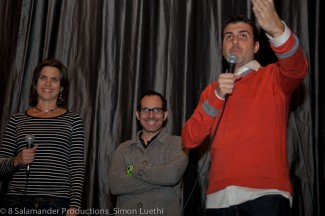
The bizarre story of Asa/Ace/Forrest Carter truly hinges on the cusp of believability. The film The Reconstruction of Asa Carter traces the confusing reinvention of white supremacist and polemicist Asa “Ace” Carter into Forrest Carter, self-proclaimed storyteller of the Cherokee Nation, and author of the New Agey book “The Education of Little Tree.” In hindsight, Forrest Carter’s success as an author (he first penned the sleeper-hit novel “The Rebel Outlaw: Josey Wales”) makes sense in a twisted way. No matter what first name he was using, Carter was clearly a consummate storyteller, regardless of whether he was using his speechwriting skills to burnish Alabama politician George Wallace’s credibility as a stark racist and segregationist, or if he was selling the character of Forrest the Novelist to a smiling Barbara Walters. Some of the film’s most striking scenes consist of capturing the reactions of the friends of Forrest as they are shown clips of the vitriolic hatred he espoused in his earlier incarnation as Ace. They are understandability bewildered, seeking an explanation that only the late Carter himself has the power to provide. Following the screening, Stranger Than Fiction Artistic Director Thom Powers spoke with director Marco Ricci, producer Douglas Newman, executive producer Laura Browder and co-producer Michael Fix. Click “Read more” below for the Q&A.
[Photo: from left, Laura Browder, Douglas Newman and Marco Ricci, courtesy of Simon Luethi]
For those who have taken many film classes, there are certain tropes that signal when a film is coming from the same audience it targets. Found footage. Voiceover that puns with the images. Autobiographical fragments piling up to a conclusion about The World or History. It’s the sort of feeling you get when you go to a poetry reading and everyone in the audience is either a poet or a poet’s significant other. This is the sort of thing that works when it works, and is a trudge when it’s got little to say, or when the balance between elements is askew. (I speak from experience here, shuddering to think of someone getting ahold of the spools of 16mm I filled up years ago with black leader and self-reference.)
Jay Rosenblatt’s short film Human Remains works. The subject—the personal habits and banal daily details of the 20th century’s autocratic rogue’s gallery—is immediately compelling. These are big name monsters, after all. Revealing that the sort of men with building sized posters of their face struggled with flatulence and eczema bends the brain a little, forcing in the uncomfortable thought that these were real humans and not grotesque exceptions. In the Q&A that followed the screening, Rosenblatt said Human Remains came about after he saw a photo of Hitler eating and was so disturbed by the thought of Hitler doing such simple, normal things that he pursued the idea into what emerged as the film. He admits that the voiceover is constructed about half from quotes, 40% from biographical facts and “about 10% I made up.” That slim bit of historical uncertainty is enough to send you to Google in search of the veracity of the missing testicle theory of dictator formation.
The Darkness of Day is preceded by the explanation that the images for this meditation on suicide were culled from films discarded by school libraries in the shift to video. Considering the graphic, spot-on nature of the raw material—scenes of death, grief, self-harm and madness—it’s hard not to picture classrooms of baby-boomers cringing at their desks watching the originals. Afraid So adapts the Jeanne Marie Beaumont poem of the same title, delivering bad news in the voice of Garrison Keillor. King of the Jews offers a guided tour through Rosenblatt’s childhood fear of Jesus.
“I started off making more conventional films with actors and writing a script,” Rosenblatt explained, but he found it stressful, especially with no budget to speak of. The editing process appealed to him, though. He made his first film from cuttings of training films he found in the dumpster at the psychiatric hospital where he worked. You could call it a reduction to the most pure strain of Eisensteinian montage, but Rosenblatt offers that his found footage style is “kind of a way of avoiding the production process.”
[Photo: From left, STF Artistic Director Thom Powers and filmmaker Jay Rosenblatt, courtesy of Simon Luethi]

 Stranger Than Fiction screens seven films co-presented with DOC NYC’s “Short List” section. See all these award contenders for FREE with the purchase of a STF Winter Season pass; or purchase tickets to individual shows.
 Viewers of Mila Turajlic’s film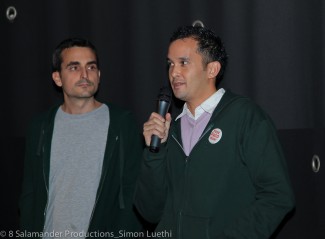
 The bizarre story of Asa/Ace/Forrest Carter truly hinges on the cusp of believability. The film