If there is such a thing as the physical incarnation of a thousand failed rock dreams, Paul Green must surely be it. The founder and proprietor of Paul Green’s School of Rock (note the prominent self-branding), Green seems to have made it his life’s mission to prove the adage-cum-cliche, “He who can, does. He who cannot, teaches.” In Don Argott’s incredibly captivating film, Rock School, Green finally gets his star turn. A psychoanalyst would likely have a field day with Green’s internal conflict between his obvious desire for the success for his students, and his envy toward their accomplishments. (His mental slips with pronouns make clear his proclivity for claiming his students’ achievements as his own.) Green’s Machiavellian teaching technique—in which he alternately pleads, cajoles and, finally, berates his students in diatribes liberally salted with curses—may, in fact, yield impressive student performances. But it leaves unclear the lasting developmental effect that his gregarious man-child approach to education has on his pupils. Still, Rock School also shows the side of Green that is able to push his students to accomplish things they likely thought they were not capable of. And, of course, there’s something compelling about watching a pair of 9-year-old twins channel Prince of Darkness Ozzy Osbourne in an onstage performance. Following the screening, STF Artistic Director Thom Powers spoke with Argott, editor Demian Fenton and producer Sheena Joyce. Click “Read more” below for the Q&A.
(photo: from left, Thom Powers, Don Argott, Demian Fenton and Sheena Joyce, courtesy of Cathryne Czubek)
By general consensus, the documentary film world agrees that Karen Schmeer was an incredibly talented editor, as evidenced by the flood of encomiums that followed her death early last year. But at Tuesday’s screening of Fast, Cheap & Out of Control (by all a accounts a master class in documentary film editing, and, incredibly, Schmeer’s first editing gig on a feature-length film), Schmeer’s friends and colleagues addended her list of editing credits by sharing stories of her sharp sense of humor and generous spirit of giving. In tribute to all of those aspects of Schmeer’s personality, a group of her friends and colleagues last year inaugurated the Karen Schmeer Film Editing Fellowship, a year-long program intended to nurture an emerging documentary film editor. Following the screening, STF Artistic Director Thom Powers spoke with colleagues David Schisgall, Brad Fuller, Nina Davenport, Lucia Small and Robin Hessman in a discussion on Schmeer’s life and work. Click “Read more” below for the discussion.
(photo: from left, colleagues of Karen Schmeer: David Schisgall, Brad Fuller, Joshua Seftel, Nina Davenport, Lucia Small and Robin Hessman, courtesy of Cathryne Czubek)
Oscar Berliner’s life story is the quintessentially American kind. The son of Polish immigrants who came to the U.S. around the turn of the 20th century, his narrative was repeated innumerable times among the families of Eastern Europeans. This seemingly ubiquitous story is granted its uniqueness by its treatment at the hands of his son, director Alan Berliner, in the film Nobody’s Business. A document of the intergenerational tension that most any father-son relationship will yield, the film’s antagonism is leavened by the underlying affection that Berliner clearly feels for his father, and an affinity between the two is readily apparent. Berliner infuses the film with a playfulness that makes the sometimes sobering reality of life easier to deal with, leaving the viewer with something that is equal parts document, cinematic essay, fine art and a love letter to his father. Following the screening STF Artistic Director Thom Powers spoke with Berliner. Click “Read more” below for the Q&A.
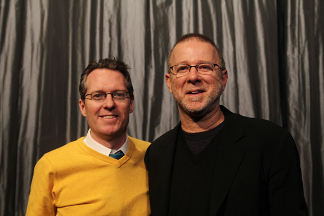
(photo: from left, Thom Powers and Alan Berliner, courtesy Cathryne Czubek)
With the notable exception of The Hurt Locker, one is hard-pressed to cite examples of narrative cinema born of the U.S. wars in Iraq and Afghanistan that have managed to have any significant cultural impact. Much of the rhetorical work that was done a generation ago by war films like Apocalypse Now and The Deerhunter is today being shouldered by nonfiction films like Restrepo and Poster Girl, which provide viewers with insights into both the surreality of war, and the staggering cost it inflicts on both its willing and unwilling participants. The conventions of nonfiction storytelling lend themselves to an immediacy that is hard to duplicate in fictional narrative work, which may explain the wealth of astounding war-related documentary films in the past few years. (Films like Iraq in Fragments, Taxi to the Dark Side and The Oath immediately spring to mind, to cite just a few examples).
In the beautiful and emotionally striking experimental documentary Diary, we see Restrepo co-director Tim Hetherington visually processing the experiences of his own life, split between the Western world and several war-torn societies in West Africa. In Poster Girl, director Sara Nesson turns her camera on Iraq war veteran Robynn Murray as she painfully struggles with combat-related Post Traumatic Stress Disorder (PTSD), and attempts to reintegrate herself into a civilian society from which she feels completely alienated. STF Artistic Director Thom Powers spoke with Hetherington and, in a separate Q&A, with Nesson and Murray. Click “Read more” below for the Q&As.
(photo: from left, Sara Nesson and Robynn Murray, courtesy of Cathryne Czubek)
It’s impossible to pin down the cause of the collapse of the U.S.’s myriad manufacturing sectors to any one source. A host of factors have conspired to hasten the demise of the country’s industrial economy, and with it, a major source of social mobility for the thousands of immigrant laborers that once flooded U.S. shores. In Schmatta: Rags to Riches to Rags, filmmaker Marc Levin focuses his attention on a subset of one of these sectors—New York City’s garment district. Once a steady means of ingress to a solid middle class lifestyle, the city’s garment industry has contracted to a degree that leaves it a stone’s throw from extinction, with little hope for recovery. These industries are now reborn in the developing world, where labor, absent organization, is being exploited to grim result. Schmatta remains a cautionary tale about the excesses of capitalism that is easily applied to a range of other industries, and a warning of its ability to repeat its cruel brand of havoc today in sweatshops the world over. Filmmaker and writer Hugo Perez spoke with Levin following the screening. Click “Read more” for the Q&A.
(photo: from left, Hugo Perez and Marc Levin, courtesy of Cathryne Czubek)






 If there is such a thing as the physical incarnation of a thousand failed rock dreams, Paul Green must surely be it. The founder and proprietor of Paul Green’s School of Rock (note the prominent self-branding), Green seems to have made it his life’s mission to prove the adage-cum-cliche, “He who can, does. He who cannot, teaches.” In Don Argott’s incredibly captivating film, Rock School, Green finally gets his star turn. A psychoanalyst would likely have a field day with Green’s internal conflict between his obvious desire for the success for his students, and his envy toward their accomplishments. (His mental slips with pronouns make clear his proclivity for claiming his students’ achievements as his own.) Green’s Machiavellian teaching technique—in which he alternately pleads, cajoles and, finally, berates his students in diatribes liberally salted with curses—may, in fact, yield impressive student performances. But it leaves unclear the lasting developmental effect that his gregarious man-child approach to education has on his pupils. Still, Rock School also shows the side of Green that is able to push his students to accomplish things they likely thought they were not capable of. And, of course, there’s something compelling about watching a pair of 9-year-old twins channel Prince of Darkness Ozzy Osbourne in an onstage performance. Following the screening, STF Artistic Director Thom Powers spoke with Argott, editor Demian Fenton and producer Sheena Joyce. Click “Read more” below for the Q&A.
 By general consensus, the documentary film world agrees that Karen Schmeer was an incredibly talented editor, as evidenced by the flood of encomiums that followed her death early last year. But at Tuesday’s screening of Fast, Cheap & Out of Control (by all a accounts a master class in documentary film editing, and, incredibly, Schmeer’s first editing gig on a feature-length film), Schmeer’s friends and colleagues addended her list of editing credits by sharing stories of her sharp sense of humor and generous spirit of giving. In tribute to all of those aspects of Schmeer’s personality, a group of her friends and colleagues last year inaugurated the
  Oscar Berliner’s life story is the quintessentially American kind. The son of Polish immigrants who came to the U.S. around the turn of the 20th century, his narrative was repeated innumerable times among the families of Eastern Europeans. This seemingly ubiquitous story is granted its uniqueness by its treatment at the hands of his son, director Alan Berliner, in the film Nobody’s Business. A document of the intergenerational tension that most any father-son relationship will yield, the film’s antagonism is leavened by the underlying affection that Berliner clearly feels for his father, and an affinity between the two is readily apparent. Berliner infuses the film with a playfulness that makes the sometimes sobering reality of life easier to deal with, leaving the viewer with something that is equal parts document, cinematic essay, fine art and a love letter to his father. Following the screening STF Artistic Director Thom Powers spoke with Berliner. Click “Read more” below for the Q&A.
 With the notable exception of The Hurt Locker, one is hard-pressed to cite examples of narrative cinema born of the U.S. wars in Iraq and Afghanistan that have managed to have any significant cultural impact. Much of the rhetorical work that was done a generation ago by war films like Apocalypse Now and The Deerhunter is today being shouldered by nonfiction films like Restrepo and Poster Girl, which provide viewers with insights into both the surreality of war, and the staggering cost it inflicts on both its willing and unwilling participants. The conventions of nonfiction storytelling lend themselves to an immediacy that is hard to duplicate in fictional narrative work, which may explain the wealth of astounding war-related documentary films in the past few years. (Films like Iraq in Fragments, Taxi to the Dark Side and The Oath immediately spring to mind, to cite just a few examples).
 It’s impossible to pin down the cause of the collapse of the U.S.’s myriad manufacturing sectors to any one source. A host of factors have conspired to hasten the demise of the country’s industrial economy, and with it, a major source of social mobility for the thousands of immigrant laborers that once flooded U.S. shores. In Schmatta: Rags to Riches to Rags, filmmaker Marc Levin focuses his attention on a subset of one of these sectors—New York City’s garment district. Once a steady means of ingress to a solid middle class lifestyle, the city’s garment industry has contracted to a degree that leaves it a stone’s throw from extinction, with little hope for recovery. These industries are now reborn in the developing world, where labor, absent organization, is being exploited to grim result. Schmatta remains a cautionary tale about the excesses of capitalism that is easily applied to a range of other industries, and a warning of its ability to repeat its cruel brand of havoc today in sweatshops the world over. Filmmaker and writer