Mr. and Mrs. Stranger headed out West for a jam-packed weekend, attending the Independent Spirit Awards and other festivities around the Oscars. Here are some souvenirs.
Me with the one and only Werner Herzog. He remembered meeting my father a few years back and insisted that I take this photo for Jack.
.
Josh Braun of Submarine Entertainment sharing a laugh with Diane Weyerman of Participant Media at the Independent Spirit Awards.
Filmmaker Laura Poitras (MY COUNTRY, MY COUNTRY) with Cara Mertes of the Sundance Institute at the Independent Spirit Awards.
I knew the William Greaves Tribute was going to be special when I got a call on Monday from Sidney Poitier in Los Angeles. Since he couldn’t honor Greaves in person, he asked me to read a note on his behalf: “I have had the privilege of working with William Greaves and will always remember how gifted he has been in life and as a groundbreaking filmmaker…. He has given us visions of the best in ourselves and reminds us to always reach beyond our grasp.”
Greaves’s achievements were expressed through film excerpts spanning 50 years of work. The clips included EMERGENCY WARD (1959) made while Greaves was working for the National Film Board of Canada; STILL A BROTHER (1968), a feature-length film about the black middle class; THE FIRST WORLD FESTIVAL OF NEGRO ARTS (1966), featuring footage of Duke Ellington and the Alvin Ailey Dance Company in Dakar, Senegal; THE FIGHT (1974), chronicling the boxing match between Muhammad Ali and Joe Frazier at Madison Square Garden; and SYMBIOPSYCHOTAXIPLASM: TAKE ONE (1968), an experimental work, shot in Central Park, where reality and fiction overlap.
The final clip was from Greaves’s latest work-in-progress that revives 16 mm footage he took in 1971 at a gathering to remember the Harlem Renaissance. The crowd is a who’s who of Harlem speaking with living memory of Zora Neale Hurston, Marcus Garvey, Countee Cullen and other major figures. The footage was a revelation. Greaves is still seeking funds to complete the work. Any arts agency would do itself proud to pitch in.
Last night STF hosted a sold-out screening of Lucia Small and Ed Pincus’ documentary film THE AXE IN THE ATTIC. Lured by the added bonus of a free boxed DVD set of “THE KATRINA EXPERIENCE” (courtesy of Indiepix), patrons showed up an hour before the screening started.
The film was followed by a fun reception at 99 Below, featuring a tasty “Axe In The Attic Cocktail” which helped keep us going till the wee hours of the morning. Here are some pictures:
L to R: Director Lucia Small, filmmaker Robert Hatch-Miller and Pola Rapaport, director of WRITER OF O.
David Leitner and Ian Vollmer – coincidentally both have worked as DPs for Alan Berliner (Leitner on NOBODY’S BUSINESS and Vollmer on WIDE AWAKE). Berliner’s film INTIMATE STRANGER shows at STF on February 24.
Last night’s Stranger Than Fiction was Morgan Dews’ MUST READ AFTER MY DEATH, “a documentary about documentation” or in other words, Dews took his late Grandmother Allis’ home movies and audio tapes from the 1960s and constructed them into one cohesive story arc dealing with Allis’ unconventional relationship with her husband Charley and the psychological effects it had on their four children. The entire film is told through these documentations without any narration or talking heads. MUST READ AFTER MY DEATH, which debuted last fall at the Hamptons International Film Festival, will be distributed by Gigantic Releasing and opens Feb. 20 at Quad Cinema in New York. David Nugent, head programmer of HIFF, moderated last night’s discussion. Below are some of the highlights. (I have not included any of the audience Q&A because most of those questions pertain to specific things that go on in the film, and I don’t want to give too much away. You just have to see it for yourself.)
Nugent: How did you come across the tapes and what was it like the first time for you to listen to them?
Dews: I actually found out about the tapes really late. I always knew about the films, but my uncle’s ex-wife told me about the tapes…It was kind of shocking actually. I was very close to my grandmother…I was born about the end of the story. She in fact never really talked with me about Charley. She would talk with me about lots of other things…It was really crazy to hear this life that she had that I had no idea about.
Each summer as I review submissions for the Toronto International Film Festival, I look forward to receiving a big package of screeners from Sandra Buchta, who leads documentary promotion for German Films. Last year, she turned me on to HEART OF JENIN, a co-production of Germany and Israel. In addition, I receive German titles from other sources, such as UPSTREAM BATTLE that came straight from the director. It’s a healthy sign for a country’s output when the official organization can’t keep track of everything. Given so much production happening in Germany, Sandra does a fine job with staying on top of the national scene. Here’s how she responded to my three questions…
DESCRIBE THE TRADITION OF GERMAN DOCUMENTARY MAKING.
Sandra Buchta: In Germany there are two traditions of modern documentary filmmaking: one evolved in Eastern Germany, the other one in Western Germany. In the former GDR most documentary films were produced by the state-owned DEFA studio. Among the notable directors who created a distinct style are such names as Volker Koepp, Jürgen Böttcher and Thomas Heise. In Western Germany the documentary production was closely linked to the public broadcasters. The 60s and 70s were particularly fruitful and produced the rise of filmmakers such as Werner Herzog, Alexander Kluge or Hartmut Bitomsky, to mention a few. After 1989 these two traditions of documentary filmmaking crossed – and a new generation of filmmakers has been emerging since then.
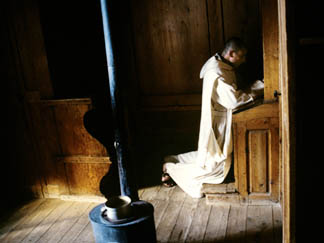
Three German documentary filmmakers who have had an impact on the documentary world: Werner Herzog – no comment necessary or if so, watch his latest film ENCOUNTERS AT THE END THE WORLD (by the way, not a German production). Volker Koepp – from his Wittstock-series in the 70s up to his last two films SONS and ELDER BLOSSOM in 2007, he has been exploring unknown Eastern territories and has introduced us to unforgettable protagonists such as Mr. Zwilling and Mrs. Zuckermann in a very unique and human approach. Philip Gröning – for creating a 3-hour-documentary about Carthusian monks which turned out to become not only an international festival-hit, but one of the most successful German documentaries in cinemas at home and abroad (INTO GREAT SILENCE, pictured).

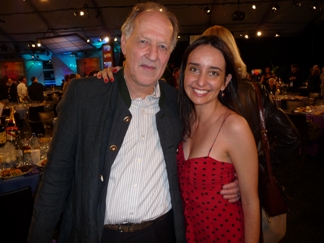 Me with the one and only Werner Herzog. He remembered meeting my father a few years back and insisted that I take this photo for Jack.
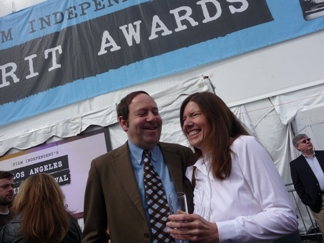 Josh Braun of Submarine Entertainment sharing a laugh with Diane Weyerman of Participant Media at the Independent Spirit Awards.
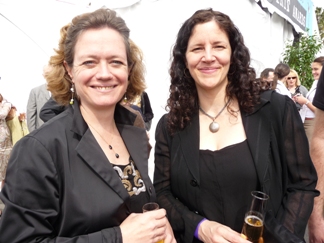 Filmmaker Laura Poitras (MY COUNTRY, MY COUNTRY) with Cara Mertes of the Sundance Institute at the Independent Spirit Awards.
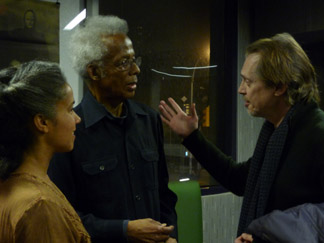 I knew the William Greaves Tribute was going to be special when I got a call on Monday from Sidney Poitier in Los Angeles. Since he couldn’t honor Greaves in person, he asked me to read a note on his behalf: “I have had the privilege of working with William Greaves and will always remember how gifted he has been in life and as a groundbreaking filmmaker…. He has given us visions of the best in ourselves and reminds us to always reach beyond our grasp.”
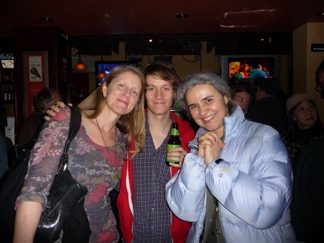 L to R: Director Lucia Small, filmmaker Robert Hatch-Miller and Pola Rapaport, director of WRITER OF O.
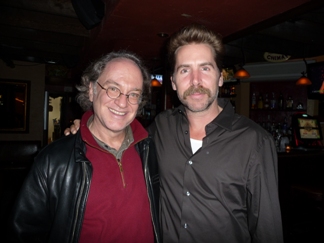 David Leitner and Ian Vollmer – coincidentally both have worked as DPs for Alan Berliner (Leitner on NOBODY’S BUSINESS and Vollmer on WIDE AWAKE). Berliner’s film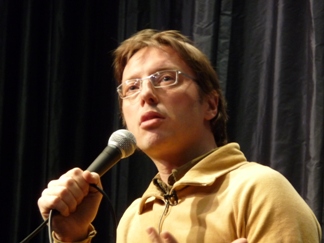
 Each summer as I review submissions for the Toronto International Film Festival, I look forward to receiving a big package of screeners from Sandra Buchta, who leads documentary promotion for