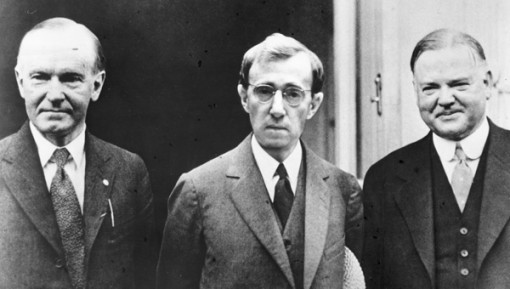
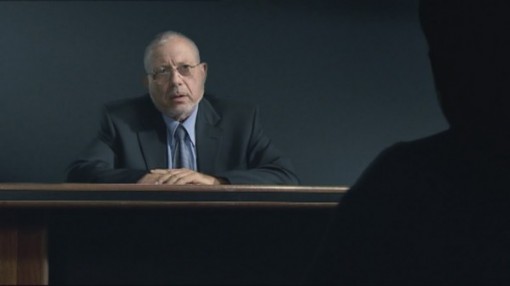
Woody Allen’s mockumentary ZELIG and Dana O’Keefe’s AARON BURR, PART 2 have in common a dedication to characters lost to history. ZELIG is prescient in its foretelling of a person lacking any defining characteristic who is nonetheless celebrated as an artifact of mass culture, then discarded and forgotten about (Jon and Kate, anyone?). O’Keefe, for his part, in AARON BURR, PART 2 explores a revisionist history of his titular character, but displaces period setting in favor of the present. Both films question the criteria by which our society celebrates its heroes, and defames its villains. After watching them, one can’t help but consider that what might be of paramount importance today, in 100 years might just be a parking lot in Weehawken. Following the screening, Stranger Than Fiction Artistic Director Thom Powers spoke with Dana O’Keefe and actor/score composer Alex Kliment. Click “Read more” below for the Q&A.
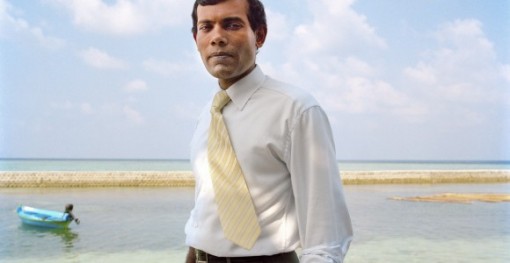
President Mohamed Nasheed, the subject of THE ISLAND PRESIDENT, was deposed this week.
Jon Shenk’s well-received film THE ISLAND PRESIDENT took on an urgent relevance this week, after news broke that Mohamed Nasheed, the president of the archipelego nation of the Maldives, had resigned on February 7, reportedly at gunpoint. Shenk’s film center’s on the struggles of Nasheed, a former rights activist and the first democratically elected leader of the Maldives, to draw attention to the threat posed to his country by rising sea levels resulting from climate change. News reports out of the Maldives indicate that officials loyal to former dictator Maumoon Abdul Gayoom have since effectively seized control of the government. The New York Times has an overview of the turmoil here.
The Times on February 8 published on its website an op-doc by Shenk containing excerpts from THE ISLAND PRESIDENT that can be viewed here. Shenk also released a statement to the press about Nasheed’s ouster, which read in part, “This is not the first time that Nasheed has suffered a political setback in his fight for justice in the Maldives. We expect this is just the next chapter. We are deeply concerned for Nasheed’s safety, we stand in solidarity with him and hope others will join us.”
In news closer to home, Documentary Fortnight 2012, the Museum of Modern Art’s nonfiction film festival, is set to begin February 16 and run until February 28. MOMA describes the program as a “selection of international feature-length and short documentaries from around the world represents the wide range of creative categories that extend the idea of the documentary form and reflect on new areas of nonfiction practice.” The complete eclectic schedule can be found here. (Hardcore doc watchers may want to consider springing for a MOMA membership.)
A still from THE LAW IN THESE PARTS, which won Sundance’s world cinema grand jury documentary prize.
In our second roundup of reviews coming out of Sundance, we’ll take a look at THE HOUSE I LIVE IN; THE LAW IN THESE PARTS; and THE IMPOSTER. But first we wanted to point out the running diary of BBC Storyville editor Nick Fraser’s Sundance experience at Britain’s The Guardian newspaper. Fraser during a panel discussion spoke on whether docs are able to change the world. “I say they don’t, or rarely, and probably only in ways we can’t measure, though that doesn’t mean that we shouldn’t want them to do so,” he writes.
Eugene Jarecki’s THE HOUSE I LIVE IN, a look at the wide-ranging effects of the U.S.’s failed War on Drugs, impressed Sundance jurors enough to take home the festival’s documentary grand jury prize.
Writing for The Hollywood reporter, John DeFore said the film balances “big-picture stats with personal perspectives, it should connect solidly with viewers at a moment when it seems possible to change public attitudes.”
Working methodically, Jarecki’s nearly two-hour film views the war from a number of perspectives too great to summarize here. Crucially, while he speaks to academics who have long argued for drug-law reform, he also goes to those most directly involved in enforcing the laws: a U.S. District Court judge in Iowa, an Oklahoma corrections officer who’s an avowed law-and-order man; numerous narcotics officers. They tell him variations of the same thing: Our laws aren’t working to decrease drug use; we’re putting too many people away for too long and doing too much harm to their families.
GASLAND director Josh Fox (left) was arrested attempting to videotape a House subcommittee meeting on fracking.
Documentary news this week was dominated by the arrest of Oscar-nominated director Josh Fox at a House subcommittee meeting on Wednesday. Fox was reportedly shooting the meeting as part of his work on the sequel to GASLAND, his investigation of the environmentally destructive practice of hydraulic fracturing, or “fracking,” used to extract natural gas. The congressional hearing was held to discuss an Environmental Protection Agency report on the effect of fracking practices in Pavillion, Wyoming. According to media reports, Fox has had increasing trouble attending congressional meetings on the controversial practice of fracking ever since the Republicans seized control of the House in the 2010 elections. Raw footage of his arrest is below.
Fox, who was charged with unlawful entry, and was processed and released later that day. He subsequently released a statement to the press which read, in part:
As a filmmaker and journalist I have covered hundreds of public hearings, including Congressional hearings. It is my understanding that public speech is allowed to be filmed. Congress should be no exception. No one on Capitol Hill should regard themselves exempt from the Constitution. The First Amendment to the Constitution states explicitly “Congress shall make no law…that infringes on the Freedom of the Press”. Which means that no subcommittee rule or regulation should prohibit a respectful journalist or citizen from recording a public hearing.
One of the most talked about docs out of Sundance was Lauren Greenfield’s THE QUEEN OF VERSAILLES.
We thought we’d take a look at some of the recent reviews of Sundance docs that came out over the past few weeks. Even before the festival had begun, Lauren Greenfield’s THE QUEEN OF VERSAILLES was grabbing press coverage after she and Sundance were sued by one of her subjects, David Siegel, who alleged that he had been defamed in the festival’s promotional descriptions of the film. All the publicity may have helped the film, about the rise and fall of one family’s economic fortune, snag its North America distribution deal with Magnolia Pictures.
The Hollywood Reporter’s John DeFore described the film as “a particularly lurid look at pathological excess.”
To a certain extent, Greenfield gives her subjects enough rope to hang themselves as they moan over their diminished economic clout: David paints a picture of callous bankers who, having made him addicted to cheap credit, are now yanking the rug out; Jackie whines that she thought the federal bank bailout was supposed to eventually benefit “the common people … us.” The lack of self-awareness is staggering. But it’s also clear that on some level Greenfield likes these boors—that she gives them more credit than they deserve for small virtues, and bizarrely views their hyperbolic selfishness as a crystallization of the American Dream.