First-time director Lotfy Nathan's 12 O' CLOCK BOYS is screening at SXSW this year.
For someone mired in New York City’s dark winter for far too long, South by Southwest holds the promise of warmer climes, reasonably priced barbeque and cold beer. This year–like any other–the festival’s programmers have put together a selection of non-fiction work designed to entice any self-proclaimed fan of documentary out of the sunshine and into a darkened theater. Here are five films I think are worth waiting in line for.
THESE BIRDS WALK (Visions) Last summer Filmmaker magazine anointed the duo of Omar Mullick and Bassam Tariq as among the 25 new faces of indie film, and for good reason. The pair earned a mountain of press for their 30 Mosques in 30 Days documentary project and its user-generated offshoot, 30 Days of Ramadan. Mullick and Tariq banned both voiceover and talking heads in the making of THESE BIRDS WALK, a portrait of a young runaway living in Karachi, over which hovers the story of Pakistani humanitarian Abdul Sattar Edhi. The film comes to Austin fresh from a screening at the True/False Film Fest, where it built both buzz and a solid base of support among viewers. Watch the trailer; if there’s a heart beating in your body I promise you will have goosebumps.
12 O’CLOCK BOYS (Feature Competition) Lotfy Nathan’s directorial debut ostensibly follows the not-quite-yet teenager Pug as he seeks to align himself with an outlaw dirt bike gang that runs roughshod over the streets of Baltimore. But the clear subtext of 12 O’CLOCK BOYS is the dire economic and class divisions that drive Charm City’s young bikers to define themselves oppositionally to the Baltimore police, along with pretty much any other established social institution. Nathan’s film ends with a major catharsis for his subject, but probably not in the way you’d expect.
Continue reading…

The Act of Killing by Joshua Oppenheimer was one of the films that screened at True/False this year.
The focus of much of the doc world was in Columbia, Missouri, this weekend for the 10th True/False Film Fest. At the POV blog, Tom Roston recapped his experience, explaining how the festival’s idiosyncrasies add up to a great film experience. Roston earlier in the week had also described why True/False is a standout among festivals. For a look at news that came out of the festival, you can head over to the news section of their website.
LEVIATHAN from directors Lucien Castaing-Taylor and Véréna Paravel got a great press bump in advance of the theatrical release of the film this weekend at the IFC Center. Writing for Filmmaker Magazine, Robert Greene shared his take on the film, describing it as the “progeny of direct cinema, experimental film and ethnography,” while Anthony Kaufman of the SundanceNOW blog considered some of the film’s horror genre-like qualities. At the Documentary Channel blog, Christopher Campbell spoke with Castaing-Taylor, while Indiewire’s Eric Kohn spoke with both Castaing-Taylor and Paravel. Rich Juzwiak of Gawker also had an in-depth look at the film, and Forrest Cardamenis of The Film Stage and Melissa Anderson of the Village Voice both reviewed the film.
Continue reading…
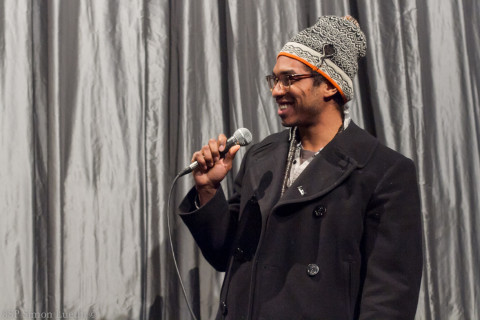
Terence Nance discusses the complex origins of AN OVERSIMPLIFICATION OF HER BEAUTY. Photo by Simon Luethi.
In 2006, filmmaker Terence Nance made a short film called How Would You Feel? Though it was billed as a fictional narrative, How Would You Feel? stars Nance and his close friend, Namik Minter, as versions of themselves. The film also dramatizes actual events and emotions experienced by Nance and Minter, as told through Nance’s perspective. Years later, Nance decided to put How Would You Feel? in context, using interviews, animations, letters, and home movies to tell a more complete, if still personal and subjective, story. The resulting film is his feature documentary, An Oversimplification of Her Beauty. Oversimplification demonstrates the ways in which fiction can be used as a tool to convey truth and explores the challenges that arise when such truth is one-sided.
Oversimplification was the final film screened as part of STF’s Winter 2013 season. After the screening, Nance spoke with STF’s Thom Powers about the origins of his film and the success it has had over the past year.
Continue reading…
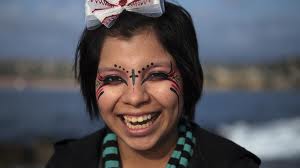
The film INOCENTE from directors Sean Fine and Andrea Nix Fine took home the Oscar for best short documentary this year.
Coming as no surprise to anyone, SEARCHING FOR SUGAR MAN by Swedish director Malik Bendjelloul–which screening in DOC NYC’s short list section last year–took home this year’s Oscar for best documentary, after going on an impressive awards run that lasted pretty much all year. The Oscar for best short-form documentary went to INOCENTE from directors Sean Fine and Andrea Nix Fine; the film follows a young, undocumented and homeless artist in San Diego.
For those interested in the practice of Monday morning quarterbacking, there was no shortage of prognostications prior to Sunday’s awards ceremony, with SEARCHING FOR SUGAR MAN named as the odds-on favorite by most, including Adam Benzine of Realscreen. He was joined by Richard Corliss of Time and Tom Roston on the POV blog. On the New York Times Carpetbagger blog Larry Rohter considered how the recent voting rules changes had helped SUGAR MAN. Rohter also spoke with HOW TO SURVIVE A PLAGUE director David France about his filmmaking education, while Peter Knegt of Indiewire also talked to the team behind the film. At Movies.com Christopher Campbell wondered whether the “most important” doc films would win awards. At AwardsDaily.com, Brian Whisenant similarly considered how important docs stacked up against entertaining ones. In another post for POV, Tom Roston recalled Michael Moore’s 2003 acceptance speech denouncing the Iraq War. Writing for the Documentary Channel blog, Christopher Campbell made the argument that THE INVISIBLE WAR director Kirby Dick deserved greater recognition for his professional body of work. (Campbell’s argument was helped by the fact that Dick’s film picked up the best documentary award at this year’s Independent Spirit Awards, and that it also won the 2013 Ridenhour Documentary Film Prize.)
Continue reading…
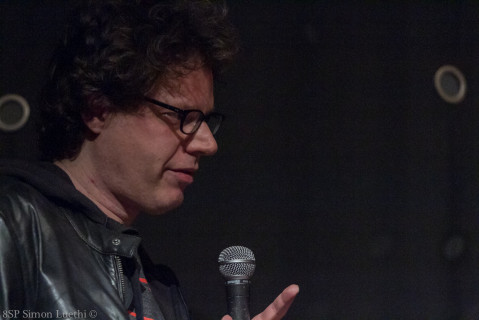
Filmmaker John Walter shares his admiration for Shohei Imamura and A MAN VANISHES
It is appropriate that Shohei Imamura’s A Man Vanishes, a documentary about a missing person and the often blurry distinctions between fiction and truth, was nearly impossible for U.S. audiences to see for nearly 40 years. In late 2012, the film’s belated U.S. release was met with praise from critics; Manohla Dargis wrote that, had A Man Vanishes premiered at Cannes that year, “it would have been hailed as a thrilling discovery.” In the film, the man who has disappeared is Tadashi Oshima, an unassuming middle-aged businessman, and Imamura attempts to aid in the search for him by interviewing those closest to him. The deeper the search goes, however, the more complicated it becomes, and more questions are raised about the true motives of those involved. A Man Vanishes is a fascinating exploration of the boundaries of reality, and its reflexivity makes it a film as much about the documentary medium as it is about the search for Oshima.
After the screening, STF’s Thom Powers invited filmmaker John Walter (How to Draw a Bunny, Theater of War), a longtime Imamura enthusiast, to join him in discussing the film and Imamura’s work as a whole.
Continue reading…