


Q&A: Barry Avrich on Lew Wasserman, THE LAST MOGUL


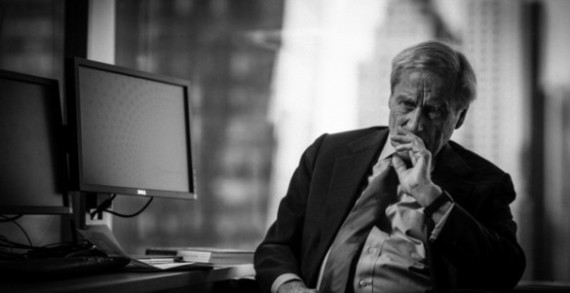
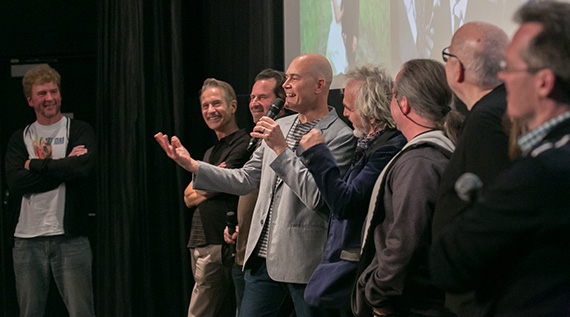
Filmmaker Barry Avrich answers audience questions following the STF screening of his film about Hollywood mogul Lew Wasserman. © Jasmin Chang

This post was written by STF blogger Krystal Grow.

There was a time when movies were made by men with relentless energy and a uncompromising quest for greatness who made some of the biggest films in Hollywood history possible, and changed the landscape of how major motion pictures were made forever.

Lew Wasserman grew up on the “rat infested” east side of Cleveland and got his start in show business in speakeasies and brothels in the 1920s, where he became good friends with rising stars and influential mobsters. In 1936, he became a publicist for MCA, then a musical booking agency with intricate ties to the Chicago mob. By 1938, MCA was managing 90 percent of the Chicago’s nightlife talent.

Over the next four decades, Wasserman transformed MCA from a one-trick booking agency to a multi-platform conglomerate, producing radio shows and motion pictures, and later spearheading the company’s foray into television, a move many other entertainment agencies and media companies were reluctant to make. But Wasserman, now a power player in Hollywood with a roster of influential friends, executed a strategy that allowed him and his company to dominate a fledgling medium, producing shows like Alfred Hitchcock Presents, Amos and Andy, Dragnet, Wagon Train and The Jack Benny Program.

He also pioneered the TV mini-series, an innovation that further solidified his role as a force to be reckoned with in the increasingly competitive world of movies and television. In a deal that was unheard of for it’s time, he brokered the purchase of Paramount Pictures’ entire pre-1950s archive, which he ran in syndication, another first for the last great Hollywood mogul.

As famous for his commanding demeanor as he was for his resistance to accolades and public appearances, Wasserman captivated director Barry Avrich to follow his career for much of his life. Avrich committed to the idea of making a film about his legendary status among Hollywood high rollers.

“I was one of those nerdy kids reading Variety from age eight, so I followed him and I watched him and I was amazed at him and the entirety of his career. I knew that this was going to be a complex film to make about six decades of power,” Avrich said in a Q&A following the screening of the film at the Stranger than Fiction series at the IFC Center. A revealing look into the man behind mega hits like JAWS, THE STING and AMERICAN GRAFFITI, THE LAST MOGUL is a film as much about an individual career as it is about an entire industry, one that’s seen drastic change at the hands of technology, consumer culture and the constantly evolving Hollywood studio system. It’s a chronicle of one man’s unprecedented rise to power, and a shocking and complicated series of missteps and bad deals that led to his demise. But the legend he left in his wake shaped the way Hollywood as a whole functioned, and left generations of would-be moguls still struggling to achieve even a fraction of his greatness.

FULL Q&A

Thom Powers: What got you started on making a film about Lew Wasserman?

Barry Avrich: I met Lew and I told him I wanted to make a film about him and he said, ‘It’ll never happen whether I’m alive or dead.’

Powers: What did you know about Wasserman that made you want to know more about his career?

Avrich: I was one of those nerdy kids reading Variety from age 8, so I followed him and I watched him and I was amazed at him and the entirety of his career. I knew that this was going to be a complex film to make six decades of power. And the Wasserman family came after me big time. I’d have interviews scheduled with major power players and [the family] would make phone calls and say, “No, you’re not going to participate in that film” and then I’d have doors slammed in my face, and in studios setting up. I was followed. I was threatened.

Powers: But for all that you have some incredible power players, Jack Valenti, President Jimmy Carter, big producers…
Continue reading…


Monday Memo: Sundance Doc Edit and Story Fellows Named


The film (T)ERROR from directors Lyric Cabral and David Felix Sutcliffe was among those selected for participation in the Sundance Institute documentary edit and story lab.

This week the Sundance Institute named this year’s fellows for the documentary edit and story labs. Writing for Realscreen, Manori Ravindran covered the news, as did Nigel M. Smith of Indiewire.

The film NORTHERN LIGHT from director Nick Bentgen began a run at the Maysles Cinema this week. On the True/False Fest blog Chris Boeckmann posted an interview conducted with Bentgen about a year ago. Lance Edmands of Hammer to Nail also had an interview with Bentgen, while Jeannette Catsoulis of the New York Times awarded it a Critics’ Pick.

Basil Tsiokos turned out a slew of overviews of some upcoming film festivals and events on his blog, What (Not) to Doc. Among the events he looked at were the BAMcinemaFest, the American Black Film Festival, the AFI Docs festival, and the Edinburgh International Film Festival.

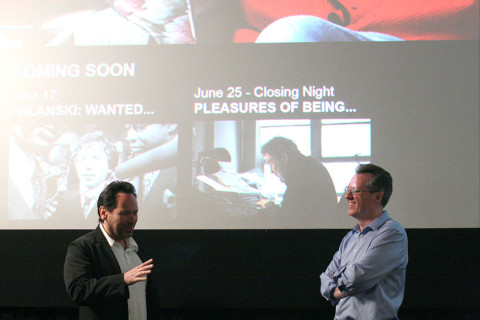
This week Stranger Than Fiction closes out its spring/summer season with a special Wednesday screening of THE PLEASURES OF BEING OUT OF STEP, a profile of music critic Nat Hentoff from director David L. Lewis, on June 25 at 8 p.m. at the IFC Center in Manhattan. Following the screening, Lewis will be in attendance for a Q&A. For more information or to purchase tickets please go here.

Continue reading…


Q&A: Paul Devlin and The Loaded Poets


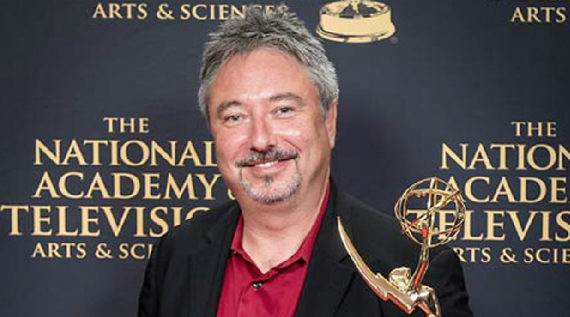
Director Paul Devlin leads a Q&A with his film subjects, members of the band The Loaded Poets following an STF screening of THE FRONT MAN.
© 8 Salamander Productions, Simon Luethi

This post was written by STF blogger Krystal Grow.

Following the STF screening of THE FRONT MAN, filmmaker Paul Devlin leads a Q&A with his film subjects, members of the band The Loaded Poets and their musician friends.

FULL Q&A

Thom Powers: How did you start filming this and what was the evolution of this film.

Paul Devlin: Well, it started because I had to answer the question of “what’s your next movie?” and I was doing a lot of different projects and I said to Jim one day, “I’m just going to start showing up with a camera every time we get together and see what happens,” and it was really just for fun at first and we had a really good time. It was a lot of laughs, and we were just joking around. And then things started to evolve and the ‘baby no baby’ sequence happened, and then she actually got pregnant, and then I realized “ok this is more than just a gag.” And then we just kept shooting and I would do other films and drop it for a year or two and then Jim would say that something was happening and we’d start again and I’d edit through the whole thing, and then we brought Glen and Graham into it and that brought a whole other dimension to it.

Powers: Jim, from your end, Paul followed you around with a camera for many, many years. What did you think of this process?

Jim Wood (The Loaded Poets, vocals): I loved it. Paul said, “I want to follow you around with a camera and see if anyone who doesn’t know you will think you’re funny,” which is kind of insulting, you know, but by the time we played it to a room full of strangers and they liked the film, I said “We’re done, mission accomplished.” It was over a long, long period of time, so there would be months, almost years where nothing would happen at all. I think the most profound thing for me is watching myself, taking a step back and watching my life on screen. He fixed my life in the editing, you know? So, I now realize I’m leading a charmed life because of the film. Whereas in the day-to-day shooting, it’s not so great.

Continue reading…


Monday Memo: Sheffield Prizes Go To ATTACKING THE DEVIL, A SHORT HISTORY OF THE HIGHRISE


The film ATTACKING THE DEVIL from directors Jacqui Morris and David Morris took home the jury prize from this year's Sheffield Doc/Fest.

This year the Sheffield Doc/Fest Special Jury Award went to ATTACKING THE DEVIL: HAROLD EVANS AND THE LAST NAZI WAR CRIME from directors Jacqui Morris and David Morris. Writing for Indiewire, Casey Cipriani had coverage of all of the awards, as did Manori Ravindran at Realscreen. Christopher Campbell of Nonfics.com broke up his coverage of the festival into five parts, which you can find here: part 1, part 2, part 3, part 4, part 5. Filmmaker Laura Poitras also issued a statement after accepting the festival’s Inspiration Award in absentia. At Realscreen, Adam Benzine spoke with THE OVERNIGHTERS director Jesse Moss. Writing for Indiewire, Paula Bernstein broke down a potential formula for winning an Oscar for best doc.

The folks at Televisual wrote a post laying out some of the themes they found in the the Sheffield Doc/Fest commissioning panels. Writing for The Hollywood Reporter, Stephen Dalton reviewed THE LAST MAN ON THE MOON from director Mark Craig. At the DocGeeks blog, Ben Unwin reviewed REGARDING SUSAN SONTAG from director Nancy Kates. Adam Benzine of Realscreen also spoke with Alex Gibney regarding his film FINDING FELA. Paula Bernstein of Indiewire covered a master class at the festival from director Joe Berlinger. Bernstein also wrote a piece on the increasing difficulty of making a living as a documentary filmmaker.

Writing for Leveled Magazine, Jamie Maleszka previewed the Human Rights Watch Film Festival. At Nonfics.com, Daniel Walber made a list of the five best films screening at the fest. And Basil Tsiokos provided an overview at his What (Not) to Doc blog.

This week Stranger Than Fiction is hosting a screening of ROMAN POLANSKI: WANTED AND DESIRED from director Marina Zenovich on Tuesday June 17 at 8 p.m. at the IFC Center in Manhattan. The film investigates the sexual assault case that embroiled the filmmaker decades ago. Following the screening film critic Scott Foundas will be in attendance for a Q&A. For more information or to purchase tickets please go here.

Continue reading…


Q&A: Filmmaker Ursula Liang on 9-MAN


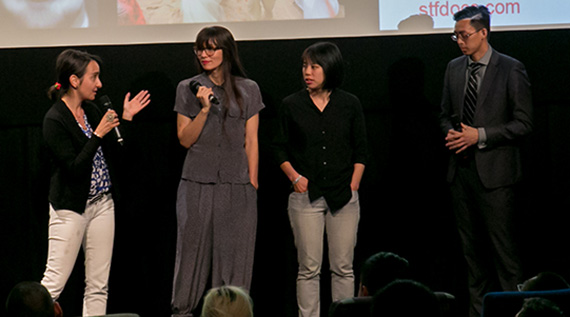
STF Executive Director Raphaela Neihausen in conversation with filmmaker Ursula Liang, editor Michelle Chang and film subject and athlete, Wayne Chow, following the screening of 9-MAN. © 8 Salamander Productions, Simon Luethi

This post was written by STF blogger Krystal Grow.

Sports journalist Ursula Liang waited for years for someone to recognize the phenomenon know as 9-Man in Chinatowns across North America, but eventually picked up a camera and started shooting herself.

Liang’s interest in 9-man volleyball is both personal and objective. As a German-Chinese sports journalist whose brother was deeply involved in the game and the community that surrounded it, she sensed the drama on the blacktop courts and empty parking lots where most 9-man games are played. She was invested in the culture surrounding the game, but with no allegiance to any particular team, she was able to tell a bigger story in her film – one about Chinese-American identity, the unique history of Chinese immigrants and their struggles to establish something truly their own.

In her first film, Liang dives into a distinctly Chinese-American game that has exploded into a community of dedicated players striving to maintain a connection to their culture. Logistically speaking, the rules of 9-man are more rigid and complicated than a standard, 6-person volleyball. Though players don’t rotate positions, they can make contact the with the ball twice in a row. While these variations have attracted volleyball players from around the world, it’s another set of rules that have remained a key point of contention among and outside the 9-man community.

‘Content rules,’ as defined by a group of 9-man elders and passed on through the generations, states that only Asian Americans are allowed to play. There are various percentage rules that define which position a player can occupy, and if a player’s racial integrity is questioned, they must present proof of their Asian heritage to tournament officials or be barred from the court.

Liang said the content rules were initially enacted to maintain the cultural significance of the game, which originated during the early days of Chinese immigration to North America as a way for Chinese men to build community during a bleak period of Chinese-American history. As the years have passed, younger generations of Chinese men, who spend their lives outside the tight-knit Chinatown community, see 9-man as a way to reconnect.

The cultural significance of 9-man makes the annual Labor Day tournament far more than a game. It is a yearly statement of the game’s legacy and the feverish loyalty of the men who play. By following a few select teams from their off-season practices through the final round of the grueling 4-day tournament, Liang captures the elements that make the best sports movie riveting, and the most effective documentaries captivating: drama, suspense, surprise and characters the audience can truly root for.

FULL Q&A

Raphaela Neihausen: How did you come to know about 9-man, how did you start shooting this film, and how did you come to this project?

Ursula Liang: My brother played 9-man. He played a lot of sports and so did I, but when I saw him play this sport, I saw the importance it took in his life. He came to it in his 20s, and the 9-man community became incredibly important to him. I saw that there was something else there greater than just a sport. I’d been a print journalist for most of my life, and this is my first film.

Neihausen: Let’s clap for that.

Continue reading…