It’s an all too familiar story – a peaceful protest fueled by a deep desire for change becomes a violent battle for basic human rights. In the past few years, we’ve witnessed the rise of revolutions in Egypt, in Spain, and in the US, but on the opening night of the Fall season of Stranger Than Fiction, we had a front row seat to an uprising in The Ukraine, and a country’s struggle for independence, freedom, and a better future.
WINTER ON FIRE: UKRAINE’S FIGHT FOR FREEDOM follows 93 days of protests that began in Kiev’s Maidan Square, following then-president Viktor Yanukovych’s refusal to sign an agreement that would allow his country to enter the European Union. The people of Ukraine saw inclusion in the EU as a move that would help stabilize the long-flailing country, and usher in a new era of hope, independence, and eventual prosperity. But Yanukovych instead signed a major deal with Russian President Vladimir Putin, and in the eyes of millions of Ukrainians, betrayed his country and his people.
Director Evgeny Afineevsky brings viewers to the front lines of this turbulent time in Ukraine’s history, and shows how a peaceful youth movement morphed into a bloody struggle. With a crew of over 20 cinematographers using a combination of cameras, Afineevsky and his team capture the major battles and hidden moments that fueled a revolution.
“For the people of Ukraine, this was an important moment in their history, and a chance for them to show that the people still have the power,” Afineevsky said during the Q&A following Tuesday’s screening at the IFC Center. “It started as a joyful youth movement. No one expected thing to unfold the way they did.”
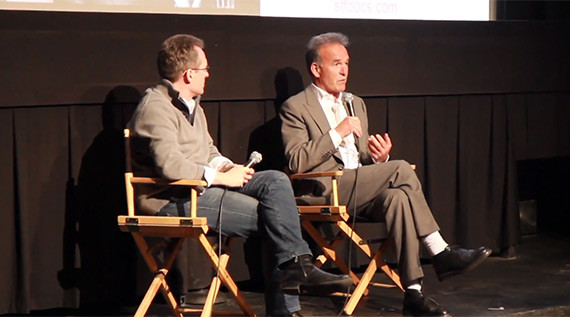
In a special appearance in the IFC Center’s Stranger Than Fiction documentary series, director Nick Broomfield screened AILEEN: LIFE AND DEATH OF A SERIAL KILLER. “Of all the films I made maybe it was one of the most affecting,” Nick shared.
Aileen leaves its audience in a murky wake that questions how society treats the incarcerated, views the death penalty, and addresses mental health. Aileen exposes the surreptitious ties between the media, the election process, and the United States justice system. It begs a deeper, honest exploration of the driving forces behind what justice is, and what it looks like in American society.
On October 9, 2002 Aileen Wuornos, a former homeless, hitchhiking prostitute was executed by lethal injection for the murder of seven men. In her first trial in 1992, the jury bears witness to Aileen’s searing testimony of a man who poured rubbing alcohol into her rectum and eyes before raping her. She killed him in self-defense, but was found guilty and sentenced to death. Upon sentencing, Aileen, visibly distraught and angry, had the unmistakable look of someone betrayed.
Trust did not play an integral role in Aileen’s difficult life. Her girlfriend and local police tried to sell her story to Hollywood. When one cop objected to selling her story, he was taken off the case, and no proper investigation was ever conducted. The timing of Aileen’s execution corresponded to Florida Governor Jeb Bush’s reelection trail. Bush endorsed her execution, and his running mate Brad Thomas, an advocate for a swift death penalty, said, “Bring in the witnesses, put them on a gurney and let’s rock and roll.”
Aileen did trust director Nick Broomfield. In a rousing Q&A, Broomfield shared, “We had the distinction of being the only film crew that had been strip searched before they went in, and Aileen thought we were tremendous. She thought we were part of a—I mean this is just how crazy it was—she thought we were part of a band that were playing that night in the prison, and I said ‘no Aileen we’re actually here to interview you today’, but she just decided we were great, we had driven all over the lawn, we’d upset the guards, so she was kind of wonderfully open from the beginning.”
In the span of her ten years in jail, Broomfield witnessed how Aileen Wuornos changed her story from self-defense, to murder in cold blood, thereby expediting her death sentence. In an interview scene with Broomfield where Aileen does not know Broomfield’s camera is on, he asks her why her story changed and if her first murder was in self-defense. She whispered, “Yes but I can’t tell anyone, there’s nothing I can do about it, they would never do me righteous. I would never be able to handle a life sentence, they’re evil to people who are incarcerated.”
In Broomfield’s last interview with her she was convinced that since 1997 she was tortured via sonic pressure on her head, she was ready for her execution, and that death would be “more like Star Trek and I know it will be good because I didn’t do things as bad as they said I did.” Broomfield asked her what got her to kill the seven men, and her voice pained and heated, she exclaimed, “I was a hitch hiking hooker and if there was physical trouble I would hurt them. Couldn’t get a fair trial, couldn’t get a fair investigation. Movies, books, reelection–you sabotaged me society, a raped woman gets the death sentence!”
Asked about his ethical considerations in documenting footage without her knowledge, Broomfield said, “it goes in a sense to the heart of my involvement as a witness. We managed to catch her saying something like ‘I killed the first one in self defense’. I felt this was really the essence of the whole thing. She was somebody who had killed once in self-defense, she then got into killing, and I think the other people she killed was for money. I don’t think she was a proper serial killer. The number made her a serial killer but she wasn’t into the fetish of killing. That justified leaving that footage in there, because for me, it told the world who Aileen Wuornos really was.”
Broomfield beautifully and charismatically concluded the evening on the power of spontaneity and the craft of documentary making. “I think the style of making documentaries currently is very much beautifully composed shots with people sitting in chairs and then cutting between them and kind of chucking a few pictures of graphics in between, which I don’t think is great documentary film making. I think reality is so fascinating, and people are so unbelievably weird and incredible, the way they deal with things, the cast of characters in this film you could never really write them, and I think that is the power of documentary I’m so pleased to film.”
The Stranger Than Fiction Spring 2015 season runs through June 2. The line-up includes sneak previews of highly anticipated docs such as SUNSHINE SUPERMAN and THE WOLFPACK along with revivals of classic docs such as Alan and Susan Raymond’s THE POLICE TAPES (1977), The series takes place each Tuesday night at the IFC Center.
Writing by Megan Scanlon. For the last decade Megan has been working in the field of education both internationally and domestically. She has written for the DOC NYC blog as well the Journal of Community Engagement and Scholarship, and is a volunteer at the Bronx Documentary Center.
Videography and photography by Steff Sanchez, a filmmaker and designer based in New York City. Twitter @steffsanchez.
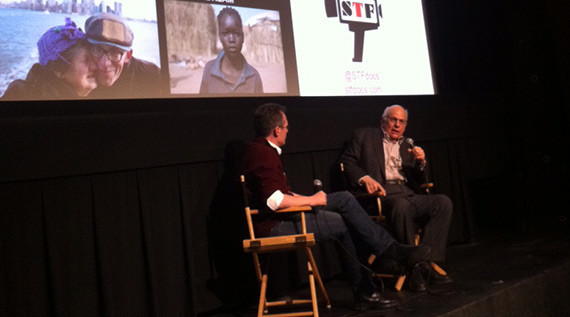
STF Artistic Director Thom Powers discusses NAM JUNE PAIK & TV LAB: LICENSE TO CREATE with the director of the film, Howard Weinberg.
In a shocking moment of clairvoyance, a collective of artists realized that television did not have to be taken at face value. It was a medium as pliable as paint and as immediate as film, and in the 1970s, its creative potential seemed nearly limitless. The late 1960s saw the rise of cinema verite and experimental filmmaking, but television was still ruled by big broadcasting and the mainstream media. But under the bright lights of New York City’s WNET public television studios, the entire format was being dismantled, reimagined, and radically rearranged.
TV Lab was an incubator of early video art that would come to foreshadow the current state of media saturation and fragmented imagery that we now know as social media, information sharing and ceaseless video streaming. There are an abundance of ways to interact with video now, but in the 1970s and early 1980s, the technology associated with television broadcasting was inaccessible to the average, creative types who wanted to try something different. TV Lab gave them that chance.
In what Stranger Than Fiction Artistic Director Thom Powers called “a relentless effort to excavate an era of TV history,” director Howard Weinberg’s NAM JUNE PAIK & TV LAB: LICENSE TO CREATE documents the rise of early experimental television through the people who paved the way. With Paik and executive producer David Loxton at the forefront, and with funding by the Rockefeller Foundation, WNET essentially turned their studios into a rotating, artist residency program, where for the first time artists and early video hackers had access to equipment, and to a community.
Paik, along with fellow artists Russell Connor, Bill Viola, and William Wegman, experimented with both the form and function of television by dismantling cameras and bending signals to create fascinating visual puzzles that were broadcast to the small masses who tuned in to WNET in New York. By turning television sets inside out and reprogramming them, they created tools the other artists could use in their own projects and programs, and they did, often to outrageous and powerful effect.
Journalists and documentarians hopped on board too, and saw an opportunity to tell stories that mainstream media outlets left untold. From gritty crime docudramas like THE POLICE TAPES (screening at STF on May 12), to political satire and socio-economic travel diaries, TV Lab was a platform that launched the careers of dozens of artists and filmmakers, and changed the way people looked at television.
“If you’re lucky in life, you will encounter some magic moments in time when you know what you’re doing is exciting, and to some degree, is needed,” filmmaker Jon Alpert says in in of the film’s many revealing and insightful interviews. “That’s what TV Lab let us all do.”
Writing and photography by Krystal Grow, an writer, producer and photo editor based in New York City. Follow her on Twitter and Instagram @kgreyscale.
Isaac Bashevis Singer (יצחק באַשעװיס זינגער) was a Nobel Prize-winning Polish author and a celebrated leader of the Yiddish literary movement in America. Although he was married to Alma Singer, Tuesday’s documentary, THE MUSES OF ISAAC BASHEVIS SINGER, shows that he had many women in his life.
Muses is a biopic that tells the story of Singer’s “harem” of female translators and proofreaders who he picked up with firm confidence, charmed and beguiled, and often bedded during his 85-year lifetime. These women served as the inspiration for the characters in his novels, which were charged with lustful desire.
Singer wrote and published dozens of collections of short stories in addition to 18 novels, 14 children’s books, several memoirs, and numerous essays and articles. He wrote them all in Yiddish and then sat with women who translated them line-by-line into English, and many more languages. One of the translators says in the film that he was a tireless worker with a remarkable ability to concentrate on one story for however long it took to finish it. “We will polish it until it will shine!” he would exclaim. Even bathroom breaks were frowned upon during the translation process.
Another translator in the film reads from the book, The Art of Translation, “A good translator must be both a sage and a fool.” His translators were loyal to him and many adored him, but he did not share the benefits of his fame with them. At the Q&A session with co-director, Asaf Galay, one of Singer’s fifty translators, Carol, was a surprise showing in the audience. She told some of her personal experiences with him and admitted that he only ever wrote her one check for her labors, which was a pittance that you couldn’t buy much of anything with.
Galay explained that he tried to edit the film like one of Singer’s stories. He constantly felt like Singer was behind him, watching over his shoulder, and he wanted to make a story that would have satisfied him. The film attempts to pose more questions than it does give answers in a similar style to a Singer story. And yet, the film reveals Singer as a controversial figure.
In 1983, Singer’s story, Yentl, was adapted into a film that starred singer, Barbara Streisand. In the Q&A session, Galay said that Singer didn’t get along with Streisand because he did not like the Hollywood movie adaptation of his novel. She would not participate in the documentary, because she did not want to rehash turbulence of the past.
Galay said that Singer was also very much at-odds with the Orthodox Jewish community, because of the morally precarious themes that permeate his writings. In an archival interview with Singer in the film, he was asked if he was a good Jew, to which he replied, “I’ve been a good man, so how could I be a good Jew? I’d like to be a good man and a good Jew, but who knows how you do that?”
Stranger Than Fiction begins again on Tuesday April 14 for its 27th season! STF Spring 2015 opens with KING GEORGES, followed by a Q&A with director Erika Frankel and film subject Georges Perrier. The line-up includes sneak previews of highly anticipated docs such as SUNSHINE SUPERMAN and THE WOLFPACK along with revivals of classic docs such as Alan and Susan Raymond’s THE POLICE TAPES (1977) and Nick Broomfield’s AILEEN: LIFE AND DEATH OF A SERIAL KILLER (2003). The series takes place each Tuesday night at the IFC Center.
Writing by Maya Albanese, a New York City based multimedia reporter, writer, producer, and filmmaker covering social and environmental sustainability as well as innovation in the arts, food, and technology worlds. Maya has produced content for print, digital, and broadcast media, including The Washington Post, The Huffington Post, NBC Nightly News, The Today Show, GreenBiz.com, Fresh Cup, Coffee Talk, Heritage Radio and TellurideTV. In 2015, she is producing two documentary films and will receive a Masters degree with an emphasis in Documentary Filmmaking from Columbia University’s Graduate School of Journalism. Twitter @mayaalbanese.
Videography and photography by Steff Sanchez, a filmmaker and designer based in New York City. Twitter @steffsanchez.
The picturesque sand dunes of Aberdeenshire, the ancient walls of Dubrovnik and the suburban sprawl of Bedminster, New Jersey may not have all too much in common at first glance. Yet for some they share an unexpected foe. Golf.
Stranger Than Fiction welcomed director Anthony Baxter and a host of guests at the screening of A DANGEROUS GAME, Baxter’s second film documenting the construction of luxury golf courses and their high environmental and personal cost to local residents.
The film is a follow-up to Baxter’s first documentary, YOU’VE BEEN TRUMPED. Released in 2011, the film documented the construction of Donald Trump’s, ‘Trump International Golf Links’ course, in an environmentally protected rural area on the coast of Scotland. Following characters such as local farmer and fisherman Michael Forbes, the film exposed their struggle against the billionaire mogul. A DANGEROUS GAME continued following the same characters, with highlights including Forbes’ receipt of the ‘Top Scot Award’ in the wake of the film, whilst also expanding to other examples of the problem in parts of the world such as Dubrovnik, Dubai and Las Vegas.
Though “they may not be Trump by name,” Baxter said in his introduction to the film, they are “Trump by nature.”
Combining compelling personal narratives and interviews with experts and celebrities such as Robert Kennedy Jr. and Alec Baldwin, A DANGEROUS GAME wove together touching tales of personal struggle enthused with geopolitical and environmental themes. Throughout, Baxter’s simple yet direct line of questioning to political leaders, and even Trump himself, evoked a strong response from the audience.
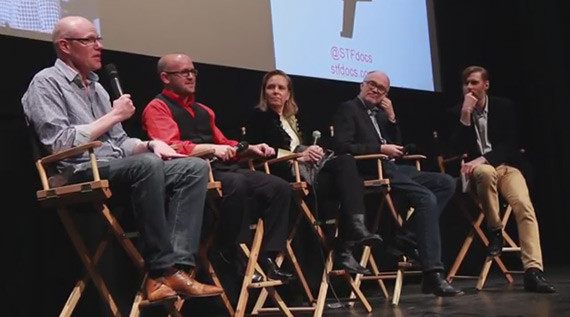
In the Q&A after the film, Baxter was joined by producer, Richard Phinney; executive director of the Raritan Headwaters Association, Cindy Ehrenclou and activist Justin Wedes, one of the organizers of the Occupy Wall Street movement.
A consistent theme in the Q&A and in the film was the golf courses as a manifestation of wealth inequality across the world. “I think it is revealing, especially in the second film, just how pervasive the notion of the 99% and the 1% has become in the mindsets of people in this country, but also around the world,” said Wedes. “It is this universal symbol now.”
Baxter also echoed this sentiment, referring to the disconnect between people living in a “Trump Tower” environment in comparison to ordinary people. He spoke with affection and reverence for the local people he had met along the way during his two films, referring particularly to the Scots in Aberdeenshire. “They did not ask for this fight,” he said. “They have shown huge courage and determination to stand up for their environment. And Donald Trump just does not seem to recognize that.”
Writer and producer on both of the films, Richard Phinney, also pointed out that there is a need to not only hold the financial figures pushing for these golf courses accountable, but also the political leaders responsible for approving them. “As societies, we really have to respond,” he said.
Stranger Than Fiction begins again on Tuesday April 14 for its 27th season! STF Spring 2015 opens with KING GEORGES, followed by a Q&A with director Erika Frankel and film subject Georges Perrier. The line-up includes sneak previews of highly anticipated docs such as SUNSHINE SUPERMAN and THE WOLFPACK along with revivals of classic docs such as Alan and Susan Raymond’s THE POLICE TAPES (1977) and Nick Broomfield’s AILEEN: LIFE AND DEATH OF A SERIAL KILLER (2003). The series takes place each Tuesday night at the IFC Center.
Writing by Chloe Mamelok, a multimedia journalist currently studying at the Columbia Graduate School of Journalism. Originally from the UK, Chloe graduated from Queen Mary’s University in London in 2013 before spending time in South America. Chloe is currently producing a short-form documentary and hopes to combine documentary production and investigative journalism in the future. Follow her on Instagram @chloemamelok and Twitter @chloemamelok.
Videography and photography by Steff Sanchez, a filmmaker and designer based in New York City. Twitter @steffsanchez.