Monday Memo: Cinema Eye, Oscar Anticipation & Sundance Previews


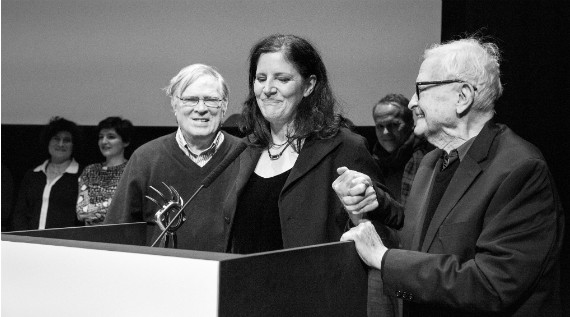
Laura Poitras at the Cinema Eye Honors podium flanked by D.A. Pennebaker (left) and Albert Maysles (right). Photo by Spencer Worthley.

With the heavyhearted departure of Rahul Chadha, whose been handling the Monday Memo here at Stranger Than Fiction for several years now, a large pair of soundly tuned shoes was in need of filling. So, with the blessing of Rahul, Thom and Raphaela, I will be attempting to serve as his dutiful replacement, shepherding this weekly roundup I’ve personally found quite useful and enlightening for the foreseeable future. Let me introduce myself: My name is Jordan M. Smith – the M. being necessary so I don’t get lost amongst the other millions of Smiths floating through cyberspace. You may know me from my film and festival coverage over at IONCINEMA.com where I’ve served as a staff writer for a few years now, or from my running commentary on life and cinema on Twitter. Most recently, I’ve been creating content and curating films for the recently launched Influence Film Club. I’m hoping with my experiences tracking the film festival circuit and watching upwards of 400 films a year, I could be of some use here at Stranger Than Fiction. So, without further ado, this week’s Monday Memo:

Among the big stories in the documentary world, nothing topped the disbursement of the 8th Annual Cinema Eye Honors, where CITIZENFOUR took home four of the major awards, including Outstanding Achievements in Nonfiction Feature Filmmaking, Direction, Editing and Production. Sarah Salovaara reported on the event for Filmmaker Magazine, as did Steve Pond for The Wrap, Nigel M. Smith at Indiewire, Adam Benzine for Realscreen, and Basil Tsiokos at his What (Not) Not To Doc blog. Before the honors were awarded, the filmmakers were taken on a surprise tour of New York City by none-other-than Timothy “Speed” Levitch, the legendary double-decker tour guide and star of “The Cruise,” on which Steve Dollar of the Wall Street Journal bore witness. Meanwhile, over at Indiewire, director Marshall Curry took the time to reflect on not only the tour, of which he happily took part in, but the Cinema Eye Honors themselves.

Next Monday the 19th, at the IFC Center, Stranger than Fiction will be hosting a screening of director Brad Bernstein’s FAR OUT ISN’T FAR ENOUGH: THE TOMI UNGERER STORY. Taking advantage of the fact that Tomi Ungerer himself will be in town for a retrospective of his work at the The Drawing Center in SoHo, both Brad Bernstein and Tomi Ungerer will be in attendance for a post screening Q&A. In light of the Charlie Hebdo tragedy, this should prove to be a timely and moving event.
Continue reading…


A Look Back at 2014 and Forward to 2015: An Interview with Thom Powers


Here’s my annual chat with Thom Powers—documentary programmer at the Toronto International Film Festival (TIFF) and SundanceNOW Doc Club, and artistic director of DOC NYC and the Stranger Than Fiction series—about the big documentary stories of 2014, and what we have to look forward to in 2015. Click here for our conversation from last year.

Rahul Chadha: What do you think was the one most important development in the doc world in 2014?

Thom Powers: I think the biggest thing that happened was the release of CITIZENFOUR. I can’t think of another documentary that has had as much far ranging impact as that film. Not just the release of the film, but also the work that Laura Poitras did leading up to it, dating back to the initial revelation of Edward Snowden in 2013.

Chadha: When I was thinking about the big doc stories of this year, the two docs I thought about were CITIZENFOUR and BLACKFISH, just because I feel BLACKFISH is the rare film in which the “impact” it’s had is easily quantifiable—there’s been a lot of reporting on how terribly SeaWorld is doing now, and it’s always attributed to BLACKFISH.

Powers: In that respect, I’d also point to THE INVISIBLE WAR, Kirby Dick’s film, which is repeatedly invoked by politicians trying to pass legislation around sexual assaults in the military. I’ll be very interested to see the follow-up to the film, THE HUNTING GROUND, that’s going to be premiering at the Sundance Film Festival. To your point, I think it does reflect a degree to which documentaries are playing a critical role at the center of culture.

Chadha: This year DOC NYC scheduled a whole day of panels dedicated to short content. We talked a little about short content last year, I was wondering if you could update your ideas about the topic.

Powers: I think it’s a growing area. A key player has been The New York Times, with their Op-Docs section that serves as a forum for independent filmmakers. But the regular New York Times video team produces short form video content of a high caliber every week. In the last year ESPN has expanded its short content. At the 2014 TIFF Doc Conference in September we had speakers from both of those companies—Jason Spingarn-Koff from the New York Times Op-Docs and Dan Silver from ESPN, and also an emerging player, Jed Weintrob, who oversees short form content for Conde Nast publications. In December, Conde Nast got a position on Apple TV under the banner “The Scene,” where that short form content is being platformed. That’s to say nothing of all the short form content that’s on platforms like YouTube and Vimeo. What’s significant here is that five years ago, for a doc maker to produce a short film, there were very few outlets. HBO has a special knack for acquiring Oscar nominated shorts. But there weren’t too many other places to get your money back. Now, there are a lot more opportunities to get paid to do a short. And you see a lot of filmmakers repurposing some of their content from feature-length films into a short form.

Chadha: One of the interesting things about all of the outlets you mentioned is that they’re cross-media platforms—the Times and Conde Nast come out of the print world and ESPN and Al Jazeera America have cable TV outlets. They’re analogues to a traditional distributor—a large part of what they bring is marketing heft.

Powers: The New York Times, ESPN, Conde Nast and HBO for that matter, are all brands  that have millions of eyeballs being driven to them naturally. It’s a different thing all together to place content on those sites as opposed to on a filmmakers own website.

Chadha: Sundance documentary head Tabitha Jackson gave a speech at DOC NYC this year calling for the strengthening of the artistic bent of documentary film that was widely discussed. What did you make of her speech? Continue reading…


Monday Memo: WNET Reinstates Monday Night Doc Shows


The PBS station WNET reinstated the documentary shows POV and Independent Lens to Monday nights this week.

This week New York City PBS station WNET announced that it would reinstate the two doc programs POV and Independent Lens to their Monday time slots after earlier announcing that they would be removed. Realscreen’s Manori Ravindran and TV Guide covered the development.

The year-end lists keep coming. Lauren Wissot of Filmmaker Magazine rounded up her list of 10 Oscar-worthy docs for 2014. At Wired Magazine, staff listed this year’s five most intriguing docs. Writing for Nonfics.com, Christopher Campbell published the 2014 Nonfics Poll of the year’s best docs, with THE OVERNIGHTERS from Jesse Moss taking top honors. In a piece at the Moyers & Company website, Tom Roston listed his top 10 social justice docs of the year. Roston also published a separate list of his favorite docs of the year in a post at POV.

At TechDirt, Tim Cushing detailed a suit being brought against Laura Poitras for NSA surveillance leaks included in her film CITIZENFOUR. Eriq Gardner of The Hollywood Reporter also covered the development.

Continue reading…


Monday Memo: WNET Pulls Doc Showcases from Monday Nights


This week WNET Thirteen announced that it was removing the doc showcases Independent Lens and POV from Monday nights.

This week Dru Sefton at Current.org reported that New York’s PBS station, WNET, planned to pull both POV and Independent Lens from its lineup in January. At Realscreen, Manori Ravindran also covered the development. At the Kartemquin Films website, the Indie Caucus–a group of independent filmmakers–issued a statement criticizing the move. The Indie Caucus posted a FAQ on WNET’s decision on its blog, asking concerned parties to sign a petition at Change.org.

The International Documentary Association (IDA) site set up a poll for documentary filmmakers regarding Fair Use issues. You can go here to complete it.

Writing for the IDA Jack Lerner wrote on the legal implications of the film THE INNOCENCE OF MUSLIMS.

At Realscreen, Julianna Cummins reported on the development of a new diversity doc training program from Hot Docs and Shaw Media. Also at Realscreen, Manori Ravindran covered the winners of the Alfred I. duPont-Columbia University Awards.

Dave McNary of Variety reported that PARIS IS BURNING from director Jennie Livingston would receive the Legacy Award from the Cinema Eye Honors for Nonfiction Filmmaking. Kevin Ritchie of Realscreen also covered the news.

Writing for Canada’s POV Magazine, Christina Clarke interviewed director Thom Andersen.

At Nonfics.com, Christopher Campbell shared a list of docs available on home viewing platforms like VOD this week. Also at Nonfics.com, Landon Palmer had a list of six docs from the year that had to be seen.

In a piece for Indiewire, Melissa Silverstein shared a list of the best woman-directed docs of 2014.

Back at Realscreen, Charlie Phillips of The Guardian responded to a year-end doc quiz presented by Manori Ravindran.

At Filmmaker Magazine, Esther B. Robinson gathered some pitching advice gleaned from the forum at this year’s CPH:DOX. Also at Filmmaker Magazine, Eli Brown had a piece on 10 tips and observations on pitching docs at this year’s International Documentary Film Festival Amsterdam (IDFA).

At his Kino-Eye site, David Tames interviewed HOLLOW director Elaine McMillion. Tames also had a separate post on the updates to Final Cut Pro X, and its viability as a go-to NLE platform.

Writing for the POV blog, Tom Roston had a piece making the case for Steve James to win an Oscar for his film LIFE ITSELF.

Back at the IDA site, Ron Deutsch had a piece on the effects that two Montreal-based festivals have had on the documentary form.

At the POV blog, Pamela Yates wrote about an ethical complication she encountered after completing the film WHEN THE MOUNTAINS TREMBLE.

Also at the POV blog, Brian Chirls penned a post on the use of a virtual reality map.

Please send any tips or recommendations for the Memo via email here, or by Twitter to @GuerrillaFace. Thanks and have a great week.


Monday Memo: More Sundance Films Announced


Among the films making it to this year's Sundance Film Festival are (T)ERROR from directors Lyric Cabral and David Felix Sutcliffe.

This week the Sundance Film Festival continued its announcements of films that made the cut for 2015. Adam Benzine of Realscreen wrote on the docs premiering at the festival, as did Filmmaker Magazine and Daniel Fienberg of HitFix Magazine, along with Casey Cipriani of Indiewire. Christopher Cambpell of Nonfics.com had a guide to Sundance documentary titles, while Realscreen’s Kevin Ritchie took a look at the festival’s short docs. Alexandra Zeevalkink of DocGeeks also had a round-up of Sundance doc selections.

A slew of “Best of 2014” lists came out this week. Paste Magazine’s staff named the best 12 docs of 2014, while Susan Gerhard listed the top 10 docs of the year at Fandor. At Indiewire, Anthony Kaufman named the best 12 docs of the 2014. Gregg Kilday of The Hollywood Reporter had a list of 15 docs from the year that must be seen.

Indiewire’s Paula Bernstein made a useful meta-post rounding up their coverage of documentary filmmaking advice from the past year.

Continue reading…